
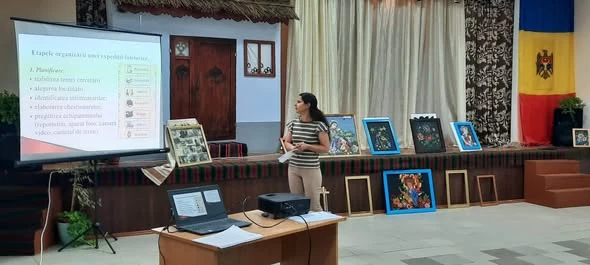
On 23 July, in the hall of the Petrești House of Culture, beneath a banner reading “Under the eaves of time”, a few dozen of the district’s cultural workers talked about something that usually does not become a subject of discussion until it is too late: the old peasant house, the one of clay, wood and reed thatch, which still keeps Ungheni’s villages tied to the way life was lived here a hundred years ago. The professional-development workshop, organized by the Culture and Tourism Department, was called “On the trail of the traditional house – research, documentation and conservation”. The title of one of the presentations said it all, really: “The last witnesses of clay and wood”.
Vasile Iucal, director of the Ungheni Museum of History and Ethnography, was the one who framed the stakes this way — researching these houses as an emergency, not as an archival whim. Before him, Vadim Pîslaru, head of the Department, had opened the meeting, and Galina Moraru, a senior specialist, had presented the cultural project “The traditional house – research, documentation and valorization”, to which the event belongs. The theoretical part was delivered by Eugenia Cepoi, a director at the Pîrlița District House of Culture, who spoke about the “folkloric expedition” as a working method. The musical moment was provided by the “Datina” folk ensemble of Petrești, and on the walls hung two exhibitions — “Under the eaves of time” and “In frames of the soul – photographs and embroideries of yesteryear”.
Beyond the program of a single day, the underlying question is simple and hard: what is lost when an old house falls — and how can at least the memory of it be saved?
What a traditional house actually is
A peasant house in the villages of the middle Prut valley is not just “an old house”. It is a whole system, made almost entirely from what the land provided. The walls — of clay: adobe brick (“chirpici”, bricks of unfired earth mixed with straw) or clay packed onto a frame of woven wattle, a technique the craftsmen called, in some villages, “ceamur”. The foundation — of stone. The roof frame — of wood. The roof — of reed thatch or straw in the lowlands, of shingle (“draniță”) in the hills. Fired brick appeared, as a rule, only in the chimneys.
Inside, the “classic” layout described by ethnographers had a central, unheated “tindă” (entrance hall) with the access to the attic, and on either side the living room and the “casa mare” (the best room) — or the “clean room”, the most conservative space of the dwelling, adorned with woven rugs (“lăicere”), with the flower-painted dowry chest, with the icon set “in the corner to the east”. No one lived there day to day: it was where chosen guests were received and the family’s feasts were held. The heart of the household, though, was the fire system — the hearth, the oven in which bread was baked once a week, the chimney lit daily, the “cotruță” niche between the chimney and the wall. (We told this “grammar” of the house at length in an explainer about a house in Florițoaia Nouă.)
The very materials that made the house cheap and warm are what make it fragile today: clay and reed thatch demand uninterrupted upkeep. Left to neglect for a year or two, they return to the earth from which they were taken. A clay house does not fall into ruin spectacularly — it vanishes quietly.
Why it is “an emergency”
Over the perishable material lies a much heavier fact: the villages are emptying. According to National Bureau of Statistics data, the Ungheni district fell from 96.292 inhabitants in 2014 to 74.507 in 2025 (a preliminary figure) — a loss of nearly 22,6% in a single decade. Nationwide, reports based on the 2024 census speak of nearly 180 villages with fewer than 100 inhabitants. In the district, the most telling example is the very village at the center of this story, Cornova: 599 people in 2024, compared with 968 in 2014.
When people leave, the empty houses remain — and, most of the time, no one looks after them anymore. And here a second gap comes in, a legal one: the ordinary, inhabited peasant house almost never holds protected-monument status. We showed this in the case of a 1907 house demolished in Dănuțeni, from which the museum managed to save only the window and the carved pediment, and in that of the Măcărești House of Culture, left in ruin along with its mosaic. Without status, such a building can be demolished with a simple permit, and the state itself acknowledges, in its heritage strategy, that it has no functioning system for inventorying what is being lost.
In this equation, documentation is no longer a curator’s luxury. It is often the only “trace” that remains of a house. That is why the museum’s director called it an emergency — and why the organizers ended their announcement with a sentence that sounds more like an appeal than a summing-up:
the safeguarding of the tangible and intangible cultural heritage of the Ungheni district depends on our actions, so necessary and urgent. Ungheni Culture and Tourism Department
How a house is “read”: the expedition
Here is the practical core of the workshop — and the part worth explaining, because it sounds technical yet is, in fact, within reach. To document a traditional house means to “read” it methodically, before it disappears: a record sheet with its data (who built it, when, from what), a measured survey (“releveu” — measuring and drawing the plan and façades to scale), a set of photographs, interviews with the elderly who remember what living in it was like, and, where possible, the collection of objects — embroideries, tools, the dowry chest — that end up in a museum’s collection.
The method has an old name: the expedition — folkloric, ethnographic, monographic. It is not an invention of the moment: the Law on intangible cultural heritage (no. 58/2012) provides precisely for inventorying through field research, in communities, as an official protection mechanism. The presentation on the “folkloric expedition” at Petrești described exactly these steps — from choosing the locality and setting the theme to preparing the equipment and recording the information. It is the invisible work behind any exhibition of old photographs or embroideries “of yesteryear”.
A method with roots at Cornova
What gives the subject a particular weight precisely here in Ungheni is that this method has, in the district, a famous birth certificate. In the summer of 1931, the team of the sociologist Dimitrie Gusti — the Bucharest Sociological School — came down to Cornova for its seventh monographic campaign and for the first Bessarabian village “read” in full: about 55 researchers from dozens of disciplines, from sociology and law to medicine, architecture and photography (the images were taken by Iosif Berman). Cornova was then in Orhei county; today it is a commune of the Ungheni district. From that campaign there remain studies, a sociological film and, much later, a volume recovered editorially by Vasile Șoimaru — about which we wrote separately, 95 years after the event.
The line is straight: what Gusti’s team did on an academic scale, in 1931, a museum and a culture department are attempting today, on a district scale — to capture the village on paper, in photography and in object before it changes beyond recognition. And the urgency now is all the greater given that the village Gusti found full of life was left, in 2024, with fewer than 600 people.
Who keeps the memory
Documentation is not done alone. In the district, the task falls above all to the museums. The Ungheni Museum of History and Ethnography, founded in 1967 and housed in the Palace of Culture, gathers over 10.000 items — from archaeology and folk costume to textiles, household objects and photographs — and publishes its own bulletin, “Pyretus”. A museum in Pîrlița even preserves two traditional peasant houses, another operates in Sculeni, and in Florițoaia Veche a private house-museum, “La Prispa lui Vasile” (“At Vasile’s Porch”), keeps even the clay technique alive: there, in June, a clay-plastering work bee was held — that is, heritage not merely described but made by hand.
The Petrești workshop adds to all of this the piece that was most often missing: the people trained to do the work. A librarian, a house-of-culture director, a village teacher can be, with a method in hand, the first to photograph a house before it falls or to record an elder’s story of how a household was built. As for what comes next — whether the record sheets, photographs and objects gathered this way end up in an accessible archive or in the National Register of Intangible Cultural Heritage — that the “Casa tradițională” project will tell in its coming editions.
For now, one thing remains clear from Petrești: every clay house documented in time is a piece of the village’s memory that does not return to the earth along with its walls.