

Ungheni Municipal Council has released the draft decision on the voluntary amalgamation of the town with nine surrounding localities and opened a consultation with residents, according to the notice from Ungheni City Hall. Those interested can send proposals to primaria.municipiul-ungheni@apl.gov.md until 29 June.
The list of ten administrative-territorial units that would form a single town hall comprises the town of Ungheni; the communes of Zagarancea, Mănoilești, Valea Mare, Morenii Noi and Florițoaia Veche; the villages of Cetireni, Unțești and Costuleni — all in Ungheni district — and the commune of Brătuleni, which belongs to Nisporeni district.
From eight to ten: the merger map has expanded
The configuration is not entirely new. On 11 May, when the process was publicly launched, the merger covered eight units and more than 38,000 residents. Since then the list has grown to include the village of Costuleni and the commune of Brătuleni, and the future town would total around 44,000 residents. Three of the localities on the list — Florițoaia Veche, Cetireni and Unțești — are the same villages Triunghi flagged earlier this month as being in talks to merge.
The detail that stands out is Brătuleni. The commune — made up of the villages of Brătuleni and Cîrnești, with nearly 1,800 residents at the last census — belongs not to Ungheni district but to Nisporeni district. If the merger goes ahead, the new town hall would straddle the administrative boundary between two districts, an unusual case for the reform now under way.
How the new town looks in numbers
Nearly all the joining localities are small. The town of Ungheni, with 26,500 residents at the 2024 census, remains the core; the rest are communes and villages at or below the 3,000-resident threshold that underpins the reform — Florițoaia Veche (1,379), Cetireni (1,297) or Brătuleni (nearly 1,800). It is on this threshold that the reform rests its argument: below it, a town hall struggles to secure major funding and spends a sizeable share of its budget on its own administrative apparatus.
The merger comes bundled with state money, and the sum is larger than the round formula suggests. The reform concept — “Strong Town Halls” — announces a development incentive of 3,000 lei for each resident of the resulting ATU, but the formula in the Voluntary Amalgamation Methodology has two terms: to the population multiplied by 3,000 lei is added a second term, which grows with the number of town halls in the group and which, for groups whose centre exceeds 10,000 residents, is calculated on the population outside the centre. For the ten units — 42,316 residents on 1 January 2024, of whom 26,458 are in the town — the development incentive works out at 150,911,700 lei, by the newsroom’s calculation. With the preparation transfer (600,000 lei) and the support for local budgets (2,000,000 lei a year for three years), the package reaches 157,511,700 lei. The government document presents this as money for infrastructure and services — but how much actually reaches each village, at what pace and on what conditions remains to be seen once the merged town halls draw up their budgets.
”There is strength in numbers”: the mayor’s appeal
Mayor Vitalie Vrabie addressed the residents of the ten localities in a comment posted on the town hall’s notice — a message signed on behalf of all the mayors taking part in the process:
Dear residents of our localities.
On my own behalf and on behalf of my fellow mayors, we invite you to take part with confidence and openness in this process, which is so important for the future of our communities.
Every opinion, idea and suggestion matters, because we want the decision we reach to be one built together and in everyone’s interest.
Together we can lay the foundation of a stronger town — better prepared for the challenges of the future and better able to offer people opportunities and improved living conditions.
There is strength in numbers, and united we will manage to do more, and do it better, for our shared future.
Vitalie Vrabie, Mayor of Ungheni, on behalf of the mayors of the participating localities
At the launch of the process in May, the mayor framed the same stakes in terms of capacity: the future ATU “will have strong administrative capacity, it will have financial capacity,” Vrabie had said, as quoted by Moldpres.
For now, though, the appeal for a “decision built together” rests on little public material. At this initiation stage, the draft decision and its annexes have not yet been drafted — they will be published, the town hall says, only once finalized, when a fresh consultation is to follow. Residents are therefore being asked now to weigh in on the principle, before they can see the actual text; and just how voluntary the merger is will be tested at the vote in each local council, and by how much weight people’s proposals are given there.
Added to this is a matter of access: the notice circulated on the town hall’s Facebook page, but not on the institution’s official website. The decision-transparency section reserved for notices of initiation — their natural place, on the town hall’s own site — was empty when the newsroom checked. For a consultation on a short deadline, that leaves a social network as the main public channel, one that residents of the ten localities can access unevenly.
What comes next and how residents can take part
The public consultation is mandatory, under Law No. 239/2008 on transparency in decision-making, before the draft reaches a council vote. Proposals are accepted between 9 and 29 June 2026 at primaria.municipiul-ungheni@apl.gov.md or at the town hall; Tudor Gavriliuc is named as the person responsible for the project.
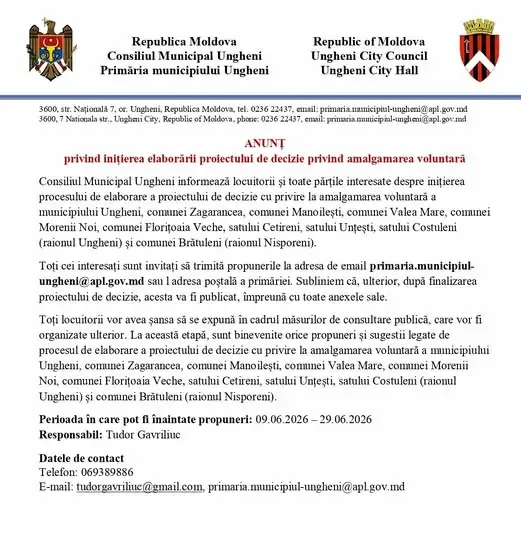
The notice of initiation, on Ungheni Municipal Council letterhead: the consultation period (9–29 June 2026) and the person responsible for the project. Source: the Facebook page of Ungheni City Hall
The law guarantees residents no more than 15 working days for recommendations — a deadline the authority can also extend, if people ask for it.
The town hall says further consultation measures will follow once the final draft is published. The decision to initiate must then be voted on in each local council involved; the reform calls for voluntary mergers to be completed by autumn 2026, a year ahead of the local elections.
Voluntary, but not uncontested
The reform is officially voluntary — but not uncontested. The Congress of Local Authorities of Moldova (CALM) and some mayors back the modernization, yet warn against forced amalgamation and call for local referendums when a town hall is to be closed, as Triunghi documented in its explainer on the reform at district level. For the ten localities around Ungheni, the consultation running until 29 June is the moment when residents can weigh the practical questions: where the merged town hall will be located, how people from the small villages will reach services, and whether the merger will be validated through a genuine consultation of residents.
This report is based on the official notice initiating the draft decision, published by Ungheni City Hall (reproduced in the article), on Mayor Vitalie Vrabie’s public appeal to residents and his remarks at the launch of the process (as quoted by Moldpres), on the Local Public Administration Reform Concept and on Law No. 239/2008 on transparency in decision-making. The population figures come from the 2024 census and earlier estimates by locality. The incentive sums are calculated by the newsroom with the formulas in points 94, 114 and 121 of the Voluntary Amalgamation Methodology, approved by Government Decision No. 925/2023 (Monitorul Oficial No. 472-473 of 8 December 2023, art. 1155) and amended by Government Decision No. 269 of 27 May 2026, on the usually resident population published by the National Bureau of Statistics as of 1 January 2024. The newsroom also verified that, during the consultation period, the notice did not appear in the decision-transparency section of the town hall’s official website, only on its Facebook page. Triunghi will follow the initiation decisions voted by the local councils involved.
Correction — 5 August 2026
In the original version of this article we wrote that the incentive for the future municipality would amount to “more than 130 million lei”. The figure was wrong, and the error is ours: we applied only the first part of the official formula.
The formula in point 114 of the Voluntary Amalgamation Methodology — approved by Government Decision No. 925/2023 and published in Monitorul Oficial No. 472-473 of 8 December 2023 — has two terms. The first is the population multiplied by 3,000 lei, the only one we applied. The second grows with the number of town halls in the group and, where the centre has more than 10,000 residents, is calculated on the population outside the centre. For the group around Ungheni — ten units, 42,316 residents, of whom 26,458 are in the town — the second term adds almost 24 million lei.
The development incentive therefore comes to 150,911,700 lei, and the full package, with the preparation transfer and the support for local budgets, to 157,511,700 lei. The passage has been corrected.
The calculation uses the usually resident population published by the National Bureau of Statistics as of 1 January 2024 — 42,316 residents, the same figure recorded in the amalgamation decisions voted in July. The “roughly 44,000” estimate elsewhere in the article is the June one, rounded, assembled from census data of different vintages; we have left it as it stands, because that is how it was published. We correct our mistakes in public.