
Update — 31 July 2026. The Ungheni Police Inspectorate has replied to the newsroom’s request and cleared up the gaps in the text below, published on 27 July. The two spaces are different: in the hearing room fitted out in 2014, no minor has been heard since 2017, and the office inaugurated on 24 July 2026, at a cost of around 42 thousand lei funded by the Embassy of the Kingdom of the Netherlands, is not meant for hearings and does not meet article 110¹ of the Code of Criminal Procedure. The headline and the affected sections have been updated.
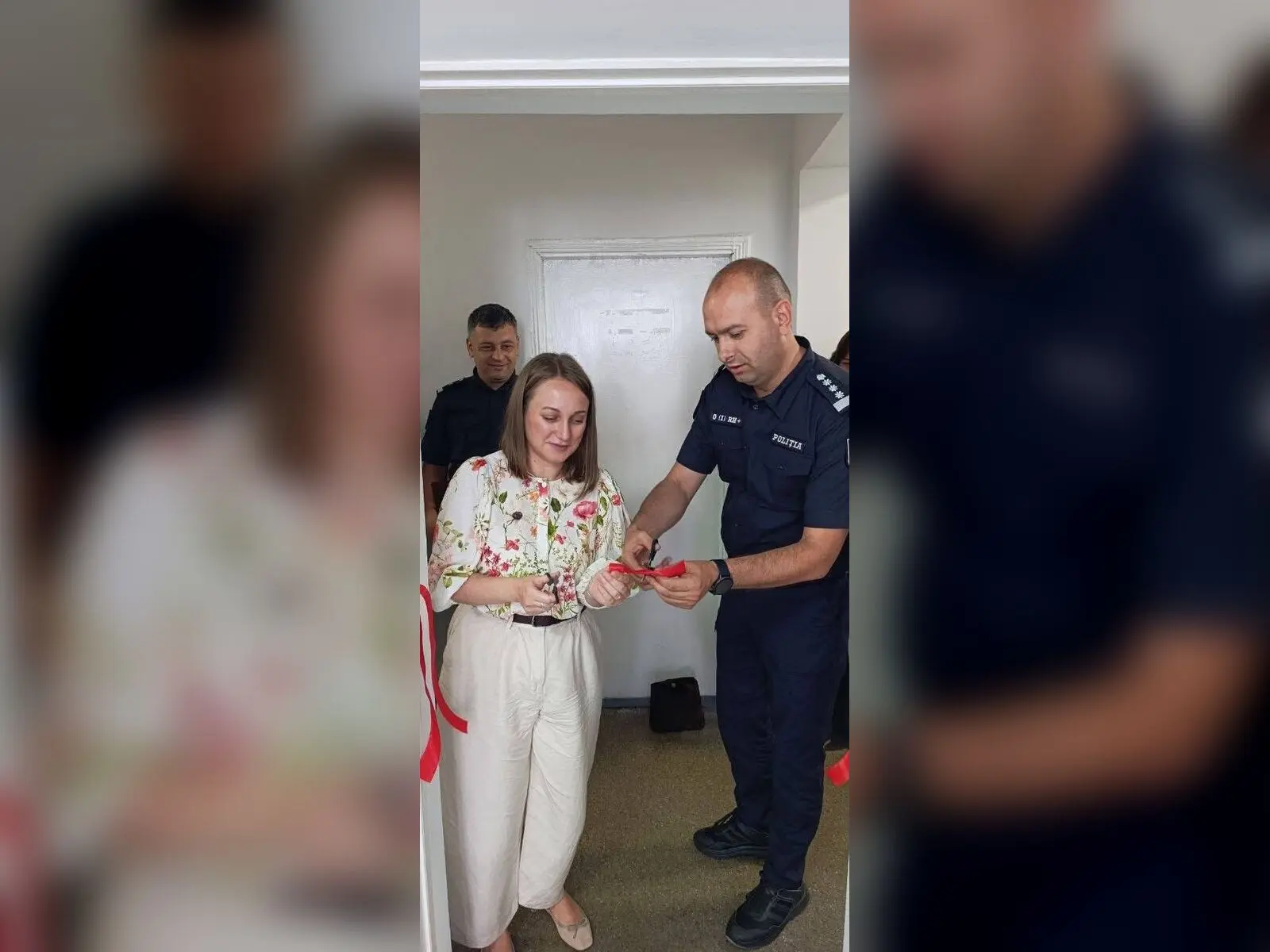
A child-friendly room has been inaugurated at the Ungheni Police Inspectorate, the Embassy of the Kingdom of the Netherlands in the Republic of Moldova announced. According to the embassy, the room is part of a project to prevent sexual violence against children, implemented by Elena Bădărău — a psychologist at the Călărași Police Inspectorate, according to an interview she gave to Radio Chișinău, and presented by the embassy as a “Tulip Youth Ambassador” — and by ReStart Social. The inauguration took place “last week”; the exact date does not appear in the announcement.
The inauguration took place on 24 July 2026, the inspectorate specified later, in a reply to the newsroom’s request. It also clarified what the space is: not a hearing room, but an office for prevention activities and somewhere for children to wait inside the police building. Official documents show that the Ungheni Police Inspectorate has a separate room for hearing minors, fitted out since 2014, and that the district remains, until at least 2027, outside the network of Barnahus-type regional centres.
The 2014 room exists — but no one has been heard in it since 2017
In an official reply sent in 2017 to the Centre for Investigative Journalism, signed by the then head of the General Police Inspectorate, Alexandru Pînzari, the police wrote that in 2014 eight rooms for hearing minors had been opened at the inspectorates in Ceadîr-Lunga, Ungheni, Edineț, Criuleni, Căușeni and in three sectors of Chișinău, “of which 2 rooms functional for hearing minors in special conditions, these being fitted out at the Căușeni and Ungheni police inspectorates”.
In other words, out of eight rooms opened, only two were actually functional for hearings in special conditions — and one of them was in Ungheni.
The same document also gives the usage figures: “At the Ungheni Police Inspectorate, in 2014, 11 minors were heard in the specially fitted room, in 2015 — 11, and in 2016 — 18 persons.” That means 40 minors heard there in special conditions over three years. For Căușeni, the other functional room, the police wrote that in 2014 and 2015 no records had been kept, and that in 2016, 29 minors were heard. The document does not specify the type of cases — hearings in special conditions are also used in child-trafficking and domestic-violence files, not only in those of a sexual nature. According to the same reply, the contractor “Cons Eurostil” SRL “carried out repair works” on the room in Ungheni, for 56.532,89 lei.
What happened after 2016 was set out by the inspectorate itself, in its reply of 31 July: “From 2017 to the present, no minors have been heard in the office you refer to, because that action takes place inside the Ungheni Court and is conducted by the investigating judge.” The room is still there, but the practice has moved — which is in line with the law, since a hearing in special conditions is conducted by the investigating judge. For a child in the district, it means the route no longer runs through the police building, but through the court.
In the same reply, the police also clarified the relationship between the two spaces, which the public documents did not show: “The office fitted out is not intended for hearing minors in special conditions, and it is not the office you refer to, fitted out in 2014.” They are, therefore, two different rooms, with different purposes.
What the office inaugurated on 24 July actually is
Not a hearing room. The inspectorate says so without hedging: the office “does not meet the conditions for hearing minors and does not correspond to the requirements of art. 110¹ of the Code of Criminal Procedure”. Its purpose is a different one — a space where the police can run prevention activities, and a friendly environment for children waiting inside the inspectorate.
The works and the equipment were funded by the Embassy of the Kingdom of the Netherlands in the Republic of Moldova and cost “approximately 42 thousand lei”, according to the same reply. For comparison, the repair of the 2014 hearing room had cost 56.532,89 lei.
The project the office belongs to aims to strengthen capacity for prevention, identification and intervention in cases of sexual abuse against children. It provides for information lessons for pupils in the district’s schools and training sessions for teachers, police officers and members of multidisciplinary teams — on recognising the signs of sexual abuse, communicating with minors and the reporting mechanisms.
What “a hearing in special conditions” actually means
The term has a precise content in law. The space must be, according to the National Centre for Child Abuse Prevention, “a combination of two rooms – the hearing room and the viewing room”: the child sits with a single trained specialist, while the investigating judge, the prosecutor, the lawyers and the psychologist follow from the adjoining room, over an audio-video link. The conversation is recorded.
The practical stake for a child from the district lies exactly here: the hearing “is carried out only once, at the criminal investigation stage”. Without such a space, a child ends up retelling the same trauma several times, in front of several people. The rule covers, as an obligation, children under 14 in cases concerning sexual offences, child trafficking or domestic violence, and specialists recommend it for those between 14 and 18 as well.
The specialised network reaches the Centre region only in 2027
The standard Moldova is moving towards is not the room inside the inspectorate, but the Barnahus-type regional centres, where a child victim finds in a single place the hearing, the medical examination, psychological counselling and legal assistance. For now the network has two centres: one in Bălți, for the north, and one in Cahul, inaugurated on 19 May 2026, which serves nine administrative-territorial units in the south — Comrat, Ceadîr-Lunga, Vulcănești, Cahul, Leova, Cimișlia, Basarabeasca, Cantemir and Taraclia.
Ungheni district is not in the area served by the Cahul centre. The centre for the Centre region, which is supposed to cover it, is scheduled in Chișinău only by the end of 2027, according to the minutes of the Lanzarote specialised commission of December 2025. Until then, the Centre region is served by the “Amicul” service, where — together with the centre in Bălți — around 60% of all hearings in special conditions in the country are carried out, by experts contracted by the National Centre for Child Abuse Prevention, the president of the CNPAC, Daniela Sîmboteanu, said at the same meeting.
At that same meeting, the General Police Inspectorate recorded that “there are difficulties in organising a hearing in conditions adapted to the child, including because of the insufficient number of hearing rooms that meet the standards”. Also at that meeting, the police reported that, nationally, in 2025, up to the date of reporting, criminal investigations had been opened in 379 cases of sexual violence committed against minors, of which 175 had been completed, and that minor victims account for 71.4% of all victims of offences targeting sexual life.
In Ungheni, the integrated service admits women from the age of 18
There is in Ungheni a service built exactly on the “everything in one place” model — but not for children. Through Government Decision no. 508 of 19 July 2023, the town launched the piloting of the Regional Integrated Service for Victims of Sexual Violence, located on the grounds of the Ungheni District Hospital, which serves six districts: Ungheni, Nisporeni, Călărași, Fălești, Telenești and Sângerei. The service is active — in June it organised information workshops for 46 women from the district.
Its regulations are explicit: “Women who are victims of sexual violence are admitted to the Integrated Service from the age of 18.” The same point provides for a single, narrow exception, for beneficiaries who meet the legal and social status laid down in art. 14 para. (2) of the Family Code.
This is what the map looks like for a child from Ungheni district who becomes a victim or a witness: the hearing in special conditions takes place at the Ungheni Court, before the investigating judge — the room fitted out at the inspectorate in 2014 has not been used for it since 2017 — the integrated service at the hospital admits women from the age of 18, and the Barnahus-type regional centre that is supposed to cover the area is scheduled only by the end of 2027.
The details about the office inaugurated on 24 July — its purpose, its compliance with article 110¹, the funder, the cost — and those about the use of the 2014 room after 2017 come from official reply no. 34/54-12055 of 31 July 2026 by the Ungheni Police Inspectorate, signed by chief commissioner Vasile Burlacu, to a request by the newsroom based on Law no. 148/2023. The event is reported on the basis of the official post by the Embassy of the Kingdom of the Netherlands in the Republic of Moldova, the only public source for the inauguration at the time of publication. The historical data on the hearing room in Ungheni come from an official reply by the General Police Inspectorate from 2017, a scanned document read through optical character recognition. The legal framework follows the explanations of the National Centre for Child Abuse Prevention, and the figures on the criminal cases of 2025 and on the share of hearings — the minutes of the Lanzarote specialised commission, published by the Ministry of Internal Affairs. The photograph was published by the embassy.