

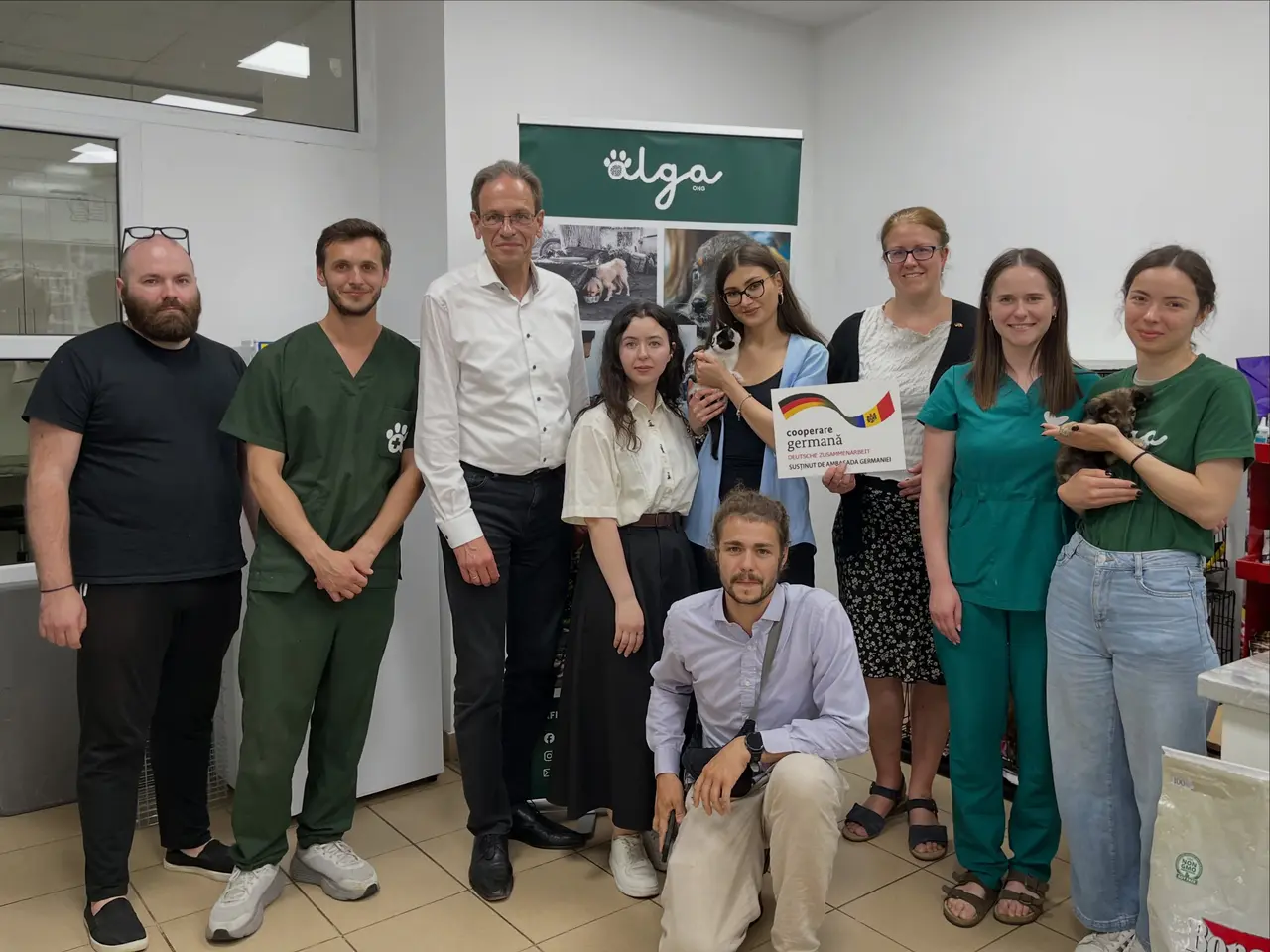
A partnership with the German Embassy in the Republic of Moldova was signed on 25 June at the AlgaVet veterinary clinic in Ungheni. At first glance it is news about animals; read to the end, it is about the public health of an entire district.
The project is called “Strengthening veterinary assistance and public health in Ungheni district through the AlgaVet social clinic,” and it has three concrete components, announced by the clinic: equipment for diagnosis and treatment, training sessions for students and young veterinarians, and the neutering of 50 community cats in Ungheni. The stated goal — “healthier animals and safer communities, through prevention and timely intervention,” plus access to veterinary care where it is lacking.
What AlgaVet is
AlgaVet is the socially-oriented clinic of the ALGA public association, an organisation for the protection of stray animals, opened in Ungheni at the end of 2025. It runs on a social-enterprise model: its services, in turn, support interventions for the communities and people who could not otherwise afford a vet. This is not the organisation’s first presence in the area — in May, ALGA had already run a free neutering and vaccination campaign for about 150 animals in Nisporeni, Ungheni and the surrounding villages.
The German funding comes, by all appearances, through the Embassy’s small-projects programme — an instrument of up to 25,000 euros per project, with a mandatory equipment component. The exact amount of support for AlgaVet has not been made public.
Why it matters: rabies and stray animals
Here is the stake that lifts the story out of the “cute” category. Neutering community animals and access to veterinary services are not only matters of animal welfare — they are instruments of public health.
According to the National Agency for Public Health, in 2025 the number of rabies cases in the Republic of Moldova nearly tripled: 46 cases across 18 territories, against 18 cases in 8 territories in 2024. And Ungheni district was the second worst-hit in the country, with 4 cases — after Hîncești (10). The agency states plainly where the risk comes from: “the presence of stray animals in localities constitutes a factor of epidemiological and epizootic imbalance, favouring the circulation and persistence of the rabies virus.” Controlling the stray-animal population — through neutering — is exactly the recommended lever.
The problem is not new, and the solutions are split
Stray animals are nothing new for Ungheni. The town already has a dog shelter, whose activity the Municipal Council took note of in December 2025, based on a note presented by Deputy Mayor Nicolae Cevaga. In other words, a public structure exists — but the problem (and the rabies figures) shows that it alone does not cover the need.
Against this backdrop, a partnership that brings equipment, trains young vets and neuters community animals with German money fills a real gap. It remains to be seen, in the coming months, how much of the promise turns into concrete interventions — and whether the social-clinic model can be coupled with the municipal effort, instead of running in parallel with it.
The details of the partnership (components, the neutering of the 50 community cats, the project’s goal) come from the public announcement of the AlgaVet clinic. The profile of the German funding matches the German Embassy’s small-projects programme (up to 25,000 euros); the exact amount for this project has not been publicly communicated, and the signatories were not named in the announcement. The rabies data belong to the National Agency for Public Health (2025). The existence of the municipal dog shelter is confirmed by a decision of the Ungheni Municipal Council from December 2025.