

A case of rabies has been confirmed in the village of Rezina, Mănoilești commune, Ungheni district. On 30 July the district’s Emergency Situations Commission met and approved a 16-point anti-epizootic plan that changes the rules in the village for at least a month: animals may no longer be collected or sold on the village’s territory, the movement of animals into the village is halted, and every animal in every household enters an official census with a five-day deadline.
This is the village of Rezina in Mănoilești commune, Ungheni district — not the town or the district of Rezina on the Dniester. The decision and the plan of measures name the locality unambiguously — “localitatea Rezina, raionul Ungheni” (Rezina locality, Ungheni district) and “Primăria comunei Mănoilești satul Rezina” (Mănoilești commune mayor’s office, Rezina village).
What actually changes in the village
The plan was approved by Decision No. 10/E of the Emergency Situations Commission of the Ungheni district, following request No. 489 of 30 July from the Territorial Subdivision for Food Safety (Subdiviziunea Teritorială pentru Siguranța Alimentelor) for Ungheni/Nisporeni/Călărași, which confirmed the case. These are the measures households will feel directly:
- Collecting and selling animals on the village’s territory are banned until the restrictions are lifted. Responsibility rests with the Territorial Subdivision and the Mănoilești commune mayor’s office.
- The movement of animals into the village is halted, for 30 days, a task falling to the local public authorities.
- An official census of all categories of animals in every holding and individual household in Rezina, with a five-day deadline running from 30 July — that is, around 4 August.
- Emergency rabies immunisation of the animals in the village, carried out by the Territorial Subdivision.
- Animals that had direct contact with the source of infection are placed under surveillance for 30 days.
- Stepped-up hunting of foxes and jackals in the village’s hunting grounds, a task falling to the hunters’ and anglers’ association.
- Disinfection of the place where the sick animal was and of the equipment there.
The act does not use the word “quarantine”. In its own language, Rezina becomes an “unfavourable point” where restrictions are imposed, and these “will be lifted 30 days after the last case of the disease”.
The difference is not a matter of nuance: the 30-day clock runs from the last case, not from the date of the decision. If a new case appears in the village, the clock resets. If 30 July remains the last case, the restrictions could be lifted around 29 August.
The decision entered into force on the day it was adopted and is, in its own wording, “mandatory for natural and legal persons in the Ungheni district” — the standard clause that makes the act enforceable across the whole district. The restrictions themselves, however, concern the village — the text says “on the village’s territory” and “in the locality”. Oversight of the implementation falls to Ion Basoc, deputy head of the Territorial Subdivision for Food Safety for Ungheni/Nisporeni/Călărași.
What the act does not say
Two things people ask about first have, for now, no public answer.
The species of the infected animal is not stated in the decision, in the plan of measures or in the District Council’s public announcement. It became public only on 4 August, in a National Food Safety Agency bulletin on the epizootic situation for 23 July – 3 August: the infected animal was a dog.
Over the same period the agency reported five outbreaks across the country — four of rabies and one of African swine fever. Besides the dog in Rezina, rabies was confirmed in a dog in Bubuieci, Chișinău municipality, in a cow in the village of Nimereuca, Soroca district, and in a goat in the village of Chetrosu, Drochia district. The African swine fever outbreak, the only active one in the country at that date, was recorded in domestic pigs in the locality of Vulcănești.
The decision, the plan of measures and the District Council’s public announcement contain no information about anyone bitten or exposed in Rezina. The plan does include measures on “identifying the persons who had contact with the source of infection” and “treating the persons who had contact with the animal sick with rabies” — but these are standard measures, present in any outbreak plan, and their presence in the document does not mean that anyone was bitten.
What to do if an animal bites you
The rules below are the same anywhere in the district, regardless of what happened in Rezina.
Rabies cannot be treated once the symptoms appear — but it can be prevented, if the person reaches a doctor quickly. Post-exposure prophylaxis is free in the Republic of Moldova, the National Agency for Public Health (Agenția Națională pentru Sănătate Publică, ANSP) states.
For any bite, scratch or contact between a wound and an animal’s saliva, ANSP recommends:
- washing the wound immediately and abundantly with running water and soap, for at least 10–15 minutes;
- disinfecting the edges of the wound with 70% ethyl alcohol or 5% iodine;
- going to a doctor — washing reduces the viral load, but it does not replace medical examination and anti-rabies treatment.
The Commission’s plan provides the same for Rezina, through the family doctor — “If a person has been bitten by an animal, they should turn urgently to medical staff”. Treating the people who had contact with a sick animal falls to the Ungheni Public Health Centre (Centrul de Sănătate Publică Ungheni).
Through the District Council’s announcement, the Emergency Situations Commission urges citizens:
to act responsibly, to avoid contact with wild animals or with animals showing unusual behaviour, and to notify the veterinarian or the competent authorities immediately if rabies is suspected. Emergency Situations Commission of the Ungheni district, announcement of 31 July 2026
Why this is no surprise in Ungheni
The Rezina outbreak does not appear on clean ground. In 2025 the Ungheni district recorded four rabies cases in animals — in the list published by ANSP, right after Hîncești (ten cases) and level with Ialoveni, Dubăsari and Camenca. The data come from the Republican Centre for Veterinary Diagnostics, cited by ANSP.
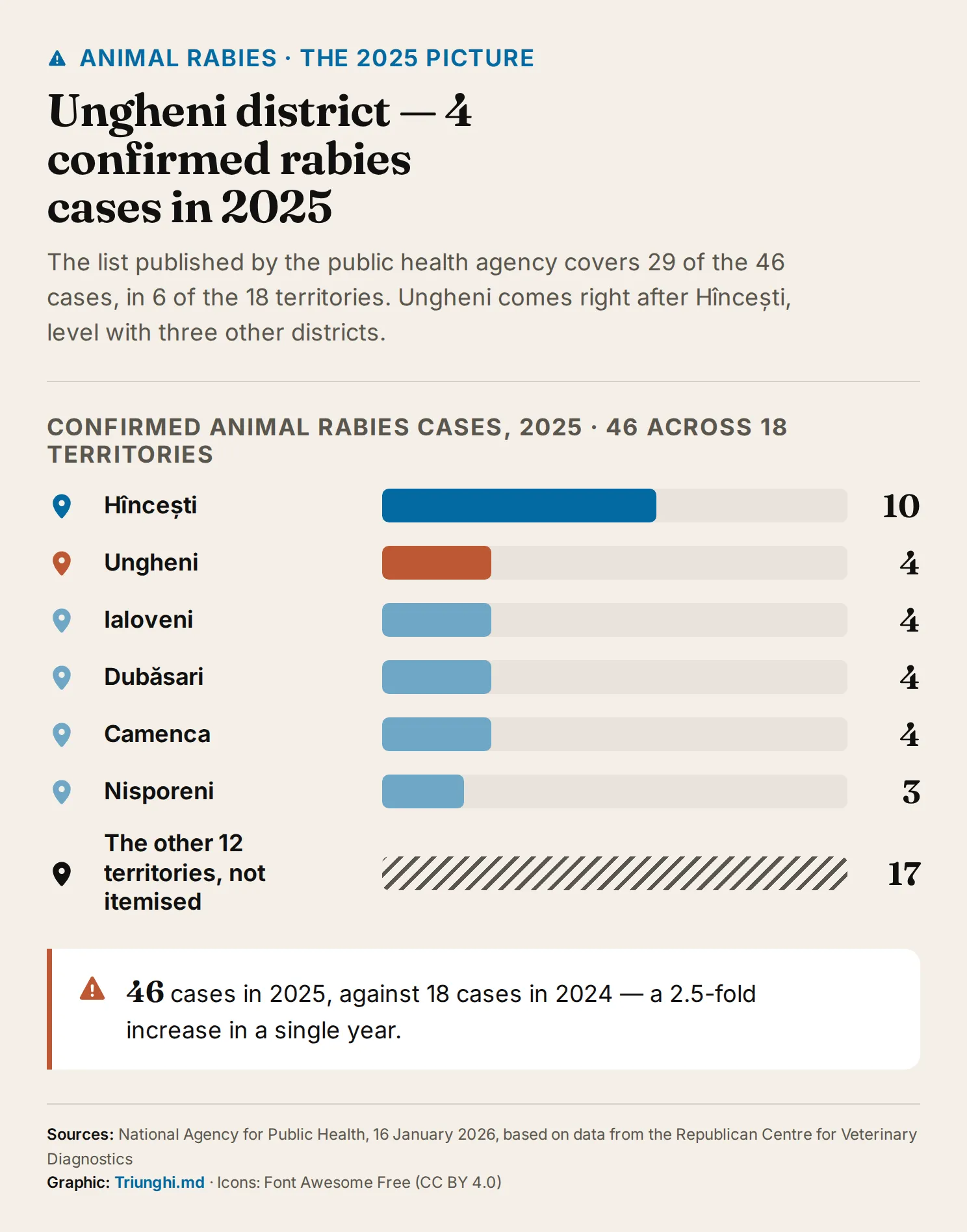 The list published by ANSP covers 29 of the 46 cases recorded in 2025, in 6 of the 18 territories. Chart: Triunghi.md. Source: National Agency for Public Health, 16 January 2026.
Nationally, 2025 was a year of steep growth: 46 cases in 18 administrative territories, against 18 cases in eight territories in 2024 — 2.5 times more. Among domestic animals, the worst affected were cattle (16 cases) and dogs (15), while of the ten cases in wild animals, eight were in foxes, “the main source of infection in the natural environment”.
In the first six months of 2026 the country already reached 53 cases in 17 districts and municipalities — more than in the whole of 2025. Ungheni does not appear in the list of districts with the most cases, published by ANSP on 10 July; how many cases the district had in that period is not a published figure. Over the same period, 4,036 people in the country were attacked by animals, 1,800 of them in the municipality of Chișinău — the capital’s figure being, according to ANSP, 20.6% higher than in the same period of 2025.
Ungheni also appears in ANSP’s data for 2024 among the ten territories with the highest rate of people seeking anti-rabies care.
What an animal owner is actually obliged to do
Many of the measures in the plan merely restate obligations that apply permanently, outbreak or no outbreak. The veterinary health norm on rabies, approved by Government Decision No. 174 of 29 March 2023 and in force since 1 January 2024, provides that:
- rabies vaccination is compulsory for dogs, cats and domestic ferrets;
- the owner must present the animal at the Agency’s request and observe the movement bans;
- the owner must notify the veterinarian immediately of any bite or scratch inflicted on a person, as well as of any change in the animal’s behaviour;
- a dog, cat or domestic ferret that has bitten a person is placed under veterinary health surveillance, with a compulsory clinical examination within 24 hours of the suspicion being reported and further checks up to day 30.
The same norm also sets out how prophylaxis is carried out in foxes, the virus’s main reservoir in the wild: through vaccine baits distributed twice a year (point 43). For foxes, the plan approved for Rezina provides for stepped-up hunting.
For anyone who keeps animals in the district, the rules now come down to three things — in Rezina animals are no longer sold or collected, and their movement into the village is stopped until the restrictions are lifted; dogs, cats and domestic ferrets must be vaccinated against rabies anywhere in the district; and any bite means a trip to the doctor the same day.