

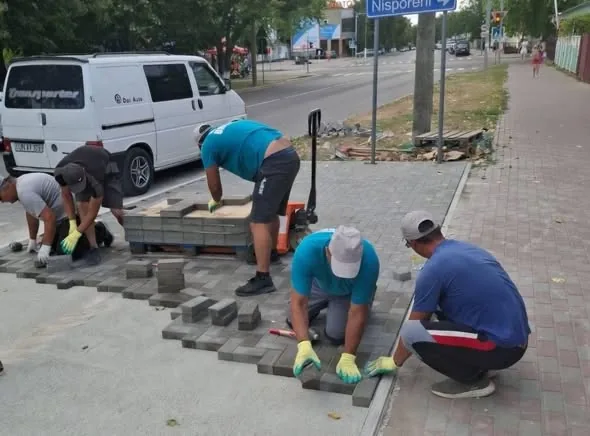
In Ungheni, a new public parking lot is being built on Decebal Street, across from the former boarding school. The work was announced on Saturday, 8 August, by Ungheni City Hall — even as the crews were laying the paving — and is paid for through a cofinancing arrangement the town has used before: nearby merchants and entrepreneurs bought the paving, while the city hall provided the labour and the other materials.
Specifically, the businesses in the area purchased 175 square metres of paving, worth 46,000 lei, according to the announcement. The rest — the labour and the other necessary materials — was covered from the city hall’s budget, which has not yet disclosed how much its share cost. The work is being carried out by the municipal enterprise «Servicii Comunale Ungheni» LLC (the municipal utility company), the same one building the access roads to the town’s new agri-food market.
What it adds up to, in figures
Divided by the surface area, the 46,000 lei come to about 263 lei per square metre of paving (newsroom calculation: 46,000 ÷ 175). That is a price within the market range for standard vibro-pressed paving in Moldova — roughly 205–290 lei per square metre, according to domestic manufacturers’ offers — consistent with the fact, announced by the city hall, that the sum covers the material itself, not its installation, which the town pays for separately. How many spaces the parking lot will have, and how much the city hall spent on labour and the rest of the materials, have not yet been made public.

How it is legal for merchants to pay for a public work
This, in fact, is the less visible part of the story. The law does not allow a city hall simply to “receive” a work from private parties: the contribution must be formalised. There are three usual instruments — the donation, accepted through a local council decision (the asset thereby enters public property); the loan-for-use (comodat), meaning free and temporary use without a transfer of ownership; and sponsorship, governed by the Law on Philanthropy and Sponsorship (No. 1420/2002).
In Ungheni, the mechanism is in regular use: the Municipal Council periodically adopts decisions “on the acceptance of donated assets”, and the public register of local acts also contains loan-for-use agreements. For the Decebal parking lot, no act naming it appeared in the public register at the time of the work; the formalisation of such a contribution can also be done later.
A street in full transformation
The parking lot is appearing in a busy and very active part of the town. On Decebal Street, the city hall is rehabilitating a 1,003-metre stretch toward the free economic zone, a work of over 25 million lei, and is building two access roads to the new agri-food market, in a section where traffic is already heavy, especially around the petrol station. Across the road from the new parking lot, on the grounds of the former boarding school, another authority — the District Council — is building the Educational Centre with sports grounds. These are different projects, with different money and different beneficiaries, that nevertheless come together in the same corner of town.
Anyone who passes through feels that the need for parking spaces is real. The town has regulated parking space before — it introduced an alternating-side parking regime on Națională Street, for street cleaning — and under Saturday’s announcement one resident summed up, in the comments, exactly what is at stake: “parking is a big problem”.
Mayor Vitalie Vrabie welcomed the work and tied it to the same idea — that the town is built “together”:
A long-awaited and necessary work. We still have so much to do in our dear Town that sometimes even days off are not enough. But it is much easier and nicer when we do things together. Vitalie Vrabie, mayor of Ungheni
He thanked the merchants and entrepreneurs “who pitched in”, as well as the Servicii Comunale team, which worked even on Saturday.
The arrangement is not new in Ungheni, but it remains notable: part of the town’s small-scale infrastructure is built with mixed money — public and private — and those who contribute are, as a rule, the very people who then use the place. On Decebal, these are the nearby merchants and their customers.
The data about the work — the 175 square metres of paving, the value of 46,000 lei and the split of the costs — come from the official announcement by Ungheni City Hall of 8 August 2026. The price of about 263 lei per square metre is a newsroom calculation (46,000 ÷ 175) and falls within the market range for standard vibro-pressed paving in Moldova; it is not an invoice. The sum paid by the city hall for the labour and the other materials, the number of parking spaces, and the act formalising the merchants’ contribution have not been made public. The mechanisms by which a city hall can accept a material contribution from private parties — a donation approved by the council, a loan-for-use or sponsorship — are described here as a general rule, frequently used in Ungheni, not as a finding about the documents of this specific work.