

Update — 25 October 2026. Law No. 154 of 30 July 2026, published in the Official Gazette on 13 August, amended Law No. 225/2023: from 1 September 2026 until the first round of the 2027 general local elections inclusive, „the adoption of decisions to initiate the voluntary amalgamation process, on voluntary amalgamation or on joining an amalgamated unit is prohibited”. The sentence in the section „What did not end on 31 July” saying that missing the deadline does not cost a locality the right to merge no longer holds after 31 August: we have rewritten it. The text below has been updated.
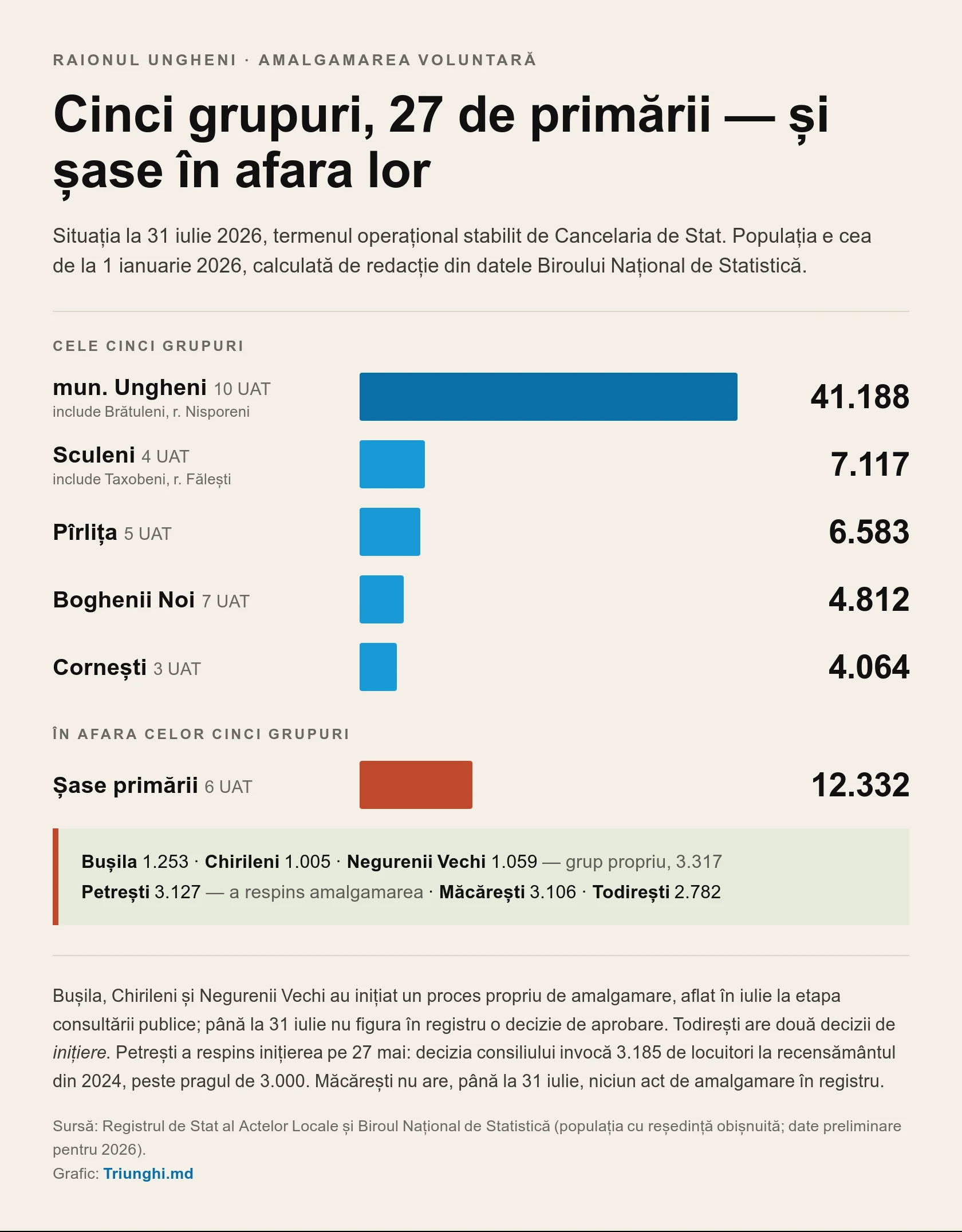
On 31 July, the administrative map of Ungheni district looked like this: five amalgamation groups taking in 27 of the district’s 33 mayoralties, and six mayoralties outside the five groups. The consolidated file of the group around the municipality had already gone to the State Chancellery on 30 July, the City Hall says.
In nine days, between 23 and 31 July, twenty-three issuers in the district published 36 amalgamation-related acts in the State Register of Local Acts: 22 decisions approving the merger, one from each mayoralty, 12 requests for a transfer to prepare the process, one order organising consultations, and one decision by which a council examined a notification from the Territorial Office.
Five groups, 27 mayoralties — and six outside them
The district has 33 mayoralties. The five groups outlined by the acts take in 27 of them — the groups count 29 units in total, but two of them come from neighbouring districts:
Around Ungheni municipality, ten units: the municipality, the communes of Zagarancea, Mănoilești, Valea Mare, Morenii Noi and Florițoaia Veche, the villages of Cetireni, Unțești and Costuleni — plus the commune of Brătuleni, from Nisporeni district. The Municipal Council voted on 24 July, through decision no. 6/3.
Around the commune of Pîrlița, five: Pîrlița, Alexeevca, Agronomovca, Rădenii Vechi and Teșcureni.
Around the commune of Boghenii Noi, seven: Boghenii Noi, Hîrcești, Sinești, Condrătești, Măgurele, Năpădeni and Cornova.
At Sculeni, four: Sculeni, Cioropcani, Buciumeni and the commune of Taxobeni from Fălești district.
At Cornești, three: Cornești town, Cornești village and Bumbăta village.
Two of the groups cross the district boundary — the municipal one, through Brătuleni, and the Sculeni one, through Taxobeni. Three have a commune at their centre rather than a town: Pîrlița, Boghenii Noi and Sculeni.
How many localities the new unit around the municipality will have is settled by the law establishing it, not by the councils’ decisions: the summary table annexed to decision no. 6/3 lists the ten administrative-territorial units, not the villages within them. (The City Hall’s announcement of 31 July speaks of 21 localities and lists 22 names.)
The centre is chosen, as a rule, by score: article 6 of Law no. 225/2023 awards one point for each of three criteria — number of inhabitants, fiscal capacity per inhabitant, and household connection to water and sewerage — and the unit with the highest score becomes the centre. Since 30 April 2026, the law also allows a derogation: the joint working group may agree otherwise, by consensus. In Ungheni district, the decisions invoke the score. The one from Pîrlița says so directly — the commune „obtained the highest score among the ATUs taking part in that voluntary amalgamation process”. At Sculeni, the same formula, with the same outcome for the commune that gives the group its name.
Six mayoralties remain outside the five groups, with 12,332 inhabitants between them — one in six people in the district. That does not mean they stood still.
Bușila, Chirileni and Negurenii Vechi started an amalgamation process of their own, the three together: their councils voted to initiate it in turn — Chirileni on 5 March, Bușila on 31 March, Negurenii Vechi on 24 April — and together they add up to 3,317 inhabitants on 1 January 2026, above the threshold of 3,000. No decision approving the merger appears in the state register up to 31 July; in July the process was at the public consultation stage.
Todirești, separately from them, has two initiation decisions of its own, of 15 May and 5 June.
Petrești discussed amalgamation and turned it down. On 24 April the council authorised the mayor to examine the organisation of public consultations on the intention to amalgamate — 12 votes in favour, none against. On 27 May, after the commune’s general assembly of 17 May, the council rejected the proposal to initiate it, with 10 votes for rejection and two abstentions. The reason is written into the decision: according to the 2024 census the commune has 3,185 inhabitants — above the threshold of 3,000 that the law requires of a unit formed by amalgamation — and therefore „the inhabitants of the commune do not agree with the administrative-territorial reform”.
At Măcărești, the plan to merge with the municipality failed to gather the necessary votes on 16 June; seven councillors called for a new vote, and the mayor convened an extraordinary sitting for 22 June — no decision arising from it appears in the register up to 31 July, and no other amalgamation act either.
The figures in the acts are two years old
The municipal group’s decisions all say the same thing. The wording, from decision no. 4/8 of the Unțești Local Council: the combined population „exceeds the minimum threshold of 3000 inhabitants, being estimated at 42316 inhabitants, according to official data supplied by the National Bureau of Statistics”. The same figure appears in seven further published decisions of the group. In a public announcement on 28 July, the City Hall attributed it to „official data supplied by the National Bureau of Statistics”.
We redid the calculation from the Bureau’s locality-level table, adding up the composition of each group. The figure is indeed the Bureau’s — but it is the one for 1 January 2024. And not only at Ungheni: all five groups used the 2024 totals, each matching to the person.
| Group | In the acts (2024) | On 1 Jan. 2026 | Difference |
|---|---|---|---|
| Ungheni municipality | 42,316 | 41,188 | −1,128 |
| Sculeni | 7,430 | 7,117 | −313 |
| Pîrlița | 6,882 | 6,583 | −299 |
| Boghenii Noi | 4,978 | 4,812 | −166 |
| Cornești | 4,172 | 4,064 | −108 |
Together, more than 2,000 people who are no longer where the acts count them.
For the fate of the mergers, the difference changes nothing. The threshold required by article 5 of Law no. 225/2023 is 3,000 inhabitants, and all five groups clear it even on the 2026 figures — the smallest of them, Cornești, with 4,064 inhabitants. As for the age of the figure: neither the law nor the Methodology approved by Government Decision no. 925/2023 fixes the year or date on which the population is taken. Both require only that the data be „supplied by the National Bureau of Statistics”. They prescribe the source, not the vintage.
The 2026 series was published by the Bureau on 9 July, and the approval decisions were adopted between 17 and 30 July — the newer figure already existed when the councils voted. The City Hall says, however, that work on the file ran „from February to July”. The 2026 data are, moreover, flagged by the Bureau as provisional.
What matters is what comes next. Budgets, the school network and services are planned on the real population, which is falling by around 564 people a year in the municipal group alone. It matters for money too: the sums the new units will receive from the Fund for the Voluntary Amalgamation of Localities are calculated per head — the Methodology provides, until 2030, an annual transfer supporting local budgets of between 100 and 200 lei per inhabitant, plus one for infrastructure, likewise tied to total population. There the figure is taken afresh, at the right moment: the transfers are determined by the State Chancellery, ex officio, once the new unit is formed.
What did not end on 31 July
The date of 31 July is not a deadline laid down by Law no. 225/2023. It is an operational deadline set by the State Chancellery — as the Ungheni Territorial Office described it in a written reply of 20 July: it is not „expressly provided for by Law no. 225/2023” and „cannot be interpreted as a legal deadline extinguishing the right to amalgamate”. As of 20 July, missing it did not cost a locality the right to merge, but it did drop it out of the voluntary package; since 1 September 2026, Law No. 154/2026 has prohibited, until the first round of the 2027 general local elections, any new decision to initiate, on voluntary amalgamation or on joining. Moreover, according to the same reply, localities that do not complete the process in time „will no longer be able to benefit from the voluntary mechanisms and will subsequently be amalgamated under the rules on normative amalgamation”.
It shows. In a post of 31 July, signed by Ion Poia and published on the Cioropcani commune City Hall page, the head of the Territorial Office wrote that „on 7 August the Cioropcani local council will also give its view” — a locality in the Sculeni group voting a week after the deadline.
In the register, as of 31 July, 22 of the 27 units included in groups had their approval decision published. For Sculeni, Cioropcani, Hîrcești, Sinești and Cornova, the register did not yet contain it. That does not mean those councils did not vote: some of the decisions taken on 23 July only reached the register on the 29th, and publication comes with a delay of several days.
In the same post, Ion Poia wrote that „278 milione de lei vor primi primariile din raionul Ungheni care au finisat procesul de amalgamare benevolă” (278 million lei will go to the mayoralties in Ungheni district that have completed the voluntary amalgamation process). Of the amalgamation acts published in the register between 23 and 31 July, the only ones that mention money are the requests for a transfer to prepare the process, under point 99 of the Methodology: 400,000 lei per group, for four of the five groups. Twelve councils adopted such decisions, and the request is filed by the centre mayoralty „on behalf of the administrative-territorial units taking part in the process”.
The rest of the money from the Fund could not appear in a local council decision in the first place — the State Chancellery allocates it ex officio. How exactly the figure of 278 million for Ungheni district is arrived at is shown neither by the post nor by the acts published in the register.
What follows is up to Chișinău: the State Chancellery examines the files, approves them, and the new administrative-territorial units are established by law. Local decisions may be challenged within 30 days of communication, at the Ungheni municipal court.
Data on the acts come from the State Register of Local Acts, queried on 31 July 2026; the texts of the decisions quoted were taken in full from the register. The population figures are calculated by the newsroom from the National Bureau of Statistics’ locality-level table (usually resident population), including the commune of Brătuleni in Nisporeni district and the commune of Taxobeni in Fălești district; the 2026 series is provisional.
Correction — 1 August 2026
In the original version of this article we wrote that Petrești has no amalgamation act in the state register, and we placed all six mayoralties „outside any group” — although Bușila, Chirileni and Negurenii Vechi had formed a group of their own. Both were wrong.
The error about the three communes was pointed out to us publicly, in a comment on our Facebook page, by MP Andrian Cheptonar. Checking it, we came upon the one about Petrești, which is the graver of the two: we presented as an absence a decision debated twice, taken through the commune’s general assembly and put to a vote. The Petrești communal council did not stand aside — it decided, with reasons, otherwise.
Petrești has two decisions on the matter — no. 02/18 of 24 April and no. 03/14 of 27 May 2026 — and with the second the council rejected the initiation of amalgamation, giving its reasons, after the commune’s general assembly. The three communes together started their own amalgamation process, which we ourselves reported on 15 July.
The error concerning Petrești came from an incomplete search of the State Register of Local Acts: the register’s search engine does not return the same results for „amalgamare” and „Amalgamare”, and the titles of the commune’s two decisions contain the capitalised form. The check has been redone on both spellings and for each of the 34 entities that publish acts in the district — the 33 mayoralties and the District Council.
The rest of the findings stands: up to 31 July, Măcărești has no amalgamation act in the register, and the composition of the five groups and the population figures in the acts are as described above. We correct our mistakes in public.
Update — 31 August 2026. The final result of the amalgamation votes in Ungheni district has been published in a separate article.