

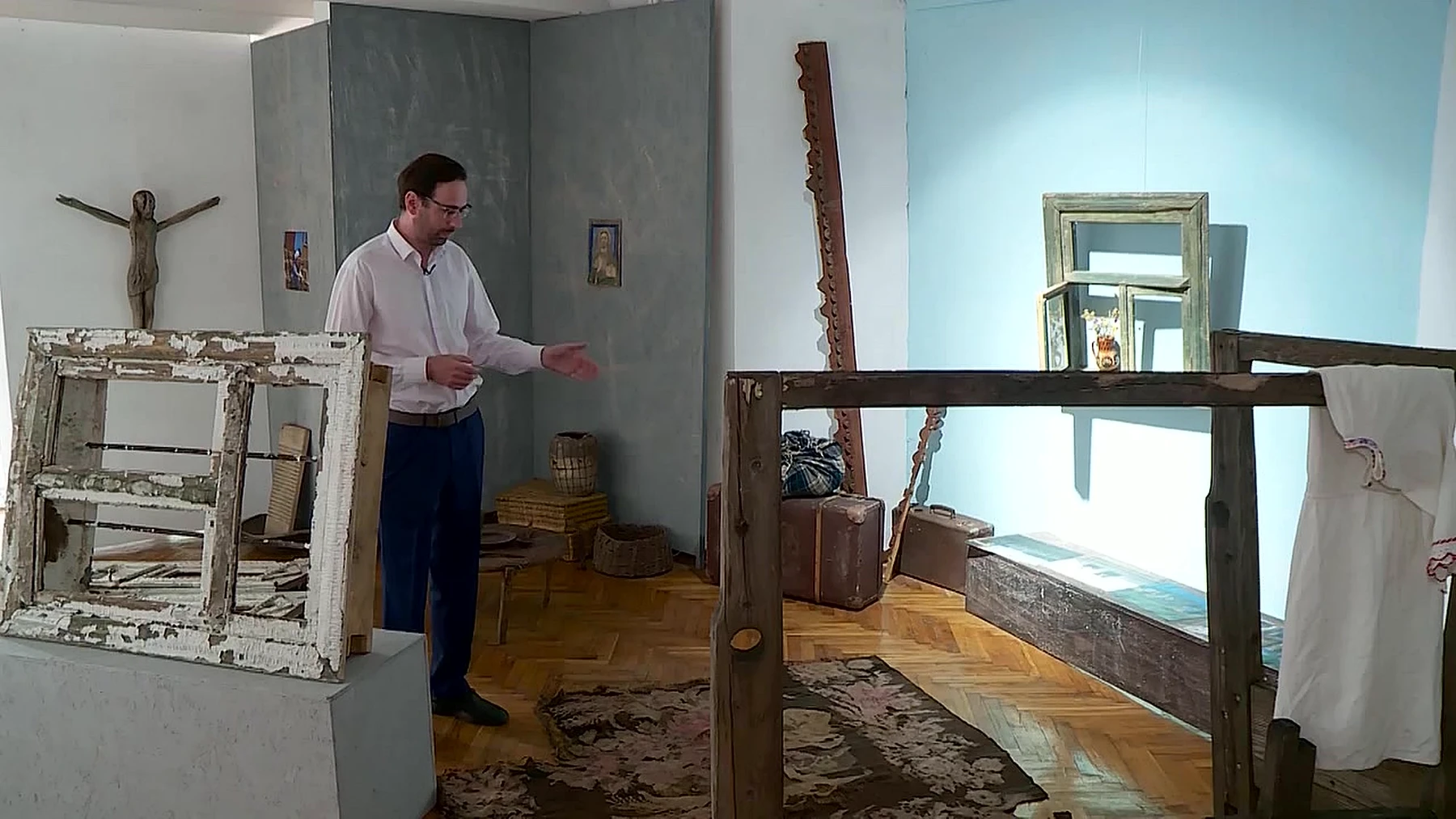
A museum curator in Ungheni happened to walk past a house that was being demolished in the Dănuțeni district, a neighbourhood of the town, called his colleagues and pulled out of it whatever could still be pulled out — a solid wood window, its frame carved in relief on three registers, and a gable with a decorated parapet. The house had been built in 1907. The pieces are now on display at the town’s Museum of History and Ethnography, in an exhibition opened recently. Museum curator Denis Bulancea described the episode in a report on the programme „Bună dimineața la Moldova 1”.
All the elements here we saved from a house built in 1907, in the Ungheni region, more precisely in the Dănuțeni district, which I noticed by chance, already at the moment when it was being destroyed, demolished. I gathered the museum’s staff and we tried to save what was left of these marvels of woodwork from Bessarabia. Denis Bulancea, museum curator at the Ungheni Museum of History and Ethnography
What was recovered reads like a manual of craftsmanship. On the gable, the curator says in the report, the motifs are geometric and plant-like — the circle, that is the sun, in the middle, the leaf on the sides. At the top sits an ornament called „horboțica” (the little lace), with a solar rosette and zigzag endings; these elements make him suspect it also served to protect the house, not merely to adorn it. Beside it, the museum has reconstructed the interior of a household — parts of a weaving loom, a woven rug from before the First World War and a low table which, he says, was usually hung back on its peg after the family had finished eating.
The curator calls the exhibition „a cultural manifesto for saving traditional folk art, the Moldovan art of Bessarabia, which is on the way to disappearing”.
The house was not a monument. Nor could it have been
In the Register of Monuments Protected by the State, approved by Parliament in 1993, the Ungheni district occupies positions 1573 to 1720 — from Palaeolithic sites and burial mounds to churches, war memorials and the railway bridge. The town has eight positions. The Dănuțeni district has a single one, the „St. Nicholas” Church, from 1882.
A peasant dwelling house appears nowhere in the district’s list. The only civil buildings that are not places of worship are the former primary school in Cetireni, built in 1913, and a cellar from the early twentieth century in Florițoaia Veche.
The list can only be read in the edition published in the Official Gazette in 2010 — the only one publicly available in full. Since then the register has been amended nine times, among others by a law of June 2024 that moved archaeological sites into a separate register, and no consolidated version is published anywhere. What exactly is protected today in the Ungheni district cannot be established from public sources — precisely what the Government finds in its own strategy: „the lack of a functional and up-to-date inventory system”.
The consequence is simple and lawful. The 1993 law on the protection of monuments defends only what is entered in the register. For everything else, the construction law of 2010 applies: the demolition permit is issued by the mayor, within no more than ten working days, on the basis of the application and the works organisation plan. The approval of the Ministry of Culture is required only for listed monuments or for buildings in built-up areas entered in the register. A house a hundred years old that is not on the list can be demolished without anyone from the culture authorities even being asked.
How much is left of the old town
The 2024 census puts figures on what can be seen in the street. The Ungheni district has 35,139 residential buildings. Of them, 118 — that is 0.3% — were built up to 1919. Another 1,292 (3.7%) date from the interwar years and the years of the war. The average age of a building in the district is 48.8 years.
In the town of Ungheni the count is even shorter. Of the 4,980 residential buildings, 18 date from before 1919. The house built in 1907 in Dănuțeni — a district that was a village until 1958, when it was taken into the town — was part of this thin layer.
The state knows its problem. The same National Strategy for Culture and Heritage 2025–2035 states in black and white that traditional dwellings and the vernacular built stock remain insufficiently protected, warning that, without intervention, more and more buildings will end up „in an advanced state of degradation or collapse, especially in rural areas and small towns”. Under the investment programme for 2025–2027, a single historical monument is funded in the whole country.
What a museum can and cannot do
The Ungheni Museum of History and Ethnography has been running since 1967, when it was set up by a decision of the district executive committee, and is subordinated to the city hall. It is housed in the Palace of Culture, on Nicolae Bălcescu street, was accredited by the Ministry of Culture in 2022 and holds more than 10,000 items. Across the district, the three museums — Ungheni, Sculeni and the Pîrlița village museum — counted last year 15,113 items in their core collections and 12,075 visits.
The register of local acts shows that, over the past two years, the municipal council approved two demolitions of buildings; in the case of the May 2026 decision, it provides that the chief architect is to draw up the demolition permit. Demolitions on private property, however, do not come before the council, so they leave no trace in the public register. Consequently, no decision concerning the house built in 1907 appears in the public register of local acts.
One fact says everything about how the mechanism works today: the window of that house ended up in the museum because an employee walked past it by chance, on the right day.