
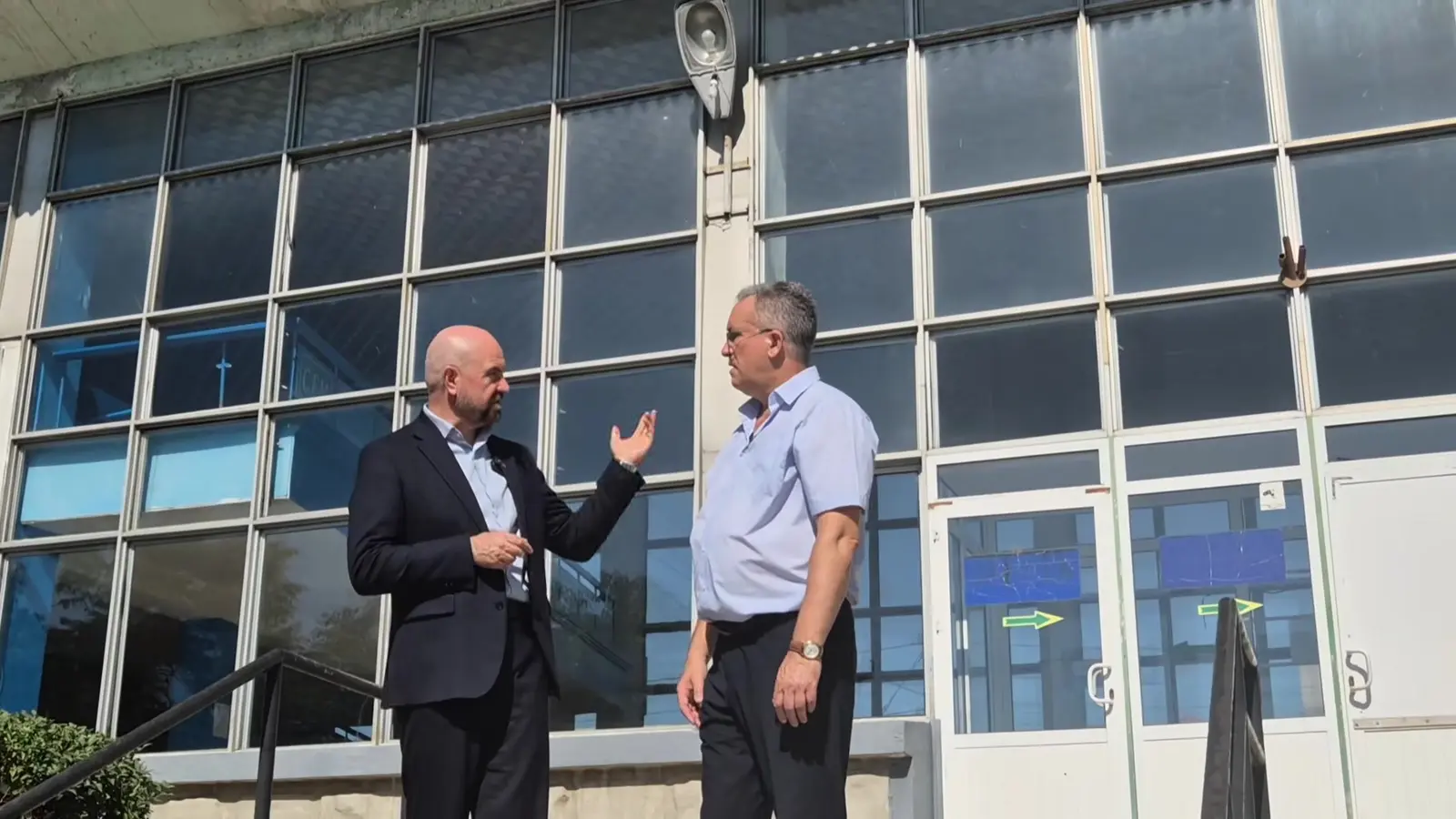
On Tuesday, August 11, 2026, the Minister of Infrastructure and Regional Development, Vladimir Bolea, was in Ungheni, on a visit to the sites of three projects in the town. In a video message published the same day by the City Hall, however, the minister also announced something else that was not on the official agenda of the visit: the town’s bus and railway station is to be transferred to the City Hall and transformed into a „multimodal hub”.
Together with the City Hall we will build a genuine multimodal hub. At the front we must bring the train, which is to bring the passengers from Iași and from Chișinău, and at the back are the buses that will take them to all the villages in the district, and later in the region. Vladimir Bolea, Deputy Prime Minister, Minister of Infrastructure and Regional Development
The Ungheni station serves both trains and buses, and that is exactly what a multimodal hub means: a single place that links the train, the district and intercity buses and minibuses, and urban transport, so that the traveler moves from one to another at the same point. The minister spoke about transferring to the City Hall both the railway station and the adjacent bus station, and promised transport „at controlled prices and fair prices”. It is an idea with logic to it — but, so far, only an idea said out loud.
What the mayor promised
The mayor of the municipality, Vitalie Vrabie, thanked the minister and promised that the local administration will invest in renovating the station immediately after the takeover.
From the moment you transfer this station into our ownership, we together will invest in it in such a way as to renovate it as quickly as possible and to bring public transport — urban, international and national — back here, where it belongs. Vitalie Vrabie, Mayor of Ungheni municipality
He ended with „Good luck to it! We are waiting.” And it is precisely this last word that most accurately describes the current state: a wait. Because, beyond the stated intention, none of the steps that would turn the sentence into a fact has yet been taken. Here they are, one by one.
The ministry’s official press release makes no mention of the station
The same day, the ministry published on its own website a press release about the visit to Ungheni. It lists three ongoing projects — the agri-food market (17.7 million lei), the regeneration of the French Park (25.9 million lei) and the access road to the Free Economic Zone (22.1 million lei) — each with a value, work stage and number of beneficiaries. The station does not appear in it.
Of all the topics the minister touched on in Ungheni, the transformation of the station is therefore the only one left solely in the City Hall’s video message, without a single line in the official press release of the institution that would carry out the transfer. It is the difference between a project committed to in writing and a sentence uttered on the ground.
Ownership or management? Who actually decides
The two statements do not even say exactly the same thing. The minister said the station will be transferred to the City Hall; the mayor spoke of the moment „when you transfer it into our ownership”. This is not a nuance of wording: the law knows two different paths, with different consequences for who owns the building, who pays for its upkeep and who could, one day, dispose of it.
The first path — into municipal ownership. The station would leave the state’s patrimony and enter that of the town. This is not decided in Ungheni: the decision is taken by the Government (Law no. 121/2007, art. 6) and only with the agreement of the Ungheni Municipal Council (the Regulation approved by Government Decision no. 901/2015, point 10). A handover act and re-registration in the cadastre follow. Only then does the municipality become the owner — with the right to invest, but also with full responsibility for the building.
The second path — into municipal management. The building remains the state’s, and the City Hall merely administers it, on the basis of a use contract. The law permits this: the ban on giving public assets „on loan for use” (comodat) concerns only private persons, not a public authority (Law no. 121/2007, art. 10). The town can then maintain and use the station, but the right to dispose of it and the underlying responsibility remain with the state.

For the railway station, an extra layer is added. Railway infrastructure — including stations — is, by law, public domain of the state and cannot be disposed of while it retains this regime (Railway Transport Code no. 19/2022, art. 10); removing an asset from this regime is likewise approved by the Government. And through the reorganization of Calea Ferată din Moldova, decided in February 2026, the state remained explicitly the owner of the infrastructure — tracks, land and stations. The bus-station part, which serves the buses and minibuses, falls under the general regime of public property. Whichever the path, the substantive act is adopted in Chișinău, not in Ungheni.
No such act is public. The State Register of Local Acts contains no decision by the Ungheni Municipal Council on taking over the station — the council’s last session, on July 24, had no such item on its agenda, and the announcement came after it. At the Government level, the public consultations portal holds no draft decision about the Ungheni station. What the state has formalized in these days on the railway front is something else: an increase in the share capital of the railway for infrastructure maintenance, announced on August 5 — not a transfer of the Ungheni station.
What happens to the „Slavena” routes
The mayor’s promise — „to bring public transport… back here, where it belongs” — reads against the backdrop of a situation that the City Hall itself has been trying to change for months.
Since December 22, 2025, some of the district and intercity routes depart from a parking lot at a shopping center on Decebal Street 19/B, known as the „Slavena bus station”, operated by the „Baza de Transport Auto nr. 28” JSC. In February 2026, the Municipal Council repealed its authorization (Decision no. 2/3 of February 17), on the grounds that the land has commercial designation, not that of a bus station, and that the location does not meet the safety conditions required by law; the City Hall then notified ANTA and the police to halt the activity.
Since then, the situation has remained unchanged: the agency that licenses bus stations has not publicly announced any measure, and the routes continue to depart from the same parking lot. „Bringing back” transport to the old station therefore requires, first, that this actually happen — on a legal basis, not merely through an announcement — and it leaves open a question for the passengers who depart today from Decebal: on what basis and under what conditions they would be moved again. The private operator, whose authorization was repealed, has previously explained publicly that it chose the Decebal location to avoid a congested artery in the center and because the area is frequented by residents.
With what money and by when
The mayor spoke of investments — „we will invest in it… renovate it as quickly as possible” — without naming a sum or a source of funding, and the renovation of a station has, for now, no publicly estimated cost. The municipality finances part of its investments through borrowing: in July 2026 it issued, for the first time, municipal bonds worth 10 million lei, money earmarked for a list of already-approved roads.
A deadline is likewise missing. The verbs used by both speakers — „we will do the project”, „from the moment you transfer it to us” — are in the future tense and conditioned on a transfer that has not taken place. No date has been announced: neither for the transfer of the building, nor for the start of the works.
Why a sentence is not, yet, a station
Put together what was said and what exists on paper and the distance between them becomes visible. For the promise to become a multimodal hub, a transfer act is needed — at the Government level and, then, a decision of the local council —, a clear formula (ownership or management), money and a deadline, and the unblocking of the „Slavena” situation, where the relevant authority has not publicly announced any measure. On August 11, none of these elements was public.
The idea itself is not far-fetched: it sits on top of the railway modernization at Ungheni, a hub town on the border with Romania, where the electrification of the railway and the switch to European gauge on the segment toward Chișinău are being prepared. But an intention announced on the ground and a project with paperwork are two different things, and between them lie months of procedures. For now, the most accurate word is the very one with which the mayor ended: „We are waiting.”