
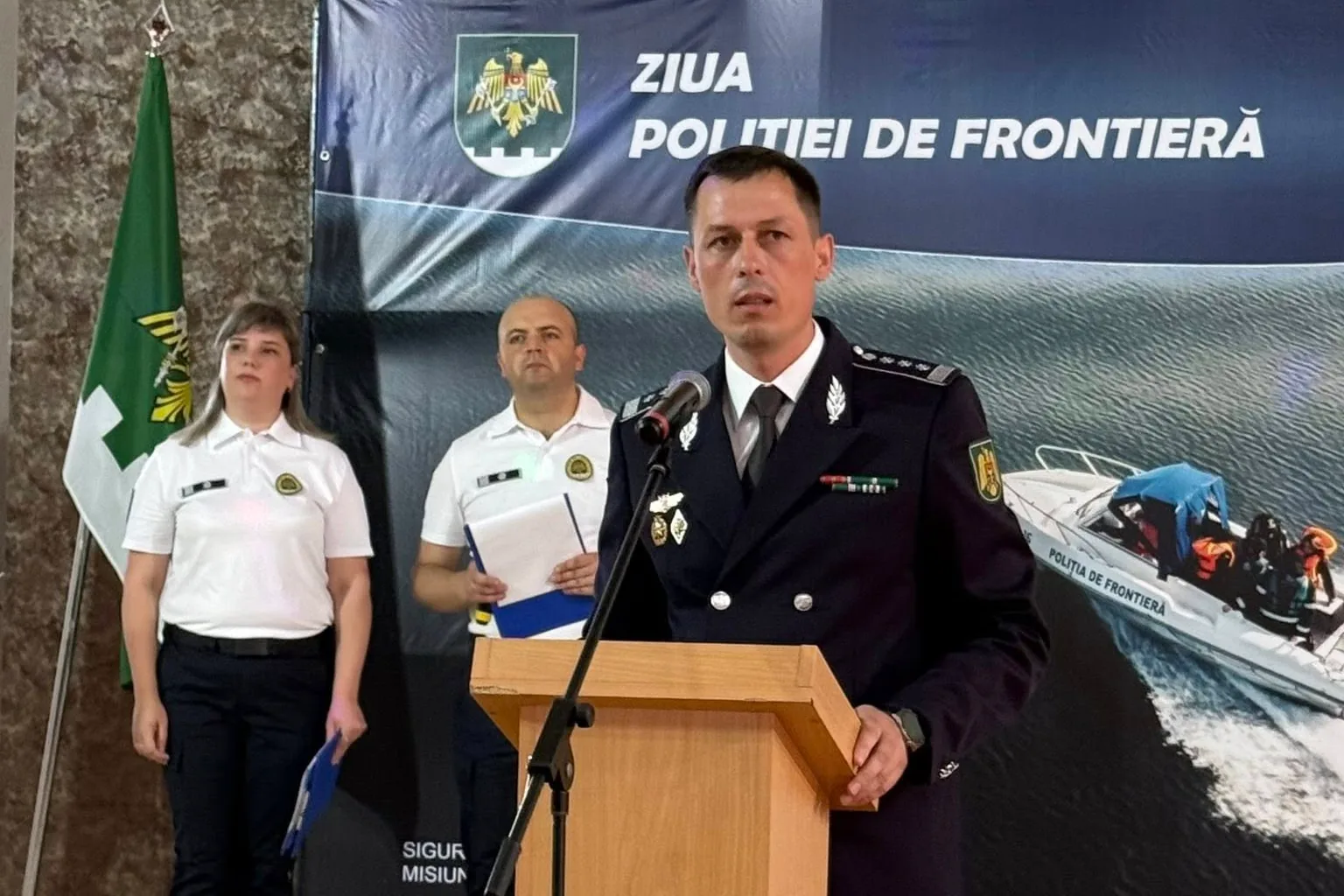
On 10 June the Border Police celebrated its professional day. In Ungheni it was marked with an event at the Palace of Culture, where the district administration — through deputy chair Corina Slupetcaia, on behalf of district head Dionisie Ternovschi — presented the force with a Diploma of Honour, according to the Ungheni District Council. The head of the Border Police’s West Regional Directorate, Sergiu Barbacari, also attended.
Beyond the ceremony, the city has a less visible reason to mark the day: it does not merely host the institution — it is at once the command post that guards the Prut border and the school that trains border police officers for the entire country.
The city the Prut border is guarded from
At 33 Națională Street in Ungheni sits the headquarters of the Border Police’s West Regional Directorate, led by Sergiu Barbacari. From here, eight sectors are coordinated — Cuhnești, Valea Rusului, Sculeni, Ungheni, Valea Mare, Frăsinești, Leușeni-1 and Leușeni-2 — covering a good stretch of the Moldovan-Romanian border, which runs along the river Prut. In other words, the people honoured with the Diploma of Honour do not guard some distant frontier but the country’s very gateway to the west, with their command centre in the middle of the city.
Two of those sectors are on home ground: the road crossing at Sculeni, a commune in Ungheni district, and the rail crossing point at Ungheni station — the only railway linking Moldova to Romania and, beyond it, to the European network.
And the command is not the whole story. Also in Ungheni, on Suceava Street, operates the Centre of Excellence in Border Security — the only institution in the Republic of Moldova that trains border police officers, with two-year studies to European standards. In practice, every officer guarding one of the country’s borders today, from the Prut to the Dniester, has passed through the city’s classrooms and training grounds.
Sculeni, one of the busiest gateways to the EU
Just how busy this border is shows in the figures. On an ordinary day — 1 November 2024 — 9,107 people crossed at Sculeni in 24 hours, according to Border Police data. That day, Sculeni was the third-busiest crossing point in the entire country, after Leușeni (10,993) and Chișinău International Airport (9,680). For a border district, that means thousands of people crossing the Prut on its doorstep every day.
And this border is about to change. In October 2025 the Government approved negotiations to introduce coordinated control at Sculeni — the “one-stop” principle, under which customs and border formalities are carried out once, jointly with the Romanian side. Sculeni would become the fourth Moldovan-Romanian crossing point with this regime, after Leușeni–Albița, Giurgiulești–Galați and Cantemir–Fălciu — meaning less time in the queue for an Ungheni resident driving to Iași. Added to this is the new Ungheni–Ungheni road crossing point over the Prut, approved by the Government in April 2026 and financed with more than €30 million in European funds — a crossing that is, for now, further along than the roads meant to feed it.
From border guards in military uniform to a European-standard police force
The day is celebrated on 10 June for a precise reason: on that date in 1995, President Mircea Snegur presented the Battle Flag to the commander of the Border Guard Troops, and Presidential Decree no. 162 fixed the date as the professional day. It was also on a 10 June, in 1992, that the Border Guard Troops had been created.
Since then, the institution has travelled a road that says something about the country’s direction: from a military structure, it became the Border Guard Service in 2005, and from 1 July 2012 — the Border Police, demilitarised and placed under the Ministry of Internal Affairs, on the civilian-police model required by European border control standards.
How much weight the institution can carry was seen in the first year of the war in Ukraine: between February 2022 and February 2023, 937,568 Ukrainian citizens entered the Republic of Moldova. Ungheni does not sit on the border with Ukraine — but the Moldovan-Romanian sector, the one overseen by the directorate headquartered in the city, saw 119,200 people enter over that period.
The festive atmosphere at the Palace of Culture was provided by the “UnFolk” guitar ensemble and the “Struguraș” folk music orchestra from Ungheni.
This article starts from the Ungheni District Council’s statement and uses public data from the Border Police and the Government. The traffic figures belong to the Border Police, not to the National Bureau of Statistics. The newsroom will follow the concrete timetable for coordinated control at Sculeni and for the new Ungheni–Ungheni crossing point.