

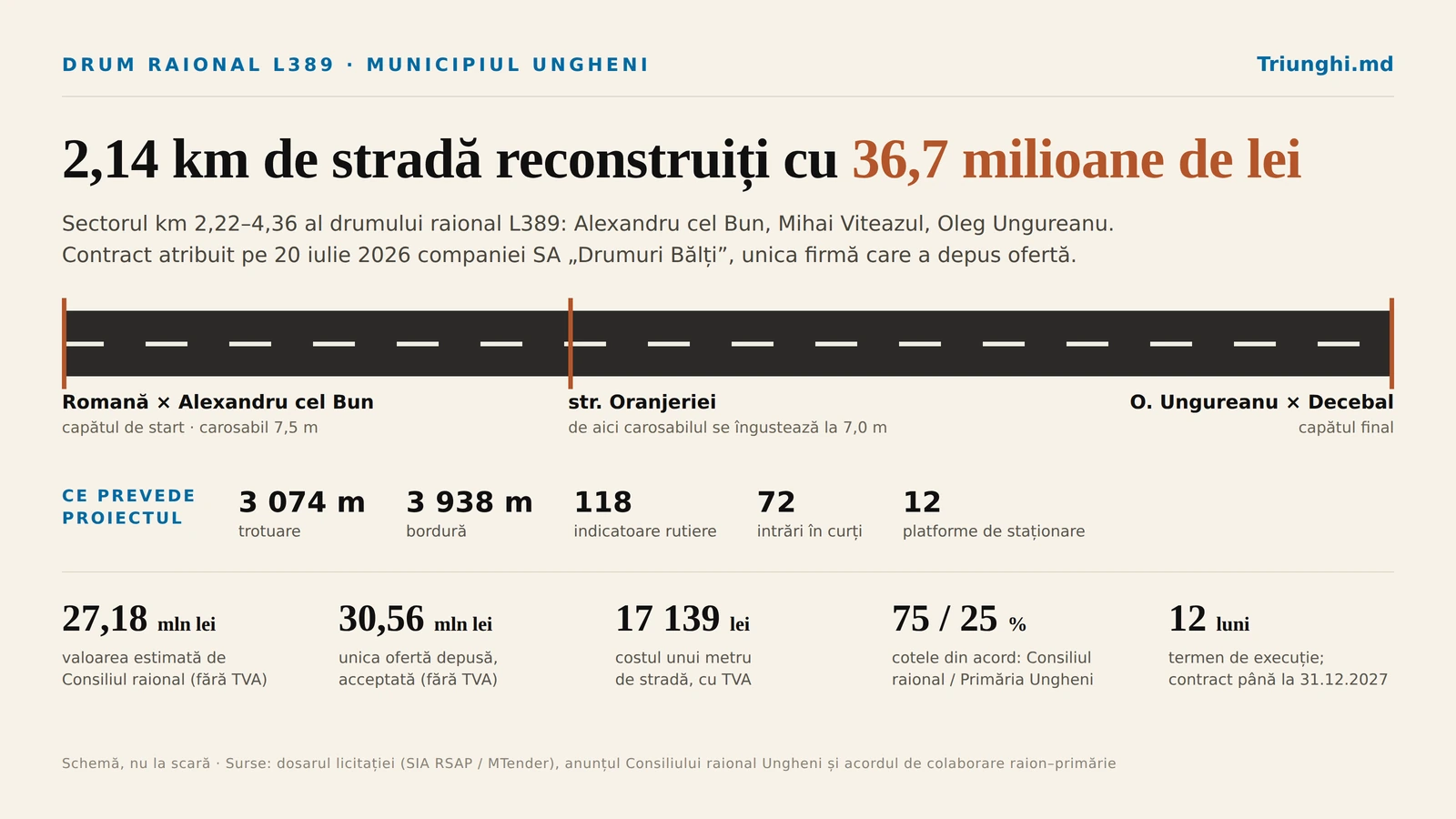
The 2.14-kilometre stretch that begins on Alexandru cel Bun street — from the junction with Romană street to the junction of Oleg Ungureanu and Decebal streets, by way of Mihai Viteazul — is to be rebuilt from the ground up. The contract, worth 36.7 million lei including VAT, was awarded on 20 July by the Consiliul raional Ungheni (the Ungheni District Council) to the company SA „Drumuri Bălți”, the only firm that submitted a bid. The cost is split, by an agreement of the two authorities, between the District Council (75%) and the Ungheni municipal town hall (25%), and the execution term set in the contract notice is 12 months.
The works were announced publicly on 27 July by the president of the district, Dionisie Ternovschi, who called them a „capital repair” of 2.1 kilometres of district road in the town of Ungheni. The file of the procurement procedure, published by the District Council in the state system SIA RSAP, shows how this price was arrived at, and the technical description published by the same authority shows what exactly is being built on every metre.
What changes along the 2.14 kilometres
This is not a surface repair. The project provides for tearing out the existing road structure and building a new one, in four layers: a capping layer of crushed stone and cement-stabilised soil, 30 centimetres thick; a 20-centimetre base layer made from the material produced by demolishing the old road itself — crushed stone and milled asphalt, with cement added; and on top of them a binder course of asphalt concrete of 8 centimetres and a wearing course of 4 centimetres.
The carriageway will be 7.5 metres wide up to the junction with Oranjeriei street and 7 metres along the rest of the route. Pavements between 1.5 and 2.25 metres wide are provided on both sides — 3 074 metres of pavement and 3 938 metres of kerb in total. The project also includes 118 road signs and markings, the arrangement of 29 side roads, 72 driveway entrances and 12 parking bays, plus the reinforcement of the green strip.
According to the technical description published by the District Council, the terrain allows stormwater to be collected and channelled along the carriageway itself, towards the low points of the route.
The contract notice requires a warranty on the works of at least five years from the handover on completion, and the company carrying them out lodges a performance guarantee of 10%.
What comes next for traffic
The contract notice requires the works to be carried out in 12 months, and the contract is valid until 31 December 2027. The date on which the site actually opens does not appear in the published documents of the procedure.
A traffic plan was nevertheless required: the „temporary traffic organisation scheme for the duration of the works” was among the mandatory documents of the bid. The published documents of the procedure, however, contain no such scheme.
For the town, the calendar matters more than usual. The stretch ends at the junction with Decebal street, where the municipality already has a site open: work has been under way since 3 July on a 1 003-metre section towards the free economic zone, with new stormwater networks. And along the very stretch now going into reconstruction, traffic already jams on Thursdays and Sundays — on market days, when the street takes on part of the flow to and from the market.
Why the District Council is paying for a street in the town centre
For someone from Ungheni, Alexandru cel Bun is a street of the town. In the state register it is something else: the stretch being rebuilt is part of road L389, entered in the List of local public roads of district interest approved by Government Decision no. 1468 of 2016, under the name „R1.1 – drumul de acces spre or. Ungheni” (R1.1 – the access road to the town of Ungheni).
Hence the full name of the object put out to tender — „Reconstrucția unui sector de drum L 389 R1.1 -G91, km 2.22 - 4.36” (Reconstruction of a stretch of road L 389, km 2.22 - 4.36). In the same government decision, R1.1 is the national access road to Ungheni, and G91 is the national road „Ungheni – Bărboieni – Nemțeni – M1”, the one that leaves the town southwards, towards the M1 express road. The street in the town centre is, on paper, the link between two national roads.
The register classification is only half the answer, though. The other half is a decision taken by the town three years ago: on 3 July 2023 the Ungheni Municipal Council transferred to the district, free of charge, three road segments that until then were public property of the municipality — 330 metres on Oleg Ungureanu street, 1 270 metres on Alexandru cel Bun and 540 metres on Mihai Viteazul — together with the land beneath them (in full on Oleg Ungureanu, 99.5% on Alexandru cel Bun and 32% on Mihai Viteazul). The District Council accepted them three days later.
The reason is written into the same municipal council’s later paperwork: the transfer was made „in order to ensure the connection with district road G91 and L389” — although, in the state register, G91 is a national road. The three segments add up to 2 140 metres — exactly the length of the stretch now put out to tender, and the district repair plan names the same three streets for this kilometre range.
This is not, then, a street that had always belonged to the district. It is a street of the town placed in the district’s charge, with the town’s agreement — and when it comes to paying, as shown below, the town has not left the equation.
What it costs and how the price was reached
The District Council estimated the works at 27 176 757,05 lei excluding VAT and put them out to open tender on 11 June, with bids due by 2 July. Throughout the question period no request for clarification was registered from any company, and by the deadline a single economic operator had submitted a bid: SA „Drumuri Bălți”, with 40 documents attached and a price of 30 564 320,19 lei excluding VAT.
The single bid is 3 387 563 lei higher than the contracting authority’s own estimate — by almost 12.5%. With VAT, the contract comes to 36 677 184,23 lei. Set against the 2 140 metres of the stretch, that means 17 139 lei for every metre of rebuilt street, or a little over 17.1 million lei per kilometre.
Before deciding, the working group asked the company for further explanations. On 10 July, according to the award decision, it was asked for a technical and material justification:
S-a solicitat justificarea tehnico-materială și actele de confirmare la: Materiale și utilaje.
Consiliul raional Ungheni, award decision no. 1 of 20 July 2026
[In translation: „Technical and material justification and the supporting documents were requested for: Materials and equipment.”]
Against the company’s answer, the document records that „the papers were submitted”. The bid was declared compliant both with the qualification requirements and with the technical specifications, no bidder was rejected, and the criterion applied was the lowest price. The award decision is dated 20 July and is signed by the working group of the District Council, chaired by Dionisie Ternovschi.
Where the money comes from and how much it weighs in the district budget
In the award decision, under the funding source heading, „state budget” is ticked. Annex no. 7 to the State Budget Law for 2026 shows what that means for Ungheni: this year the district receives 27 963 700 lei for the infrastructure of public roads of district interest — for all of its roads, not just this one. The sum is divided by chapter, through a decision of the District Council: 23.28 million for repairing roads and engineering structures, the rest for summer and winter maintenance, road safety and design work.
As a gross figure, the 36.7-million-lei contract is larger than everything the district receives in a year for its roads. The district does not carry it alone, however.
A cooperation agreement for these works was approved in January 2026 by the District Council and by the Municipal Council, and in May it was amended by an addendum, voted by both councils before the contract was awarded. The addendum replaces the original financial arrangement with fixed shares:
Finanțarea lucrărilor de construcție se va realiza în baza următoarelor cote procentuale de participare: — Consiliul Raional Ungheni — 75 %, din suma licitată; — Primăria Municipiului Ungheni — 25%, din suma licitată; Contribuțiile financiare vor fi stabilite anual, în funcție de volumul lucrărilor executate, în raport cu cotele procentuale stabilite mai sus.
Addendum to the Cooperation Agreement, approved by District Council decision no. 3/34 of 7 May 2026 and Municipal Council decision no. 4/23 of 15 May 2026
[In translation: „The financing of the construction works will be carried out on the basis of the following participation shares: the Ungheni District Council — 75% of the tendered sum; the Ungheni Municipal Town Hall — 25% of the tendered sum. The financial contributions will be set annually, according to the volume of works executed, in line with the shares established above.”]
At the same time the agreement was extended from „Stage I” of the technical design — 1 200 metres — to the whole 2 140-metre stretch, and its term was taken to 18 months, across 2026 and 2027.
The shares apply to the „tendered sum”, without the document saying whether that figure includes VAT or not. Counted both ways, the district’s share — 75% — comes to between 22.9 and 27.5 million lei, that is below its annual allocation of 27.96 million. The municipality’s share — 25% — comes to between 7.6 and 9.2 million lei. The agreement fixes no sum in lei for either party: it is set year by year, according to the volume of works executed.
The contract notice, for its part, had established that „the financial execution of the contract will be multiannual”: 13 million lei excluding VAT were to be paid by 31 December 2026, and the remainder in 2027.
On the line for roads of district interest in the State Budget Law, the Ungheni municipal town hall receives zero lei — that money goes to the district. This does not mean the town is standing aside on these works: under the agreement it pays a quarter of them, from the local budget. The town’s other streets are surfaced from different sources, among them the 10-million-lei loan through municipal bonds — a list of objects on which Alexandru cel Bun street does not appear.
The first stage of a road with three streets
The plan for repairing district roads in 2026, approved by the District Council on 25 February, contains only three items: road L381 Rădenii Vechi – Bahmut, over three kilometres; the Vulpești stretch of road L385, with a gravel surface; and L389.
The stretch on Alexandru cel Bun appears there as „Stage 1”, and road L389 covers, according to the same plan, three streets of the town: Oleg Ungureanu, Mihai Viteazu and Alexandru cel Bun. The present contract covers kilometre 2+220 to kilometre 4+360 of it.
A single bidder, a price above the estimate: where the law’s thresholds run
Two things in the file read wrong without context: a single company came to the tender, and its price is higher than the one calculated by the authority. Public procurement law treats each of them separately, and in both cases sets exact thresholds.
The sole bidder. Legea nr. 131/2015 (the Public Procurement Law) does not impose a minimum number of bids in an open tender. Thresholds of that kind exist only for procedures with pre-selection — for instance, at least five candidates in a restricted tender. Among the grounds on which a procedure is cancelled, the law lists the situation in which „no bid was submitted”, but not the one in which a single bid was submitted; the special regulation on procurement of works repeats the same list. Moreover, Legea nr. 20/2026 (the Law on remedies and appeals), in force since 1 April 2026, regulates the case expressly: when the contract is to be concluded with „an economic operator that was the sole bidder in the award procedure”, the 11-day standstill period before signature becomes optional. The District Council may therefore sign without waiting any longer.
The price above the estimate. Here the law leaves a corridor, with walls at both ends. At the bottom: a works bid that falls below 85% of the estimated value is treated as abnormally low, and the procedure is cancelled if the company fails to justify it. At the top: the procedure is cancelled if the bids „exceed by 30% the estimated value of the public procurement of works”. The Ungheni bid represents 112.5% of the estimate — between the two walls.
The law provides a second test as well, one that is not about law but about budget: the procedure is also cancelled when the bid exceeds „the value of the funds allocated for performing the contract”. How much exactly was allocated for these works does not emerge from the published documents of the procedure, and the district repair plan contains no costs per object.
No appeal was lodged against this procedure with the National Agency for Solving Complaints (ANSC). The law gives an economic operator that considers itself wronged 10 days from the day after the act is published in the state system — a term which, in the case of the decision of 20 July, had not yet expired on the date this article was published.
What a company had to prove in order to bid
According to the contract notice published by the District Council, the company had to demonstrate a turnover — both for the previous year and as an average of the last three years — of at least the estimated value of the lot, that is over 27 million lei. It had to show at least one contract for similar works „whose value is not less than 75% of the value of the future contract” — over 20 million. It had to own an asphalt concrete plant or hold a firm contract with a supplier. And it had to have, owned or rented, nine categories of equipment, from the asphalt milling machine and the paver-finisher to the recycling plant.
On top of all that — a certified technical supervisor for roads and bridges, the permit for taking part in public tenders for works, and a bank guarantee of 2% of the bid value: over 540 000 lei, set against the estimated value of the lot, tied up merely to enter the race. The company that did bid attached 40 documents.
In 2024 the same Consiliul raional Ungheni put out to tender the repair of six roads, with an estimated value of 19.8 million lei, split into two lots: 12 bids came in, from seven companies. Now, for a single lot of 27.18 million, one came in. The works are not of the same kind — then it was repair work on village roads, split into two lots; now, complete reconstruction of an urban artery, in a single lot.
Correction — 28 July 2026
In the original version of this article we wrote that the works are paid for by the District Council, out of the state budget transfer for roads of district interest, and that the contract sum exceeds everything the district receives in a year — by 8.7 million lei at the figure including VAT, by 2.6 million at the one excluding VAT. We also wrote that the street’s administration „belongs to the district, not to the town hall”, without saying how the street came into the district’s charge.
The first statement was wrong, the second incomplete. The cost of the works is split between the two authorities by a cooperation agreement approved by both councils in January 2026 and amended in May 2026, before the contract was awarded: the District Council 75%, the Ungheni municipal town hall 25% of the tendered sum. The district’s share therefore stays below its annual road allocation, not above it. And the street passed into district ownership only on 3 July 2023, when the Ungheni Municipal Council handed it three road segments free of charge — on Oleg Ungureanu, Alexandru cel Bun and Mihai Viteazul — for the connection with roads L389 and G91.
We have corrected the chapters „Why the District Council is paying for a street in the town centre” and „Where the money comes from and how much it weighs in the district budget”, added the relevant documents to the source list, and changed the article’s summary. The contract data — 36 677 184,23 lei including VAT, 2.14 km, a single bidder, SA „Drumuri Bălți”, 12 months of execution — remain unchanged.
The agreement fixes no sums in lei: the shares apply to the „tendered sum”, without specifying whether that includes VAT, and the contributions are set annually, according to the volume of works executed. The exact sums falling to each authority do not follow from the published documents.