
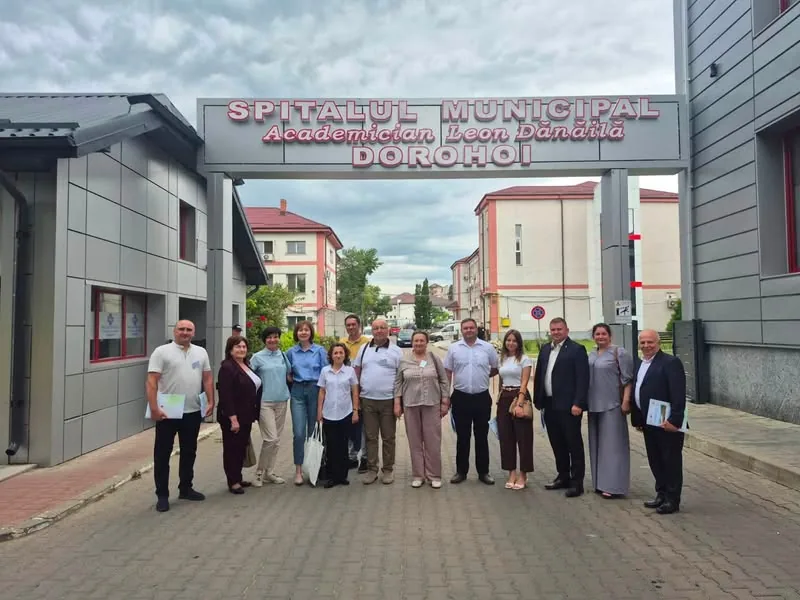
Costuleni mayor Andrei Rudicov is in Dorohoi these days, in Romania’s Botoșani county. Not on a courtesy visit, but on hands-on training in how a disaster is managed — from alerting the population to responding in a crisis. Alongside him, a delegation of mayors from the Ungheni district, who travelled there at the invitation of the city’s mayor, Vitalie Vrabie.
The study visit is part of the European project RiAdapt and is, in essence, the other face of a story that Ungheni residents already know: the same project now reinforcing the Prut dike, in the Ungheni-Vale neighbourhood, is also paying to prepare the people who should respond when the water breaks its banks.
What they learned in Dorohoi
According to the Costuleni village hall, the agenda included visits to the Dorohoi Fire Detachment, demonstrations of alarm systems, simulation exercises and an exchange of experience with emergency-management specialists. The mayor of Florițoaia Veche commune, part of the same delegation, wrote on Facebook that the group also went to the “Academician Leon Dănăilă” Municipal Hospital in Dorohoi, where it was shown crisis organisation and response solutions.
The visit is organised by the Ungheni Regional Centre for Sustainable Development, in partnership with Ungheni city hall, and brings together local authorities and emergency services from the Republic of Moldova and Romania. It is not an isolated episode: in March 2026, the same specialists had met in Ungheni, within a cross-border emergency-management network, with a visit to the Prut dike itself. The trip to Dorohoi is the reciprocal one.
A project that builds both a wall and prepared people
RiAdapt — in full, “Developing capacities for the adaptation and prevention of disaster risks of cross-border towns” — is run by the city of Ungheni together with Dorohoi, its twin city since 2015, and funded by the European Union through the Interreg NEXT Romania–Republic of Moldova Programme 2021–2027, over the 2025–2027 period.
The project has two components running in parallel. One is concrete: reinforcing, over 2,341 metres, the protective dike on the Prut and its tributary the Delia, with a promenade on top — work for which the Ungheni share means a European grant of €922,715, according to the Ungheni municipal council’s co-financing decision of March 2025. The other component, the one in Dorohoi, is not poured in cement: it is trained people, procedures and contacts between the emergency services on the two banks.
What exactly a commune mayor takes home from such a visit is a matter of application — a better evacuation plan, a direct line to the firefighters, familiarity with an alarm system. The village hall’s notice speaks not of equipment or supplies for Costuleni, but of preparation and partnership.
Why it matters for Costuleni in particular
Costuleni is a commune on the bank of the Prut, and for its residents the risk of flooding is not an abstract notion. During the July 2010 Prut flood, three houses at risk were evacuated in the village, the river had risen by about 4.3 metres, and in the neighbouring commune of Măcărești 19 houses went under water, according to Civil Protection Service data.
It was not a one-off. The Ungheni district was hit by floods in 2008, 2010 and 2020, and in the last week of May 2026 the rains again pushed the Prut and the district’s streams out of their beds, flooded part of Cornova and put pressure on the dikes at Pîrlița and Vulpești. In the same month, teams from six countries were practising flood rescue on the Prut at Ungheni. The preparedness of this bank’s local authorities is, therefore, not theory.
The participation, the agenda and the organiser come from the Costuleni village hall notice and the account of the Florițoaia Veche commune mayor. The RiAdapt framework — Interreg NEXT Romania–Republic of Moldova, 2025–2027 — and the €922,715 grant for Ungheni’s share are confirmed by Ungheni city hall and by the municipal council’s co-financing decision of March 2025, previously documented by Triunghi.md. The 2010 flood data belong to the Civil Protection Service. The project’s total budget and Dorohoi’s share have not been made public, and the notice speaks not of equipment for Costuleni but of preparation and partnership.