

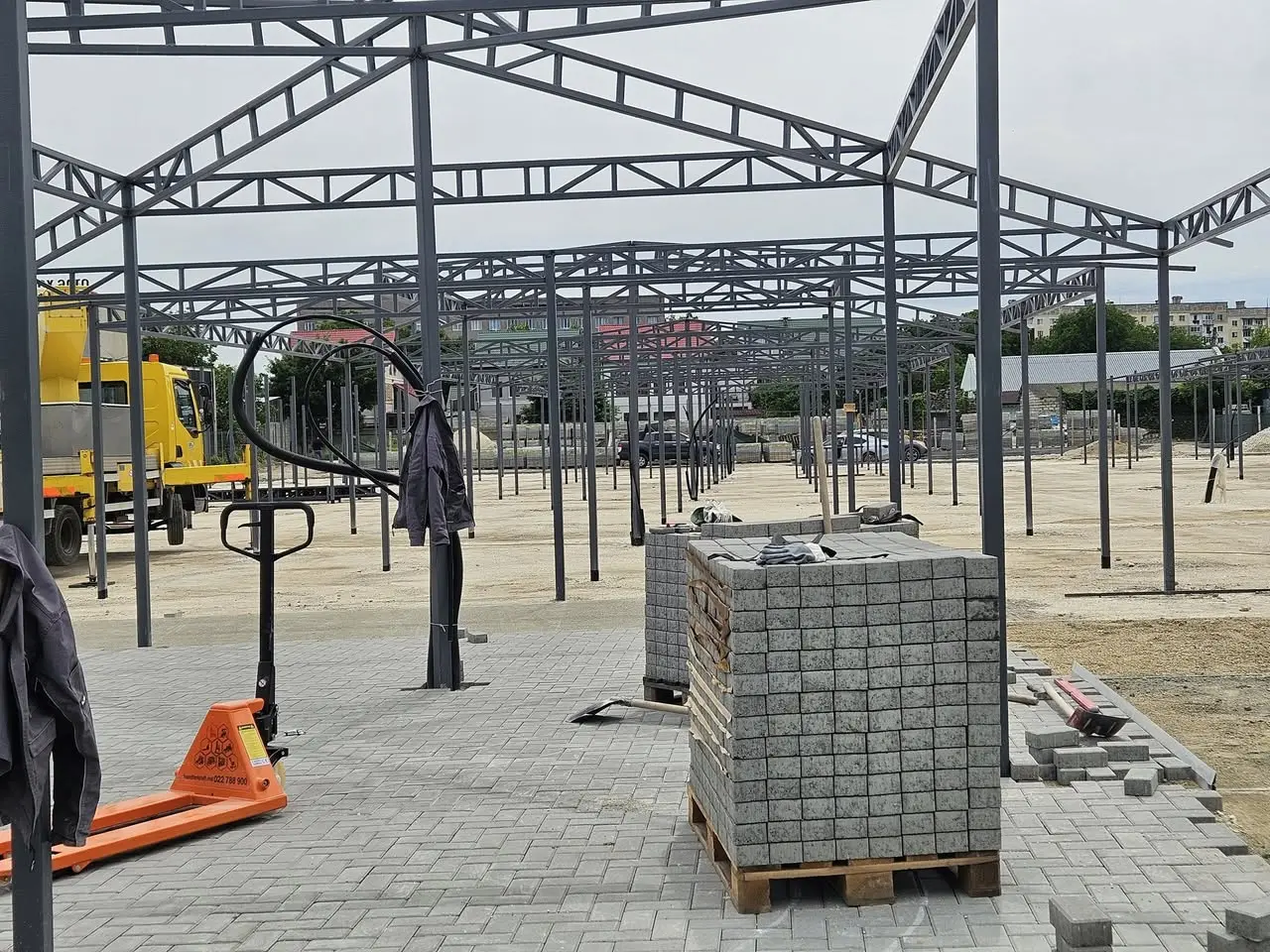
On Monday, Ungheni City Hall published a few images from the construction site of the future agri-food market and announced that the works are “taking shape”: most of the metal frames for the 30 pavilions are up, the underground networks are done, and the grounds are now being paved. Beyond the inspection photos, the public record shows a project of public money worth over 17.5 million lei, with a calendar that has kept slipping, funding shifted from a European programme to the national budget, and several transparency questions the administration has yet to answer.
What the contract shows
The exact value of the works is 17,545,449.32 lei, according to the public register of awarded contracts, consulted by Triunghi.md. The works contract was signed on 28 November 2025 by the Centru Regional Development Agency (ADR Centru), as contracting authority, with the firm “Proex Construct” LLC — a construction company from Chișinău, declared the tender winner on the “lowest price” criterion. The object of the contract: “Pavilions for the agricultural market” on the plot with cadastral number 9201103.712, on Decebal Street.
The money comes mostly from outside the town. The City Hall stated that 15 million lei are provided by the National Fund for Regional and Local Development (FNDRL), and the rest from the municipal budget. How much the town itself puts in remains unclear in the acts, however: Municipal Council Decision no. 4/3 of May 2025, through which Ungheni applied for funding, commits only to “a contribution of at least 10%” of the project budget, with no figure in lei. In statements, the figure has fluctuated — in 2025 mayor Vitalie Vrabie spoke of about 1.5 million lei, while 2026 reports indicate roughly 2.5 million. With 15 million out of 17.5, the national fund covers around 85% of the investment, near the maximum ceiling allowed by FNDRL rules.
From a “from-the-stall” market to 30 pavilions
On that 1.19-hectare plot, leased for years by the I.C.C. “Coopcomerț” UCOOP Ungheni, traders today sell “from the stall, out of vans, off the ground, in conditions far from modern” — a description by the mayor, repeated by several outlets. The new market is meant to change that. But this is also where the most concrete human stake appears: what happens, during construction, to the roughly 80 sellers from the old site.
According to the mayor, their contracts expired on 30 June and were extended for three months, and the administration was to identify “adjacent spaces” for relocation. Triunghi.md did not, however, find in the State Register of Local Acts any public order formalising the extension and relocation, and could not confirm that the relocation spaces were actually provided. For now, these remain verbal promises. Nor has the position of the historical lessee, “Coopcomerț” UCOOP, on the termination of the lease been made public.
The promised calendar and the documented one
The project was announced in the summer of 2025, when the mayor estimated a start “at the end of September” and completion “within six months at most”. The tender was launched only on 26 September 2025, with an estimated value of 15.7 million lei excluding VAT, and the contract was signed at the end of November. The works were officially started in March 2026, and the execution term in the contract is six months from the start order — which pushes completion towards the autumn of 2026, not the start of the year, as the initial promise suggested. The exact date of the written start order is not, however, public, so any delay against the contractual term cannot be established from the outside.
What can be said with certainty is that the horizon has been pushed from one promise to the next. In mid-April 2026, the water and sewerage networks were installed and work was under way on the lighting network — the foundations of the 30 pavilions were still to come. ADR Centru reported, on 28 April, the completion of the earthworks, the networks and the kerbs, with the pavilion foundations to follow. Now, in June, the City Hall announces that the metal structures are up and that the grounds are being paved.
From European funds to national money
There is also a change of funding that the documents show, but that no one has explained publicly. A Municipal Council decision from December 2024 framed the construction of the agri-food hall under the “EU4Moldova: Focal Regions” programme, funded by the European Union. The May 2025 decision, by contrast, invokes the FNDRL — national funding. Moreover, in early 2024, when the EU was announcing the “focal regions” projects, a regional agri-food market was planned in Cahul, not in Ungheni; Ungheni was then due other objectives. In practice, the market ended up being built with national money, after the European pilot programme for Ungheni and Cahul ended.
The sum is not small on a national scale either. To give a measure: the 15 million lei from the FNDRL for a single market represent, as an order of magnitude, around a fifth of the entire 2025 FNDRL allocation for a whole development region, such as the North Region.
The questions in the comments have a legal basis
Under the City Hall’s post, two readers asked questions that deserve an answer. One asked “where did the site information board go?”. The question is not a formality: displaying the information board at a construction site is a legal obligation, not an option. The Contravention Code has, since 2022, penalised “the absence of the information board at the site”, and a 2015 order of the line ministry — promoted precisely by ADR Centru, the funder of this project — sets out what it must contain: the beneficiary, the contractor, the name and phone number of the site supervisor, the building permit number, and the deadlines. It is precisely this board that would let any passer-by see who is responsible for the works. Triunghi.md did not verify on the ground whether the board exists right now at the Ungheni site — but the obligation to display it is clear.
Another comment asked what guarantee there is that the metal structures will not give way in strong wind. This is a concern, not an established defect, and we do not treat it as one. For any authorised construction site, the law provides for a site supervisor, a technical reception on completion, and contractual guarantees — the mechanisms by which quality is meant to be ensured, and by which responsibility acquires a name. Indeed, the site supervisor’s name is one of the very details that the mandatory information board is required to display.
Also around the market, another procedure — separate from the contract for building the pavilions — ran into trouble. The tender for landscaping the access roads to the market, launched by the City Hall, was cancelled in May 2026, according to the public procurement register, with the standard wording “serious breaches of the legal provisions affecting the outcome of the award procedure”. It is a procedure distinct from the one for building the market, and the contracting authority has not publicly explained the cancellation. Also connected, a storm-water network for the market grounds was contracted in April 2026, for a further 2.6 million lei or so.
A market for a town that is shrinking
The investment comes to a district that is losing people: the population of Ungheni district was about 74,500 in 2025 (preliminary data), down by almost 22% from 2014, according to the National Bureau of Statistics. Whether a market with 30 pavilions is sized for a growing or a shrinking town has no simple answer — but it is one that a public investment of this size deserves. Indeed, the official sources do not even agree on capacity: some speak of 30 pavilions with four selling points each, others of 48 kiosks.
At the signing of the contract, in November 2025, deputy prime minister Vladimir Bolea summed up the stake like this:
A well-organised market means more stable incomes for the people who produce here, in the region, and that matters enormously for the local economy.
Vladimir Bolea, deputy prime minister
It remains for the administration to show that, beyond the metal frames, the project also respects both the calendar and the rules of transparency.
A 17.5-million-lei project of public money leaves, for now, a few things the public acts do not state: the exact date the works began, the amount the City Hall actually contributes, and the fate of the roughly 80 traders after the three-month extension. At this scale, these are details that transparency requires the authority to post on its own initiative — on the site board and in council decisions — rather than have them dug out of registers. The six-month contractual term and the official horizon, the autumn of 2026, remain the benchmarks against which the people of Ungheni will be able to judge whether the market keeps its promise.