
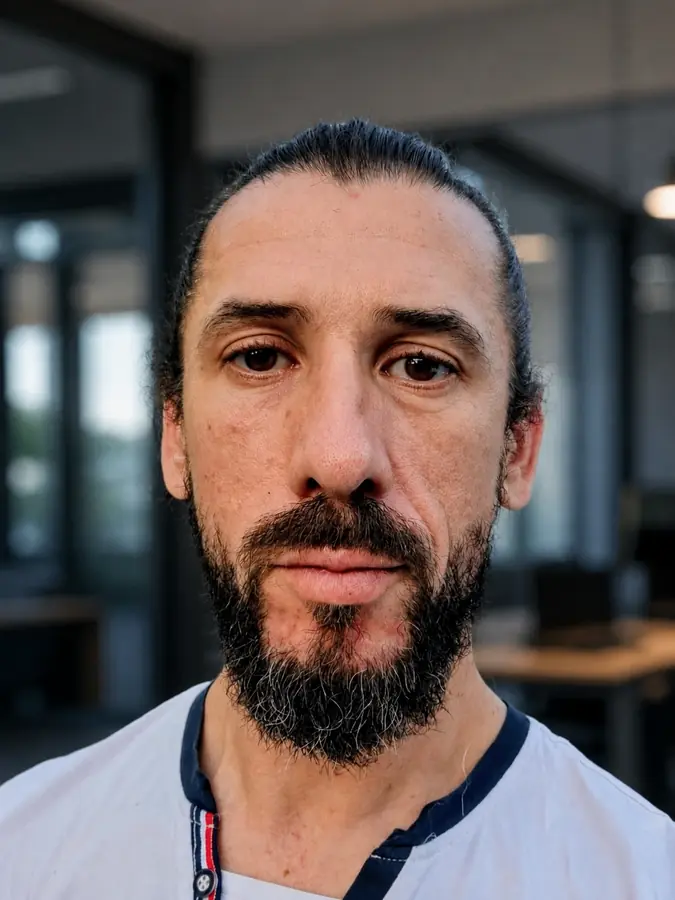
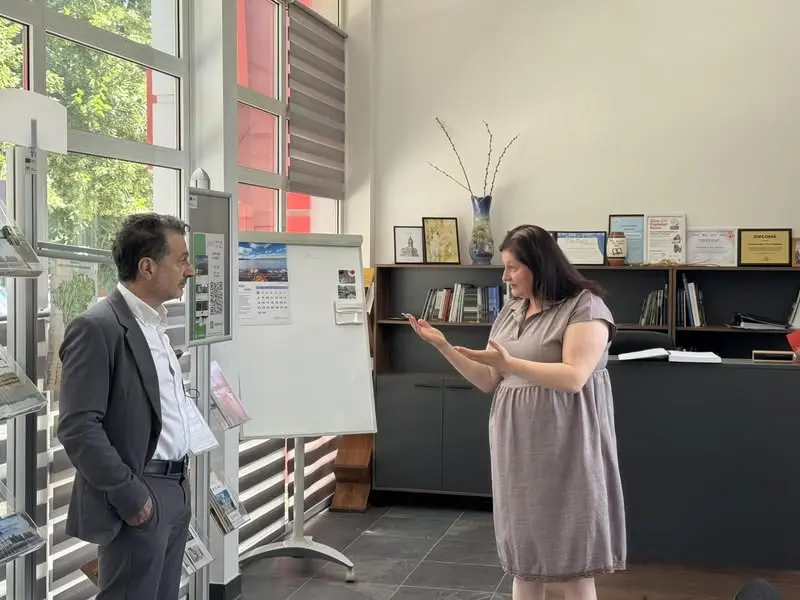
The Tourist Information Centre (CIT) in Ungheni — built in 2023 with almost three million lei in European funds — hosted on Thursday, 18 June, Alberto Cottica, an expert tied to the very programme through which the centre was created, accompanied by Veaceslav Bulat. The centre described the meeting as an «exchange of ideas and experience» on community development, social innovation and tourism. No concrete purpose was announced. Beyond the visit, the question that matters for the people of Ungheni is a different one: what the centre has produced, and what remains of the money invested here.
The centre presents Cottica as a «Global Innovation Hub expert», and Bulat — known in Moldova as a specialist in urban development — as the director of the «Mayors for Economic Growth» programme. The exact roles could not be confirmed from an independent source, and the only account of the visit is the centre’s own announcement.
A centre worth almost 3 million lei
CIT Ungheni is not a stand-alone local initiative. It was inaugurated on 28 August 2023, with European money, under the «Mayors for Economic Growth» programme (also known as M4EG), implemented by the United Nations Development Programme (UNDP). According to the Delegation of the European Union in Chișinău, the project budget was 2,988,624 lei, and the works were carried out by Ungheni City Hall together with the Regional Centre for Sustainable Development. Speaking at the opening were the EU ambassador, Jānis Mažeiks, and the then-mayor, Alexandru Ambros.
What the centre does, concretely: it runs an information point for tourists, has set up an urban route — «Ungheni, urban value» — with seventeen objectives across the city, and regularly holds promotion activities, from «City Quest» on Tourism Day to themed fairs. These are the visible products of the investment.
A programme that has entered its third phase
The programme from which the centre grew is an initiative of the European Union, implemented by UNDP in several countries of the eastern neighbourhood, through which city halls are helped to boost their local economy. The second phase — the one under which CIT Ungheni was created — ran from 2021 to 2026 and is now listed as completed. But the programme has not stopped: since 2025 a third phase (2025–2028) has been running, again with European funding, in which 85 city halls in Moldova now take part.
The centre did not say what Thursday’s meeting was aiming at, and we do not, for now, have confirmation of an official purpose. Precisely for that reason, this article does not go beyond verifiable facts.
Tourism, on paper and on the ground
The question «what remains after the money» also has a measurable side. An information centre promotes tourism; but tourism also needs places for people to stay overnight. And on that count, the official figures show a modest and shrinking sector. According to the National Bureau of Statistics, in 2025 the Ungheni district had 142 rooms and 342 bed-places in accommodation establishments — roughly a third of the nearly one thousand bed-places recorded in 2008.
How much the number of visitors has grown since the centre has existed cannot be said from public data: official statistics do not count tourists at district level, only accommodation capacity. The centre publishes its activities — routes, contests, fairs — but a figure for its own visitors was not one we found made public at the time of writing. The only impact assessment we found is qualitative and self-reported: the Interreg Europe platform, which listed the centre among good practices, notes — «according to data provided by Ungheni TIC» — a «significant» increase in visitor numbers and tourists «from over 20 countries» (a provenance indicator, not a headcount).
Thursday’s visit remains, until the centre or UNDP clarifies, a working meeting with no stated purpose. The European programme that built the centre continues, in a new phase; but the value of those nearly three million lei will from now on be set by the centre’s use, not by its inauguration — measured in visitors and in real tourism, not just in leaflets.
The fact of the visit and its description come from the public announcement of the Ungheni Tourist Information Centre, the sole source of the event; the roles attributed to Alberto Cottica and Veaceslav Bulat are those formulated by the centre and could not be confirmed independently. The data on the centre’s creation and the 2,988,624-lei financing come from the Delegation of the European Union to Moldova; those on the «Mayors for Economic Growth» programme, including its third phase (2025–2028) and the 85 participating city halls in Moldova — from UNDP; the figures on accommodation capacity — from the National Bureau of Statistics (table TUR010200reg.px). A figure for the centre’s own visitors was not found made public at the time of writing, and the concrete purpose of the visit was not public. Triunghi.md did not obtain, by the time of publication, a reaction from the centre or UNDP.