

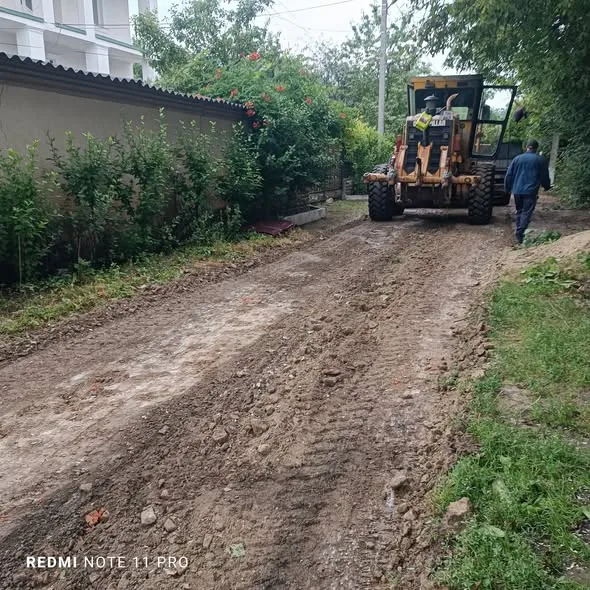
The Cornești Town Hall announced on Thursday, 23 July, that it had finished „white-variant” repairs on three streets in the town: 2 Decembrie street — 190 metres, Stejarului lane — 110 metres and Stejarului street — 660 metres. In all, some 960 metres of roadway have been brought into better shape in a locality where, according to the council’s decision, some streets had remained unrepaired since 2025.
The announcement is short and upbeat, and in the comments residents responded with thanks. Beyond it, though, remain the questions that everyone who drives on those streets is really asking: what exactly „white variant” means, who pays and whether asphalt will follow. The public documents of the town hall and of the procurement answer most of them.
Crushed stone, not asphalt
„White variant” is the administrative term for a road repaired with crushed stone and compacted gravel, without the black asphalt layer on top. The name comes from the colour of the surface itself: the mineral aggregates are light-coloured, unlike the asphalt surface — the „black variant” — in which the stone is bound with bitumen. In practice, the white variant is the foundation of a modern road, stopped short of the final layer.
Why small town halls choose this solution is easy to understand: it is far cheaper and is done quickly. The price is paid by durability, though — a gravel road erodes, throws up dust in dry weather and forms potholes in the rain, if the water has nowhere to drain. How temporary the solution is, the authority itself admits, in an exchange of questions within the procurement procedure: one bidder asked to shorten the warranty, arguing that a road made only of gravel cannot be durable, and the town hall agreed.
The contracting authority has examined your request regarding the warranty period. Given the specifics of the white-variant road-repair works made of crushed stone, as well as the principle of proportionality, the contracting authority decides to change the warranty period from 36 to 12 months. Cornești Town Hall, answer to a clarification in the procurement procedure
In other words, the contractor is liable for the work for a single year, not three — a logical measure for a gravel road, but also a clear sign that the white variant is a stage, not a destination.
Where the money comes from
The repairs are done not from a loan or a donation, but from the local budget’s own funds, which the state tops up for exactly this. The town council decided the list of streets on 23 March, through Decision no. 3/15, adopted with 10 votes in favour and none against. The document states that the works are carried out „from transfers to the local budget for general purposes — development of local roads and streets”, that is, from the money the state allocates each year to local authorities for roads.
The same decision also shows that the list in the announcement differs slightly from the plan: the council had approved repairs on 2 Decembrie and Stejarului streets — left unrepaired since 2025 — and on M. Kogălniceanu street, the latter „subject to the availability of funds”. Kogălniceanu does not appear in the completion announcement of 23 July, while Stejarului lane, which does appear, is not listed in the decision. These are differences only the town hall can clarify, but they do not change the essence: the money is public, and the priorities were voted on in the council.
A tender with five bids and no announced winner
The works went through a public procurement, registered on the MTender platform. The small-value procedure had an estimated value of 748.657,52 lei and drew five road-building firms. The lowest bid was submitted by Drumnord-Construct — 517.173,92 lei — followed by „Drumuri Strășeni” (565.766,31), EURODRUM (604.594,94), POMIXNORD (640.642,10) and Javelin N.A. (675.499,92).
Although the work is already reported as finished, the public procurement data do not yet record either a winner or the value of the signed contract — the bids appear as being under evaluation. So who actually carried out the repair, and for how much, remains for now a piece of information the platform does not display; it will become clear when the award is published or upon a request to the town hall. There was no challenge.
A programme repeated every year
Cornești does not repair all its streets at once, but a few each year, in the same cheap formula. The history of public procurements on the MTender platform shows a steady pattern: the town hall has run road-repair procedures in previous years as well. „White-variant” repairs are, in Cornești, a multi-year programme — which is why some streets return to the list from one year to the next.
Which Cornești
One clarification is worth making, as it often confuses even the locals: there are two localities of this name in the Ungheni district. This is about the town of Cornești — the one in this story, led by Mayor Angela Vatamaniuc and also taking in the village of Romanovca — and about the village of Cornești, a separate locality with its own town hall. The town of Cornești arose together with the Chișinău–Ungheni railway, at the end of the XIX century, was once a district centre and sits on high ground, in the centre of the country. At the last census, in 2014, it had around 2,470 inhabitants.
What people are asking for
Under the town hall’s announcement, a few residents raised what they would like next: extending the repairs to Vasile Alecsandri street too, and making sure the new sections have drainage for rainwater — a well-founded technical remark, since a gravel road without gutters is washed out by downpours. None of the public documents consulted provides, for now, for asphalting these streets or for storm drainage on them; the acts speak explicitly only of the white variant. For the 960 freshly gravelled metres, the next step — if there is one — depends on a new council decision and on the road money in next year’s budget.