
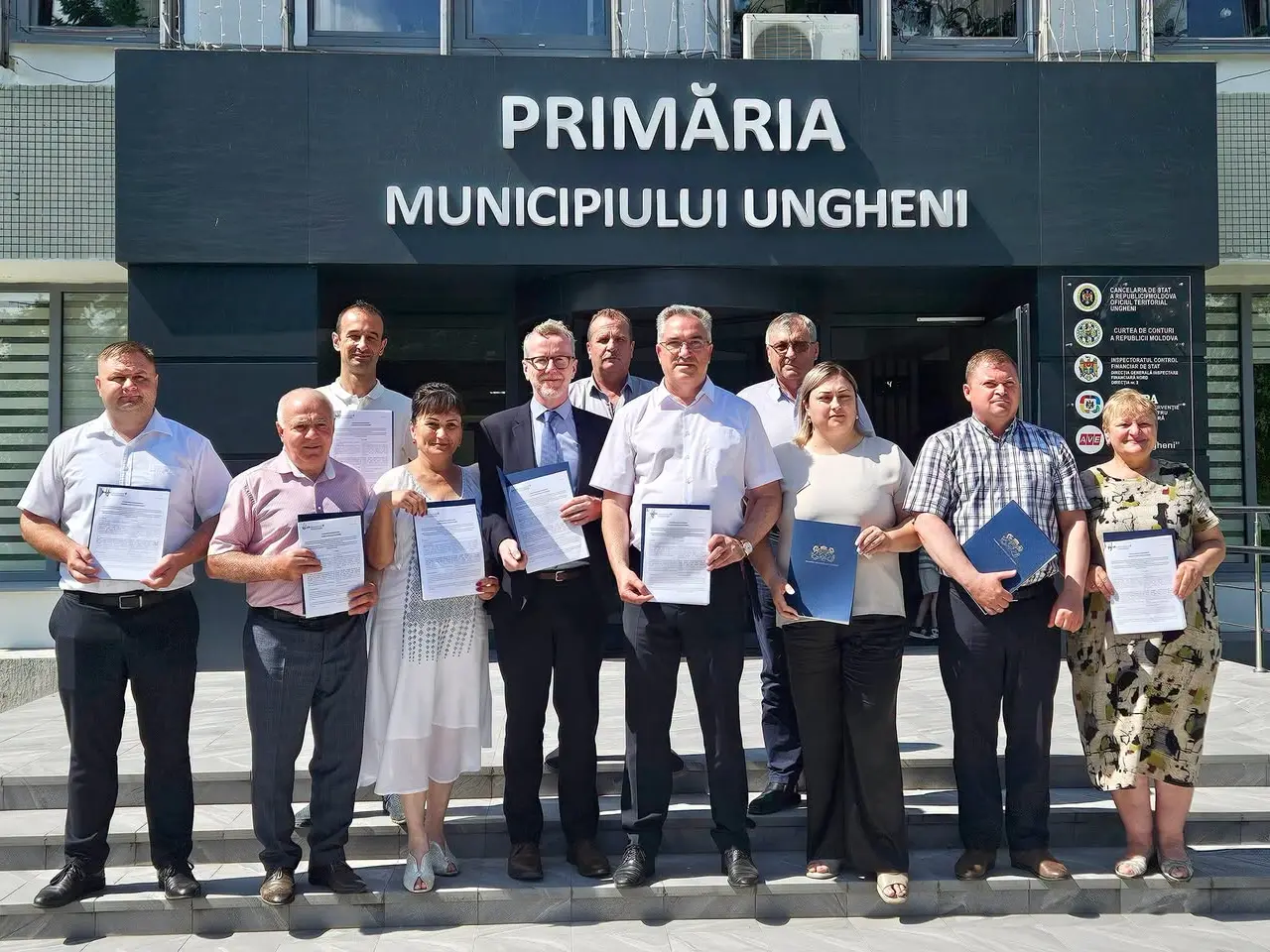
On 24 June, the mayors of the ten localities that want to form a single municipality around Ungheni signed a framework cooperation agreement with SALAR International — the Swedish organisation running the «PACE Local» project in the Republic of Moldova. The agreement brings external, Swedish-funded support for preparing the voluntary merger and for improving local public services.
It is a new step in a process we described when it was initiated earlier this month: the municipality of Ungheni and nine surrounding localities — one of them, the Brătuleni commune, even from the Nisporeni district — are to become a single city hall of around 44,000 inhabitants. Public consultation on the project closes on 29 June, and the merger decision has not yet been voted.
Who SALAR International is and where the money comes from
SALAR International is the international arm of the Swedish Association of Local Authorities and Regions — the body that brings together Sweden’s municipalities and regions. In Moldova it runs the «PACE Local: Local Public Administration, Citizen Engagement» project, which runs in 2025–2029 and is funded by the Swedish International Development Cooperation Agency (Sida). The project was launched in Chișinău in September 2025, supports the national Public Administration Reform Strategy and Moldova’s European path, and its partners include the State Chancellery and the Congress of Local Authorities (CALM). The Ungheni agreement was signed, on the organisation’s behalf, by Shane Quinn, the team leader of the project.
This, then, is Swedish money added to the incentive promised by the Moldovan state for merging — the 3,000 lei for each inhabitant of the new municipality. The formula in the Voluntary Amalgamation Methodology has two terms, however: to the population multiplied by 3,000 lei is added a second term, which grows with the number of town halls in the group and which, for groups with a centre of more than 10,000 residents, is calculated on the population outside the centre. For the ten units — 42,316 residents as of 1 January 2024, of whom 26,458 in the municipality — the development incentive comes to 150,911,700 lei, by the newsroom’s calculation; with the preparation transfer (600,000 lei) and the support for local budgets (2,000,000 lei a year for three years), the package reaches 157,511,700 lei.
What the agreement brings, concretely
According to City Hall, SALAR International’s support could reach a total of up to about 80,000 euros and covers several concrete strands:
- the development strategy of the future merged city hall, the main planning document of the new entity, plus a Sustainable Energy and Climate Action Plan (SECAP) — the document through which European city halls set emission-reduction targets;
- CUPS offices — Unified Public Service Delivery Centres, or “one-stop shops”, where people can handle several public services in one place — to be set up and equipped in selected localities of the new unit;
- public consultations, information support and legal assistance for the process;
- energy audits and technical projects to modernise the schools in Semeni, Unțești and Brătuleni.
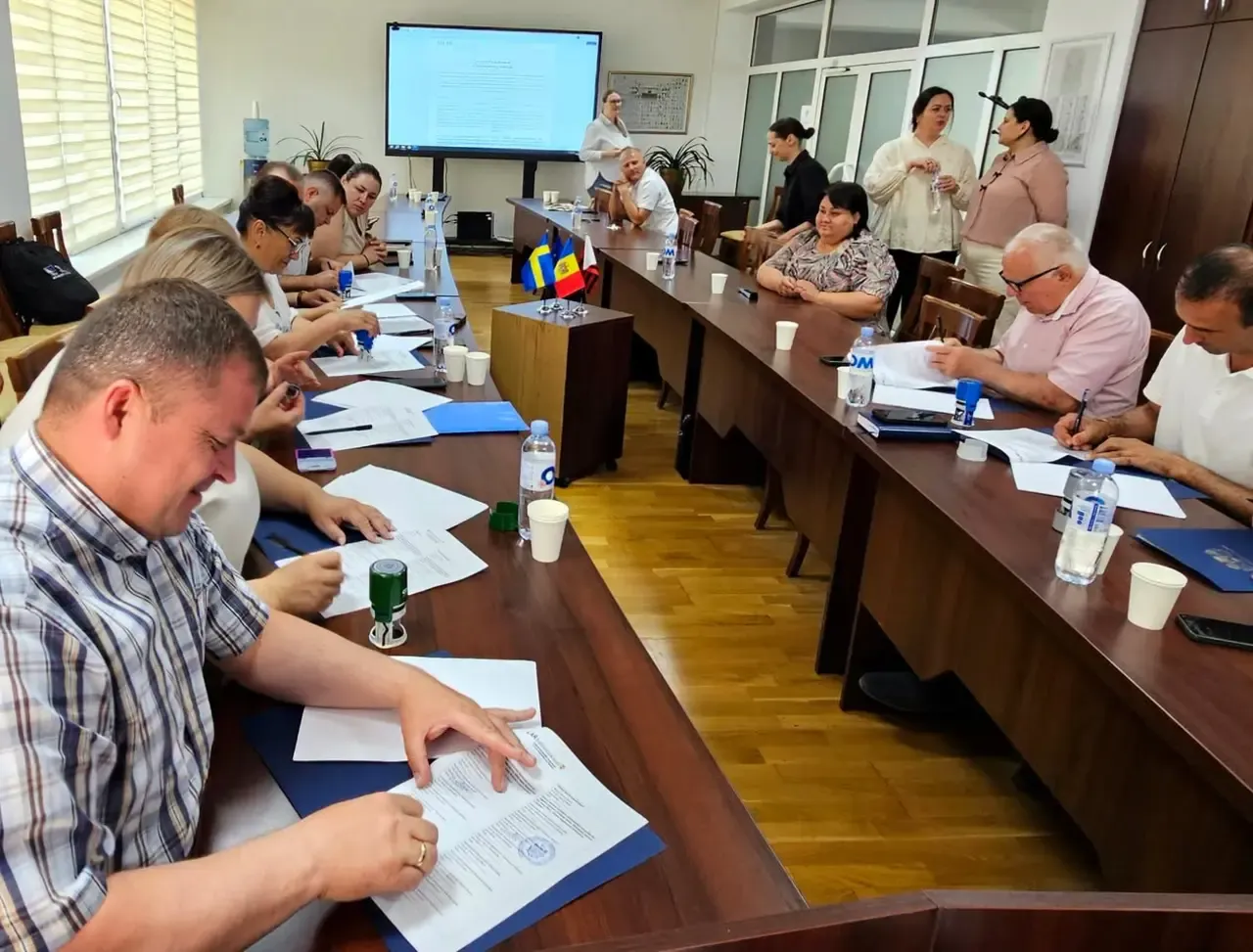 The signing of the framework agreement, in the City Hall meeting room. Photo: Ungheni City Hall.
The detail about the schools shows how the project reaches down to village level. Semeni, for instance, does not appear on the list of ten units as such — because it is a village of the Zagarancea commune, which is on the list. And the building of the former school in Semeni has already been the subject of a technical survey by the Zagarancea city hall, in June — exactly the kind of target an energy audit would address.
The support comes before the decision
One thing is worth stating plainly: the assistance agreement is signed before the merger has been approved. The process has only been formally initiated by the local councils; the consultation with citizens closes on 29 June, and the actual vote of each council — the moment that shows how voluntary the merger really is — comes afterwards. The technical support, then, precedes the decision: it is precisely what helps prepare the strategy and the consultations on which the communities are to have their say.
At the signing, Ungheni mayor Vitalie Vrabie urged those present to “stay united and move forward” and said other donors had already been identified, to be worked with later. The SALAR International representative, Shane Quinn, gave assurances that the project would provide the support needed for the planned activities.
For the residents of the ten localities, the stakes remain those we flagged at the start of the process: where the new city hall will sit, how people from the small villages will reach services, and whether the merger will be validated through a genuine consultation. The Swedish agreement brings the tools and part of the money; the substantive decision remains with the citizens and their councils.
The details of the signing, the content of the support and the figure of up to about 80,000 euros come from the official announcement by Ungheni City Hall; the figure is City Hall’s estimate for the local agreement and does not represent the total budget of the «PACE Local» project. The identity of SALAR International, the «PACE Local» project and the Sida funding were verified on the organisation’s official channels. The status of the amalgamation — a process initiated but not yet approved, with public consultation until 29 June — is confirmed by the Ungheni Municipal Council’s decisions in the State Register of Local Acts; the same source confirms that Semeni village belongs to the Zagarancea commune, which is on the merger list. The definitions of CUPS and SECAP come from official sources (the e-Governance Agency and the EU Covenant of Mayors respectively). The development incentive sum is calculated by the newsroom with the formula in point 114 of the Voluntary Amalgamation Methodology, approved by Government Decision No. 925/2023 (Monitorul Oficial No. 472-473 of 8 December 2023, art. 1155) and amended by Government Decision No. 269 of 27 May 2026, on the usually resident population published by the National Bureau of Statistics as of 1 January 2024.
Correction — 6 August 2026
In the original version of this article we wrote that the incentive for the future municipality would amount to “over 130 million lei”, by “the newsroom’s calculation on the official formula”. The figure was wrong, and the error is ours: we applied only the first part of the formula.
The formula in point 114 of the Voluntary Amalgamation Methodology — approved by Government Decision No. 925/2023 and published in Monitorul Oficial No. 472-473 of 8 December 2023 — has two terms. The first is the population multiplied by 3,000 lei, the only one we applied. The second grows with the number of town halls in the group and, where the centre has more than 10,000 residents, is calculated on the population outside the centre. For the group around Ungheni — ten units, 42,316 residents, of whom 26,458 are in the town — the second term adds almost 24 million lei.
The development incentive therefore comes to 150,911,700 lei, and the full package, with the preparation transfer and the support for local budgets, to 157,511,700 lei. The passage has been corrected.
It is the same error we made in three other articles about amalgamation money, corrected on 5 August. The calculation uses the usually resident population published by the National Bureau of Statistics as of 1 January 2024 — 42,316 residents. The “about 44,000” estimate elsewhere in the article is the June one, rounded; we have left it as it stands, because that is how it was published. We correct our mistakes in public.