
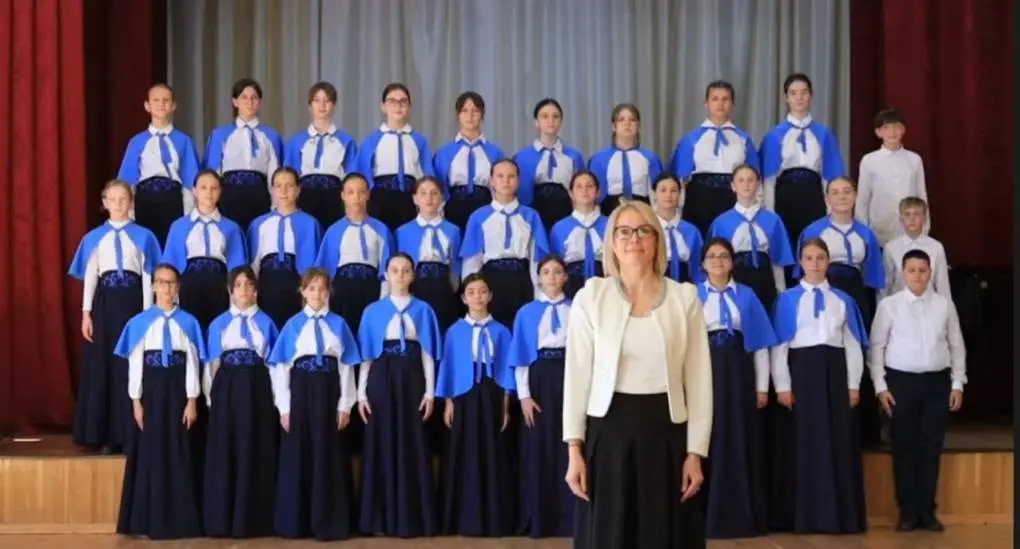
A hall with heavy velvet curtains, a few dozen children in blue capes, and a conductor raising her hands. From this frame — filmed on a stage in Ungheni — came the recording that, on Sunday, 12 July, brought the town’s Music School the best news of the summer: the «Elegie» children’s choir won the Grand Prize at the Elite International Arts Competition 2026.
The news was announced by the school itself, in a post on its Facebook page, accompanied by the competition’s official award card, which states in plain letters: «Grand Prize · Elegie choir · conductor Ala Beleac». The congratulations were addressed to the senior-class choir, its conductor Ala Beleac and its concertmaster Liudmila Melnic.
Through talent and dedication, you have represented our institution with honour and proved that excellence is the fruit of sustained work and love for music. Ungheni Music School, from the congratulatory announcement

What, exactly, this prize is
The name sounds imposing, so it is worth stating plainly what the children actually won — without belittling it, but without inflating it either.
The Elite International Arts Competition is a first-edition contest, held in 2026, that runs entirely online: participants submit video recordings, judged by a jury, with no gala on a stage. It was started by two people from the commune of Telciu (Bistrița-Năsăud county, Romania) — music teacher Cristina Vlașin, a graduate of the «Gheorghe Dima» Academy in Cluj, and writer Gelu Vlașin — with a stated mission: to encourage children who study the arts, including those in the diaspora and those who «do not have the chance to step onto a stage». The contest has sections for music (vocal and instrumental), theatre, fine arts and original creations.
The phrase «Romania, July 2026» in the announcement therefore refers to the organizers’ country and to the month the winners were announced — not to a trip by the choir. It is a young distinction, earned remotely, through a recording — not a title at a choral competition with internationally federated tradition and recognition, such as the world choir games. But that does not change the essential thing: behind a good recording lie months of rehearsal, tuning, discipline and the emotion of dozens of children singing together. The prize is a real, deserved encouragement — and, for a small town, a good reason for pride.
A choir that is not making its debut
«Elegie» is not a name that appeared overnight. Beyond the school’s own channels, the children’s choir is listed among the participants of the «A ruginit frunza din vii» International Choral Music Festival-Competition, entered there as «Corul de copii «Elegie», or. Ungheni, dirijor Beleac Ala». In other words, it is an ensemble with public appearances at choral festivals, not a one-off formation.
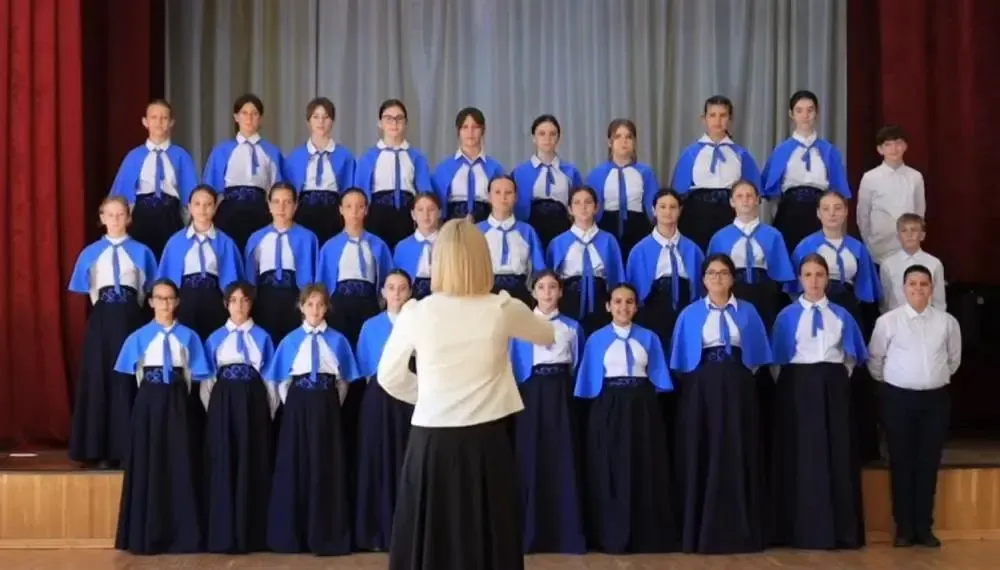
How many children sing in «Elegie», at what ages and with what repertoire — these remain, for now, details the school keeps on its social-media pages rather than in an independent public source. What is clearly visible in the images the school published is one thing: an orderly, disciplined choir in rows, in blue capes and white shirts, led by a conductor who works the gesture to the last phrase.
A school of nearly six decades
The choir belongs to the Music School of Ungheni municipality — one of the two pillars of the town’s arts education, alongside the «Raisa Cojocaru» Fine Arts School. (They are separate institutions — the first teaches music, the second drawing, painting and sculpture.) The Music School operates at 3 Alexandru cel Bun Street and is run by director Tereza Cazac, according to Ungheni Municipality, which lists it among its cultural institutions.
It is an old institution: the 60th anniversary of its founding was marked in 2023, which places the school’s beginnings around 1963. Its place in the town has also been fixed toponymically — in March 2025, the Ungheni Municipal Council gave the square near the school the name «Mihai Eminescu Square».
What system stands behind a prize
This is where the stake touches every parent in Ungheni directly. A children’s choir’s prize does not come from nowhere: behind it stands an arts-education network maintained from the municipal budget — the Music School, the Fine Arts School and the Palace of Culture. Tuition is not entirely free: the municipality charges a study fee, with exemptions for certain categories, as shown by a Municipal Council decision of September 2025 dedicated precisely to those exemptions.
At the district scale, official statistics count 62 cultural institutions in Ungheni (2025) — culture houses and clubs, libraries, museums. They form the net into which a child who wants to sing, draw or act steps. And it matters doubly, because the district is losing the very resource these institutions cultivate: the number of young people aged 15–29 in Ungheni has fallen by more than half in just twelve years. Every generation shaped «at home» — and every reason to stay — carries weight.
This is not an isolated case of cultural ambition. This year Ungheni opened an office of the World Folklore Union at its Palace of Culture and twinned with the Turkish city of Izmit, while just 21 kilometres away, across the Prut, in Iași, one of the region’s best-known youth choral festivals — «Gavriil Musicescu» — is held, with a section dedicated to children’s choirs. A prize-winning choir from Ungheni thus takes its place within a tradition, not outside it.
How a child joins the choir
For parents who read the news and ask themselves «how do I enrol mine?»: the road starts at the Music School, at 3 Alexandru cel Bun Street (phone 0236 23279), where one can learn about the sections, the enrolment conditions and the fee. After the years at the music school, the natural path in the Republic of Moldova leads to specialised colleges and high schools, and then to the Academy of Music, Theatre and Fine Arts in Chișinău — for those who want to turn a passion into a profession.
For now, though, in Ungheni there are dozens of children who have received, from a jury thousands of kilometres away, confirmation that their work is heard. For a small town, this is exactly the kind of news worth singing.