

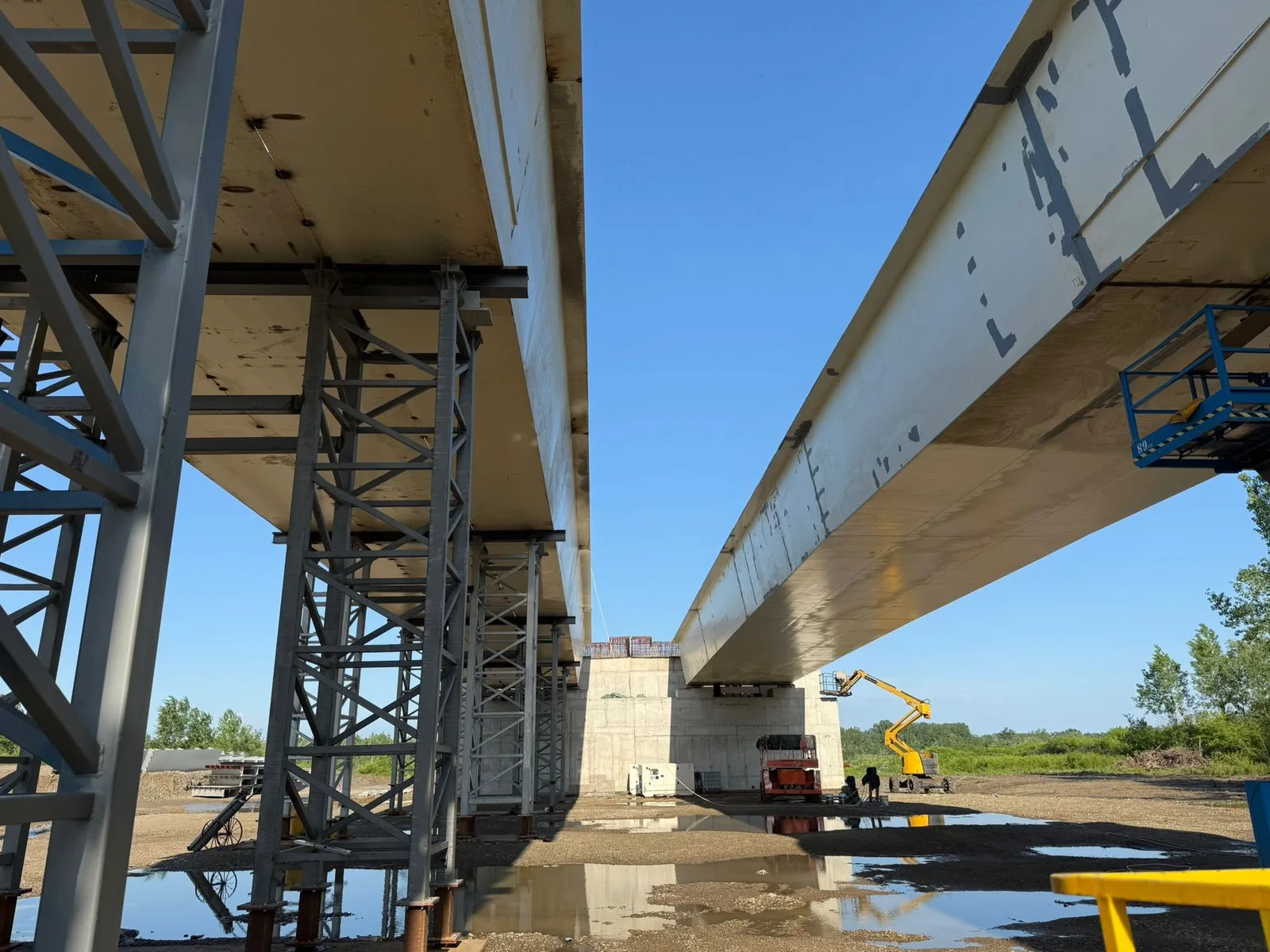
Moldova and Romania have opened negotiations on a new agreement on the development of strategic transport infrastructure, Moldpres reports. The agreement’s flagship project is right at Ungheni: the road bridge over the Prut, now in an active phase of construction and funded by the European Union with €35 million through the Connecting Europe Facility. The new framework is also meant to allow the development of related infrastructure — motorway sections and logistics facilities — but, above all, coordinated border control, explained Angela Țurcanu, secretary general of the Ministry of Infrastructure and Regional Development:
The new agreement will create the framework needed to implement coordinated control at the border.
Angela Țurcanu, secretary general of the Ministry of Infrastructure and Regional Development, quoted by Moldpres
A bridge and a crossing point that have never existed before
The bridge links the Romanian town of Ungheni, in Iași county, with Zagarancea — a commune right next to the town of Ungheni, on the Moldovan bank. There are, in fact, two parallel bridges, one for each direction, totalling 261.2 metres, with a composite steel-and-concrete deck. The contractor is NESS Proiect Europe, the contract is worth 151.68 million lei excluding VAT, and the announced completion date is July 2026. According to the authorities, it is the first motorway-grade road bridge over the Prut in more than six decades.
Work has advanced on both banks. According to an update published by the director of the Iași Regional Directorate for Roads and Bridges (DRDP), Mugurel Ovidiu Laicu, the substructure of both carriageways has been completed on either side of the Prut, and on one of the two structures the steel deck has already been erected; on the second, welding work is next.
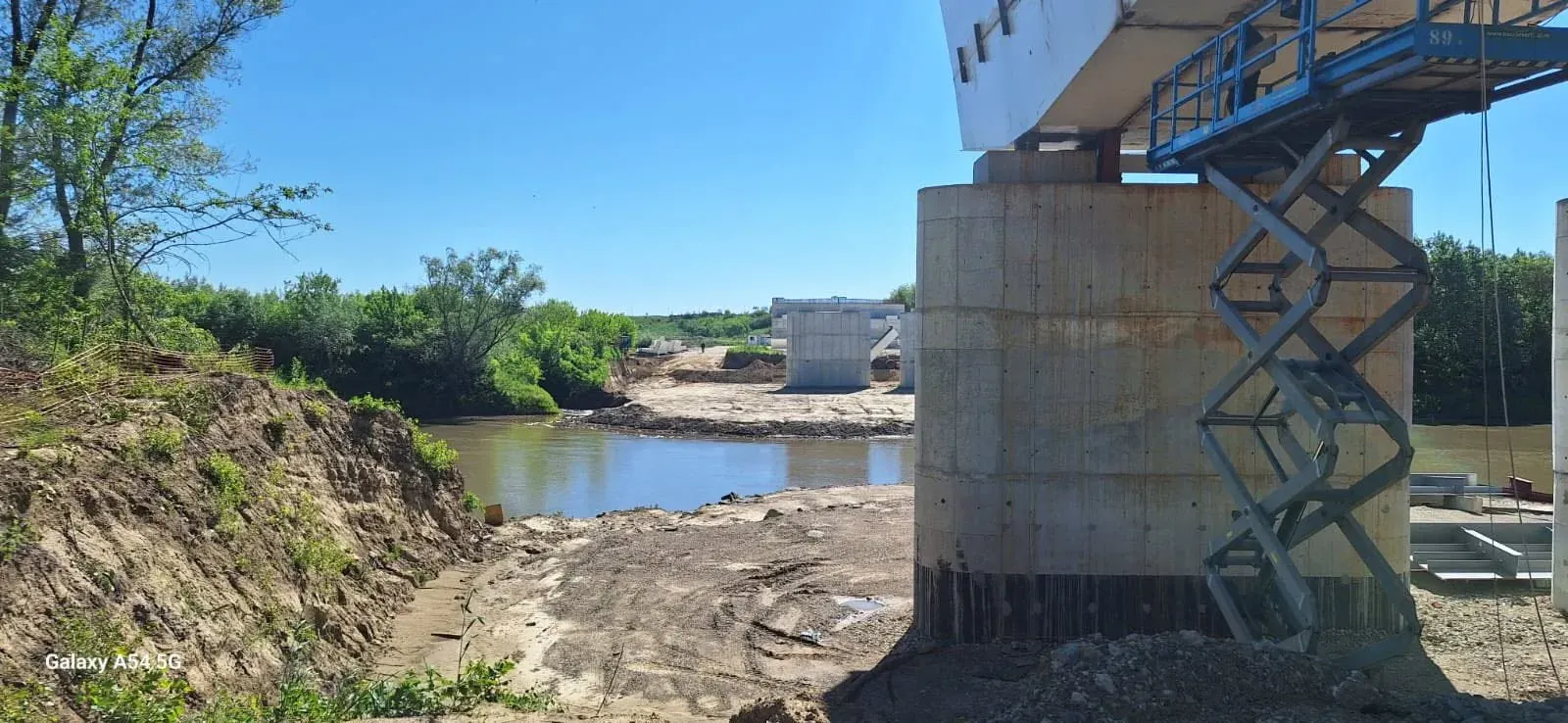
The bridge pier, rising in the bed of the Prut; the far bank in the distance. Photo: DRDP Iași
More important for the people of Ungheni than the concrete, though, is what the bridge opens up: an entirely new border crossing point. On 29 April 2026, the government approved the establishment of the “Ungheni–Ungheni” road crossing, open to international traffic. Its declared role is to relieve the congested crossings at Leușeni–Albița and Sculeni and to cut waiting times. Until now, a driver from Ungheni heading to Romania had to detour through Sculeni, some 15 kilometres to the north; the bridge brings the crossing into the town itself.
The bridge comes before the roads that are supposed to feed it
This is where the less festive part begins. A bridge only makes sense connected to a network, and the network is running late on both banks.
On the Romanian side, the bridge is supposed to connect to the Union Motorway A8 (Târgu Mureș–Iași–Ungheni). Of the motorway’s nearly 287 kilometres, more than 110 are under construction, but the very last stretch reaching the Prut — the Golăiești–Ungheni Bridge section, just 2.77 km long — was still at the bid-submission stage in the summer of 2025. With the usual design and construction timelines, the motorway will physically reach the bridge in 2027–2028 at the earliest. On the Moldovan side, the future Ungheni–Chișinău expressway remains, for now, an objective without confirmed funding — the framework for it is supposed to come precisely from the agreement that has only just been put on the table.
In his update, Laicu goes as far as calling it “kilometre 0 of the A8 motorway”:
This bridge is the first built element of the future high-speed road connection between Romania and the Republic of Moldova, being the starting point of the Union Motorway A8 towards Iași, Târgu Mureș and the European motorway network.
Mugurel Laicu, director of DRDP Iași
It is a phrase that carries its own limit within it: the bridge is “the first built element” — and, for now, the only one. A kilometre zero of a motorway that, beyond the bridge, is only just going out to tender.
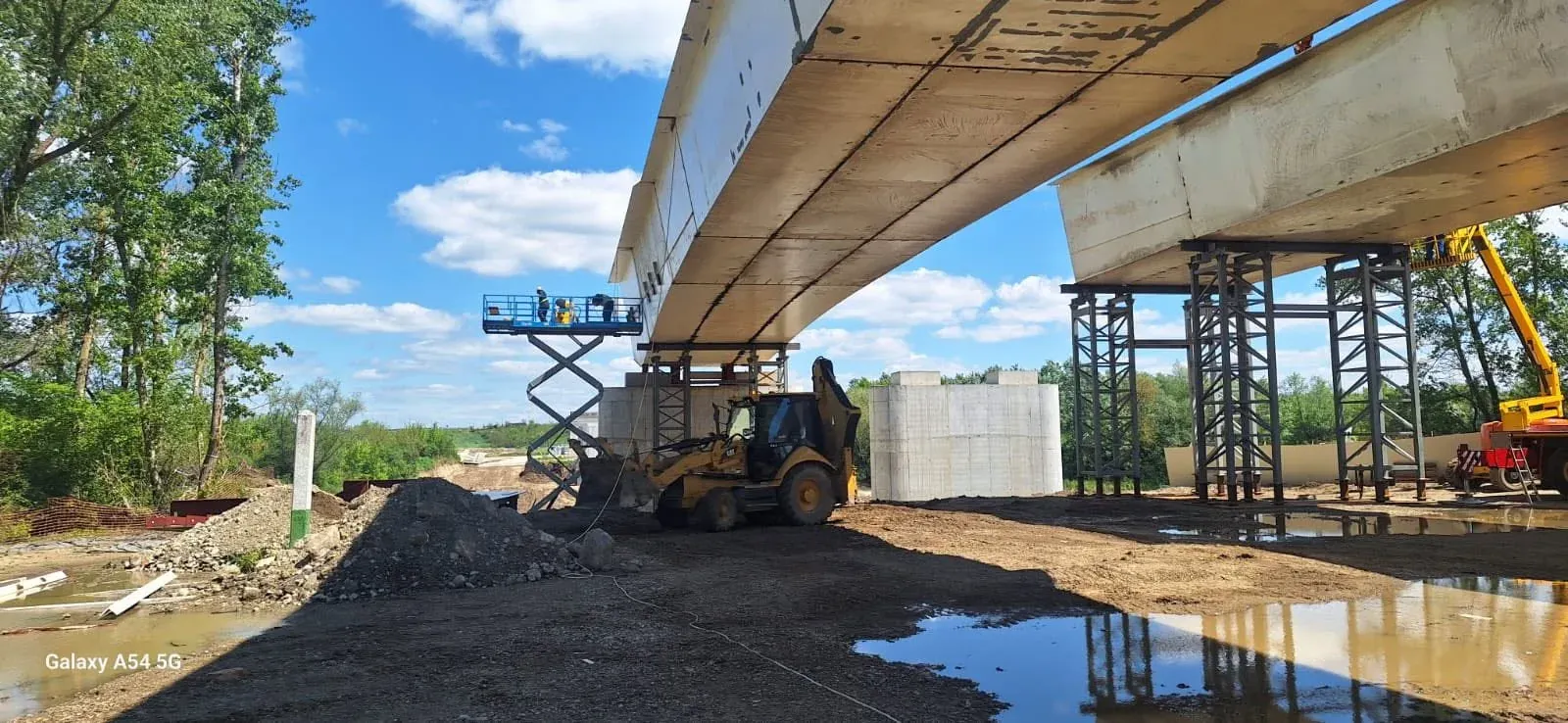
Erecting the deck, on the construction site at Ungheni. Photo: DRDP Iași
In other words, in July 2026 Ungheni could have a modern bridge that, for a while, will link two ordinary roads.
Ungheni, the “socket” through which Moldova plugs into the West
Seen from a distance, the bridge is no accident, but the latest piece in an old pattern: everything that concretely links Moldova to Romania tends to pass through Ungheni.
On the rails, the town has for a century and a half been the railway gateway to Iași and onwards to Europe — but also the place where trains stop for a unique “technical customs check”: this is where the broad gauge of 1,520 mm, inherited from the Soviet era, meets the standard European gauge of 1,435 mm, so trains have their bogies changed before crossing the Prut. That is about to change: the 25-kilometre Iași–Ungheni line will become the first electrified railway in the Republic of Moldova, with works scheduled between June 2026 and June 2028, again with European money (a €33.8 million grant), for speeds of up to 140 km/h. On the same route, the Ungheni–Iași passenger train was brought back into daily service in January 2023, after disappearing in 2018; it is operated by CFR Călători, with two services a day and a journey time of one hour and 35 minutes.
On the pipelines, the story is identical: the gas pipeline that freed Moldova from its dependence on Russian gas was likewise inaugurated at Ungheni, in 2014, and extended to Chișinău in 2021. In the 2022 crisis, when Gazprom cut deliveries, it was — in the words of former energy minister Victor Parlicov — a “lifeline”, allowing Moldova to buy gas on the European market; since late 2023, the country has given up Russian gas entirely. Gas, railway, and now a road: the same gateway, at Ungheni.
The 1877 bridge and the Eiffel legend
Ungheni is also home to the oldest symbol of the link across the Prut: the metal railway bridge, built in 1874–1876 and used heavily in the Russo-Turkish War of 1877–1878. The town knows it as the “Eiffel Bridge” — a name Ungheni municipal council made official in 2012.
The attribution, however, is disputed. History publications such as historia.ro maintain that the bridge was designed and built by the French engineer Gustave Eiffel. Other sources, including the Wikipedia encyclopaedia, note that the attribution to Eiffel is “erroneous” and that the true author is said to be the Russian engineer Nikolai Beleliubski. The only certainty is the name it has kept in local memory — and the fact that, for nearly 150 years, the thread linking Iași to Chișinău has run through Ungheni.
This article is based on the Moldpres statement, on the government’s decision establishing the Ungheni–Ungheni crossing point and on verified public sources concerning the bridge, the railway and the gas pipeline. The newsroom will ask the authorities for the updated timelines of the works and for traffic data at the new border crossing, and will publish the answers.