
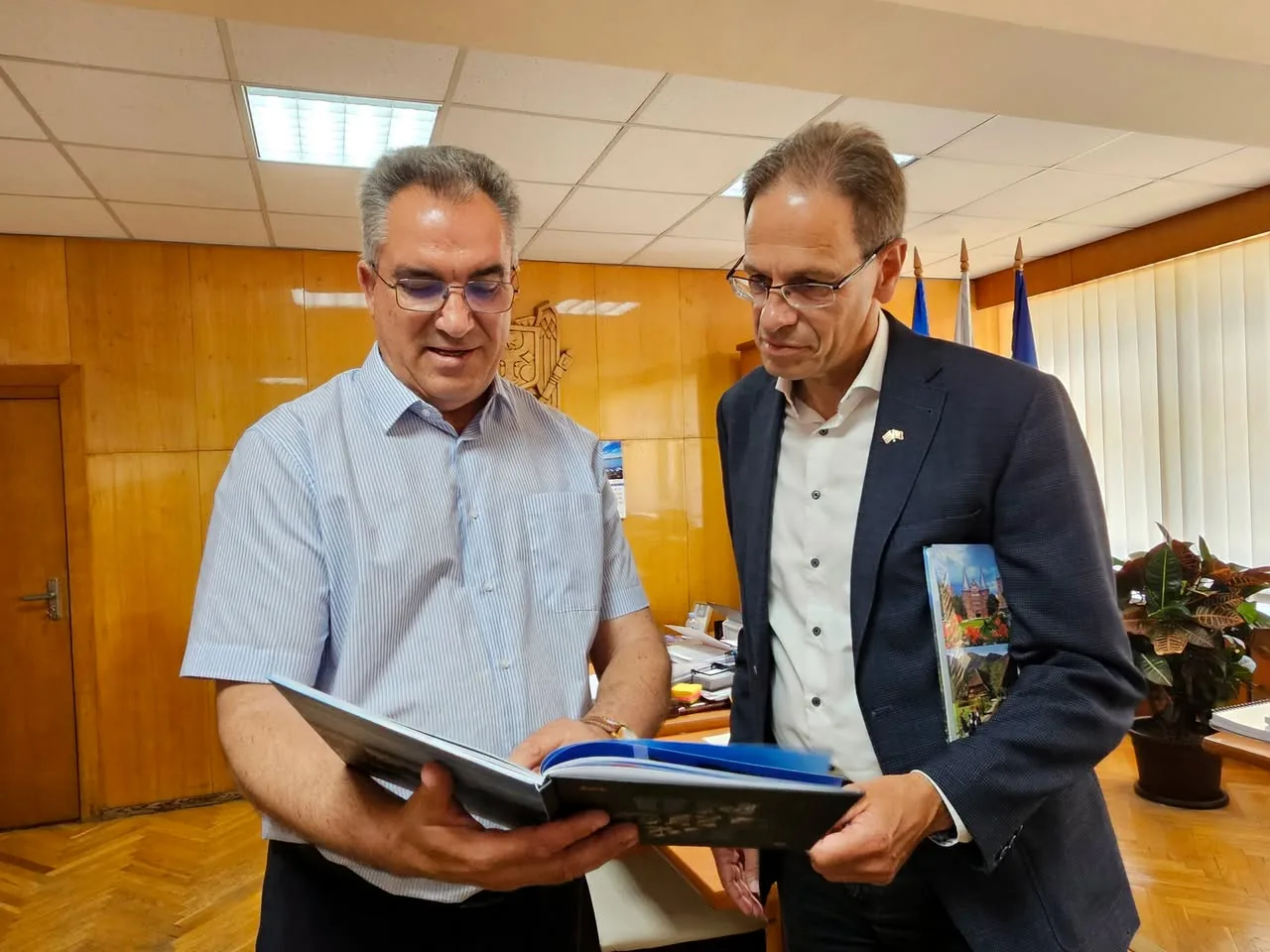
Germany’s ambassador to Moldova, Hubert Knirsch, paid a working visit to Ungheni on 25 June. The next day Mayor Vitalie Vrabie announced the meeting on the City Hall page, calling it “a very good and useful” one, with talks on the town’s achievements and challenges, on the administrative-territorial reform and voluntary amalgamation, and on inter-municipal public services.
So far, a protocol statement. The part worth reading more closely is the balance sheet the mayor drew up for cooperation with Germany — which, checked document by document, turns out to be a little more nuanced than “support from the German government through GIZ,” the phrase he used for almost all of the town’s major projects.
What Germany actually funded
Some of the projects are, indeed, direct German money, through GIZ — the federal technical-cooperation agency that has been present in Moldova since 1994.
The clearest example is water. A City Hall document states that the first phase of the water-and-sewage project was “financed by GIZ in the amount of €2.9 million,” for the rehabilitation of 12.4 km of water mains and the extension of the water network by 5.4 km and the sewerage network by 5.6 km — around 23 kilometres in all. There, the “tens of kilometres” cited by the mayor are backed by the records.
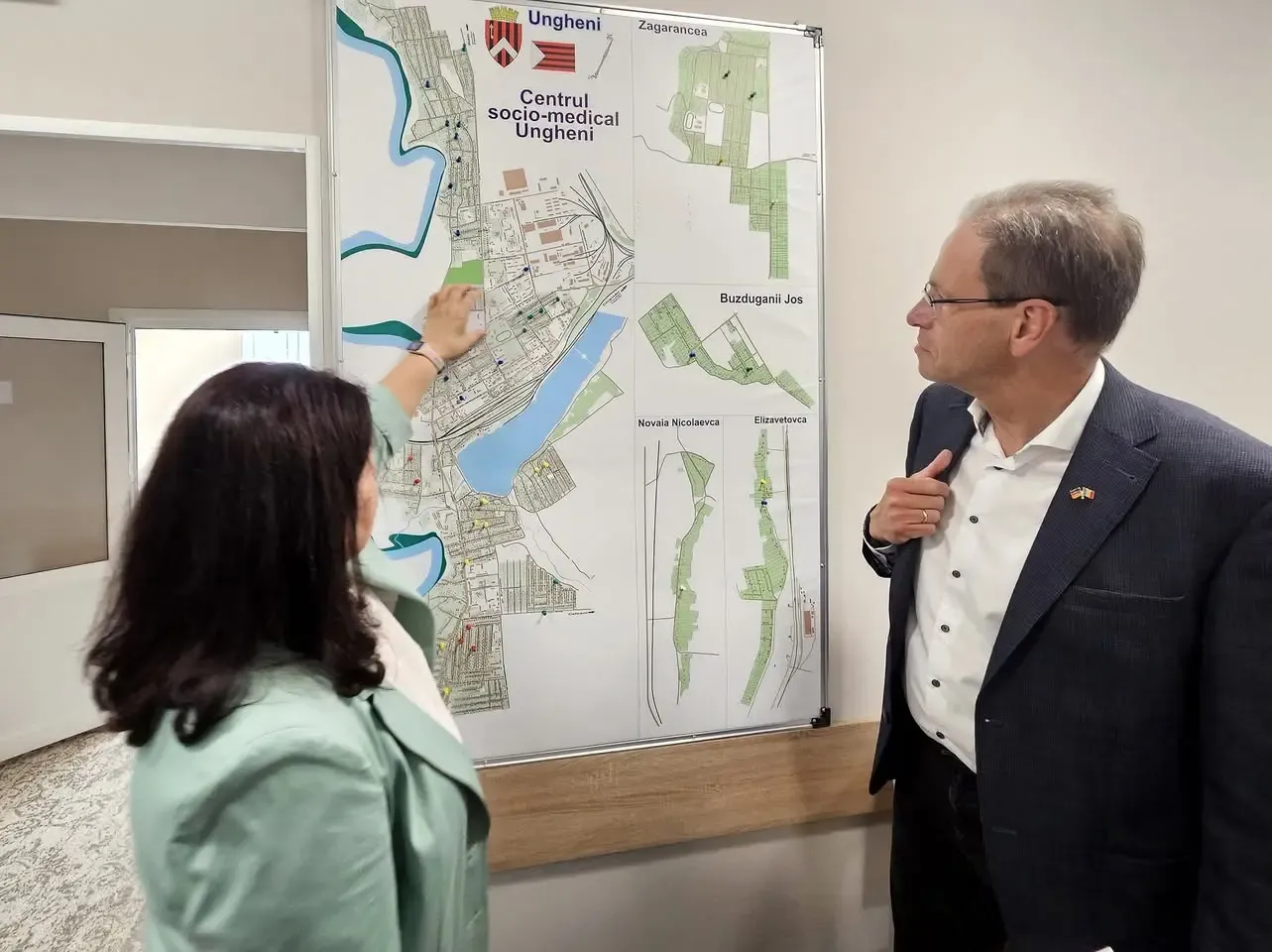
Also direct German funding, through GIZ, is the day socio-medical centre in Ungheni — the very institution the ambassador visited after the meeting. Opened in 2025, the centre was funded by the German Ministry for Economic Cooperation (BMZ) under a project supporting communities that host Ukrainian refugees. According to the government’s official statement, the centre serves at least 20 beneficiaries a day, runs two mobile teams and makes up to 5,000 home visits a year — for the elderly, people with disabilities and bedridden chronically ill patients. The same project brought a digital radiology complex to the District Health Centre and dental equipment to the District Dental Centre.
And what is, in fact, European money
This is where the nuance comes in. Two of the achievements that local rhetoric usually puts on Germany’s account are, in fact, funded by the European Union — with GIZ merely the agency that carried out the works.
The rehabilitation of the Mihai Eminescu Lyceum — over €2.67 million for windows, thermal insulation, LED lighting, heat-recovery ventilation and photovoltaic panels — is an EU-funded project delivered through the “Modernisation of Local Public Services” (MSPL) programme that GIZ runs, and in which Ungheni is one of the country’s six growth poles. Likewise, the extension of the water and sewerage networks “benefiting over 34,000 residents” is described in official statements as a contribution by Germany in partnership with the EU — that is, European money, with Germany alongside.
The distinction is not an accountant’s quibble. It matters precisely for the subject put on the table at the meeting: inter-municipal public services. The body that already coordinates them in Ungheni — the Inter-Community Development Association, with 23 communities and over 80,000 residents, which modernised the “Apă-Canal Ungheni” and “AVE Ungheni” operators — is funded by the EU under the “EU4Moldova: Focal Regions” programme (€23 million), implemented by UNDP and UNICEF, not by Germany.
Where this is heading
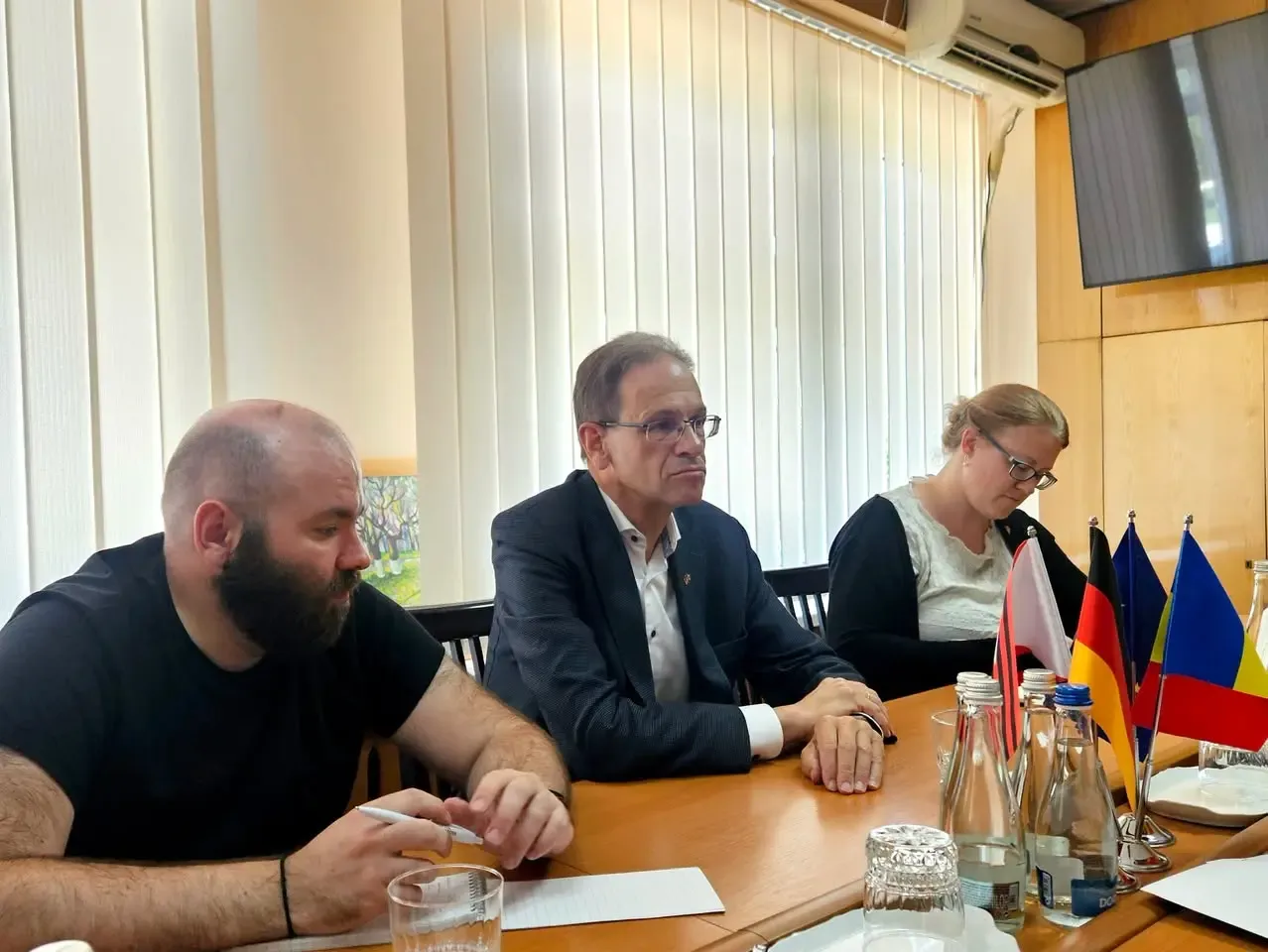
Knirsch did not come merely to cut a ribbon. According to City Hall, the ambassador said he was impressed by what he saw at the centre and noted that the mayor and his team “have a clear vision,” and the two sides agreed to meet again on possible partnerships, chiefly on inter-municipal public services.
On this ground, Germany does have something to build on. In November 2025, the same ambassador announced a €24.4 million German grant for Moldova, of which €14.4 million is technical assistance through GIZ — explicitly, for “local services” too. If part of that money reaches the Ungheni region, it would coincide with the moment when the town and nine more localities are preparing to merge into a single city hall of about 44,000 residents, through the voluntary amalgamation now under public consultation.
The 25 June visit was, in fact, only one of the day’s German stops in Ungheni: at the same time, the AlgaVet social veterinary clinic signed a separate partnership with the German Embassy under the “small projects” programme (up to €25,000) — a different instrument from GIZ’s technical cooperation.
The account of the meeting and the visit to the centre comes from Ungheni City Hall, an interested party; at the time of publication, the German Embassy and GIZ Moldova had not publicly given their own version of the visit. The funding figures come from independent official documents and statements: the City Hall document on water and sewage (the GIZ phase, €2.9 million), the government statement on the day socio-medical centre (German funding, BMZ/GIZ), the MSPL programme pages on the Mihai Eminescu Lyceum (EU funding) and the UNDP statement on the Inter-Community Development Association (EU funding). The local names for the centre vary (“Social Rehabilitation and Care Centre,” “day socio-medical centre”); we refer to the institution opened in 2025 with German support. The €24.4 million grant was announced in November 2025 and is cited here as context, not as an event on the day of the visit.