

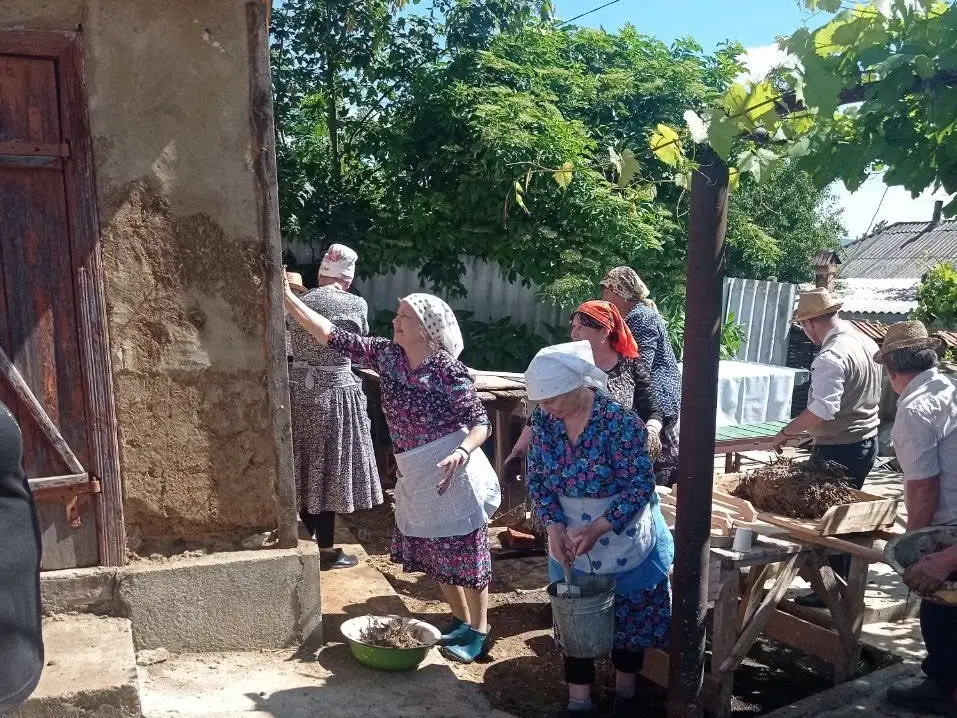
The smell of clay mixed with straw, hands covered in mortar, and the wall of an old house coming back to life: on 13 June, in the yard of the „La Prispa lui Vasile” house-museum in Florițoaia Veche, the village worked as it once did. Women in aprons and headscarves kneaded the clay with straw and spread it on the wall, while others carried buckets and mixed the mortar — a clacă, that very communal, voluntary labour for which, in the old days, neighbours and relatives would gather to get a hard job done together.
This time, the job was the restoration of a museum annex. The event was organised by the Ungheni Culture Section, the „Țărăncuța” folk ensemble and the Florițoaia Veche town hall, which described it as a living lesson in heritage.
Ancestral traditions, brought back to life through work and soul.
Ungheni House of Culture
A technique from their grandparents’ time
Plastering walls with clay mixed with straw is the traditional finish of the adobe and wattle houses of the Moldovan village — a technique today’s generations rarely see at work. The clacă brings it back not as a museum piece but as real labour: people learning, gesture by gesture, how the clay mortar was prepared and applied, how the wall was smoothed.
The „La Prispa lui Vasile” house-museum was opened in 2024 by Lidia Bolșoi, leader of the „Țărăncuța” folk ensemble, in an old house in Florițoaia Veche. Since then the place has become a small centre for preserving the village’s traditions — and a clay-plastering clacă fits that purpose naturally.
Why it matters, beyond one wall
The gesture carries a stake that goes beyond a repaired annex. Ungheni district has lost almost a quarter of its population in a single decade — from 96,292 inhabitants in 2014 to 74,507 in 2025, according to preliminary National Bureau of Statistics data. Nationwide, the 2024 census counted 176 villages with fewer than a hundred people.
Against this backdrop, every old house saved and every craft kept alive weighs more. A clacă in Florițoaia Veche will not change the demographic figures, but it shows that, where people gather, tradition does not stay only in the museum display case — but in the hands of those who make it.