

The Ungheni Police Inspectorate has opened, between the start of 2026 and July, 17 criminal cases related to drugs — already more than the 12 in all of 2025. The figures come from an official reply to a public-interest request, signed on 20 July by the head of the inspectorate, chief commissioner Vasile Burlacu, and they offer for the first time a raion-level picture of a phenomenon that is usually reported only from Chișinău.
The document answers questions put by the newsroom after the case of an 18-year-old from Ungheni, detained as a “courier” for a drug shop on Telegram. It is a dry list of figures and articles of law, but three things can be read from it: how big the problem in the raion actually is; who the people are who end up in the statistics; and where the police themselves admit that the classic methods are no longer enough.
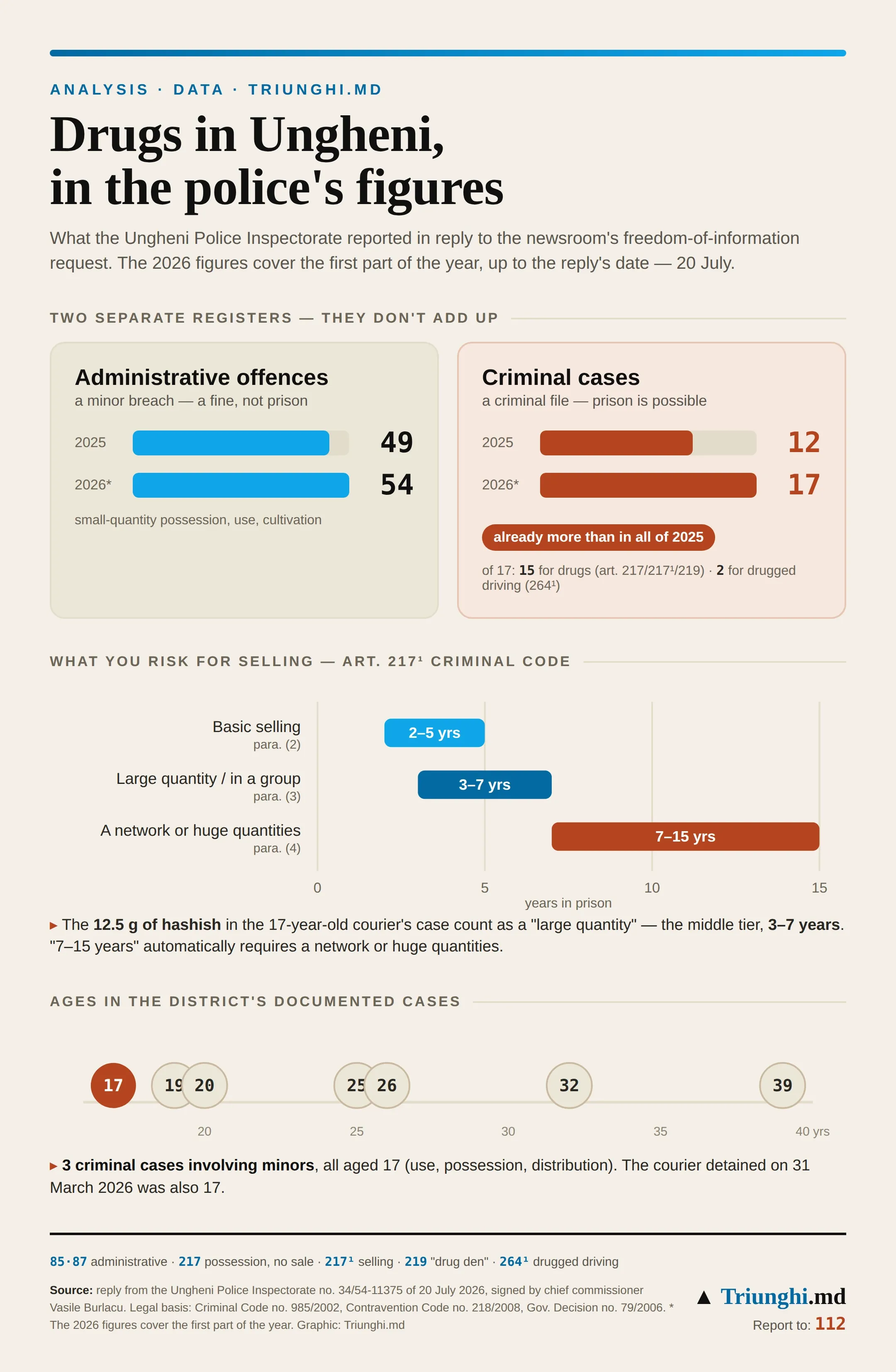
Drug enforcement in Ungheni raion in 2025 and the first part of 2026. Graphic: Triunghi.md. Source: reply from the Ungheni Police Inspectorate, 20 July 2026.
The raion’s figures, on two different registers
The first distinction that has to be made — because otherwise the figures get added up wrongly — is between an administrative offence and a crime. They are not the same thing, and the law treats them separately.
An administrative offence is the minor violation: it is punished with a fine or community service, not with imprisonment. In the drugs field, it covers small quantities for personal use (art. 85 of the Contravention Code — a fine of 1500–3000 lei or up to 72 hours of unpaid work) and the illegal cultivation of plants (art. 87 — a fine of 2100–3000 lei for a natural person). Here, the raion’s figures look like this:
- 2025: 49 reports — 42 for possession in small quantities or use, 7 for cultivation.
- First part of 2026: 54 reports — 48 for possession/use, 6 for cultivation.
A crime is the criminal act: a criminal case is opened and imprisonment is possible. This includes trafficking, possession in larger quantities, maintaining a place for use, or driving under the influence of drugs. The figures:
- 2025: 12 criminal cases (under articles 217, 217¹ and 264¹ of the Criminal Code).
- 2026, up to July: 17 criminal cases — 15 under articles 217, 217¹ and 219, plus 2 under article 264¹.
In other words, the two numbers do not add up: 49 administrative offences and 12 crimes in 2025 do not mean “61 drug cases”, but two legal categories counted separately. And the rise from 12 to 17 criminal cases, in only half a year, comes from the same source and uses the same counting method, so the comparison is valid: the raion’s criminal caseload is growing.
To these are added 26 files under management, awaiting the results of forensic examination — cases “on pause”, which the police describe as having “a prospect of criminal cases being opened”. In other words, the real picture could be larger than the figures above.
What the articles of law in the reply mean
The reply is dotted with article numbers. Translated, they show exactly what kinds of acts hide behind the statistics:
- Art. 217 of the Criminal Code — the illegal circulation of drugs without the purpose of distribution (possession, transport, acquisition for oneself, not for sale). It is punished relatively mildly: it starts from a fine or unpaid work and rises to imprisonment only in aggravated forms.
- Art. 217¹ — the same acts, but for the purpose of distribution, that is, to pass them on. This is the heavy article: the penalty runs from 2–5 years for a simple sale up to 7–15 years when the offence is committed by a network or involves especially large quantities. We explained the full mechanism — and why it hits hardest precisely the bottom link, the courier — in the article about the Telegram case.
- Art. 219 — organising or maintaining a place for drug use (a “drug den”, in the term used by the law). It appears in the 2026 statistics, but not in those for 2025.
- Art. 264¹ — driving a vehicle under the influence of narcotic or psychotropic substances, an act punished with unpaid work and the revocation of the driving licence. Its presence in the “drugs” list is a detail worth remembering: some of the criminal cases do not concern selling, but drivers stopped for driving under the influence of drugs.
This last nuance explains why “drug criminal cases” are not all about traffickers: the same category also includes the user caught behind the wheel.
Who ends up in the statistics: 17, 19, 20 years old
The reply also lists a few concrete cases, documented by the raion’s police officers. All the people are described only by age and locality, without names, and — with the exception of a single conviction — they are at the criminal-investigation stage, meaning they benefit from the presumption of innocence.
The common denominator is their young age:
- 14 January 2025 — a 19-year-old from the municipality of Ungheni, detained while placing drugs in stashes; 52 envelopes taped shut, shown by forensic examination to be hashish and LSD. He was convicted by the first-instance court to 3 years suspended.
- 31 March 2026 — a 17-year-old, whom the police describe as a “courier” and who, they say, allegedly intended to place 17 small packets; the total mass seized — 12.5 grams of hashish.
- 16 April 2026 — a 20-year-old (0.45 g), two people aged 25 and 26 (1.68 g) and a 32-year-old man (34 g).
- To these are added 3 criminal cases involving minors, all aged 17 — one each for use, possession and distribution.
This is exactly the pattern described in the Telegram case: the role filled with young people, sometimes minors, is the one at the base of the chain — the one who carries, hides and places the package, that is, the one easiest to catch and to replace. The 12.5 grams of hashish in the case of the 17-year-old courier fall, according to Government Decision no. 79/2006, into the “large quantities” category — not “especially large”, a threshold that begins only at 50 grams.
The Telegram network and the limits of “on the ground” work
The largest case in the reply is the one documented over the period 2024 – February 2025 and concluded on 16 May 2025: a group of people originating from Ungheni raion who, according to the police, handled the acquisition, storage, transport and distribution of drugs on the territory of the raion through the Telegram app. This is the case we already reported — three people detained, goods valued at over 2.5 million lei.
The current reply adds details about the logistics behind it: during the searches, police seized 3 electronic scales, 5 bank cards, 6 mobile phones, a Ford Fusion car, 22050 lei in cash and drugs of the PVP, marijuana, hashish and mephedrone types packed into 2878 small doses, ready for distribution. The details describe an organised distribution operation, not casual use.
This is also where the most direct passage of the reply comes from — a finding that institutions rarely put into words:
The situation on the ground shows us that the mere presence of a police officer in the field is insufficient; in order to document drug-related offences, the involvement of modern technology becomes necessary.
Vasile Burlacu, chief commissioner, head of the Ungheni Police Inspectorate
It is an acknowledgement that a trade moved onto encrypted apps, with stashes and online payments, can no longer be documented with street patrols alone. The same logic explains why the police do not break the problem down by locality: it “cannot be assigned to any one region”, the inspectorate writes, but is one “at the level of the raion, the country”.
Prevention in schools
On the prevention side, the reply lists a substantial volume of activity. In 2025, as part of a joint plan by several institutions, police officers held information sessions in 26 educational institutions in the raion, where 1672 pupils were instructed; 19 coordination meetings were organised, 27 meetings of the multidisciplinary teams for children at risk, and 57 field visits. In the first part of 2026, the information sessions continued in 21 institutions, with 920 pupils.
These are figures about the volume of activity — how many sessions, how many pupils, how many teams — distinct from the actual outcome, which a list of activities cannot show. One marker of outcome does appear, however: in 2025, two minor drug users were identified and placed on record.
As for the “more than 400 police officers with psycho-pedagogical training” announced in the joint plan of the ministries of Internal Affairs and Education, how many are allocated to Ungheni raion and from what point is not public information: their distribution is decided at the national level and does not appear at raion level.
The “Anti-Drug” operation, through August
On 18 June 2026, the inspectorate approved the plan for the “Anti-Drug” operation for the territory of Ungheni raion, running over the months of June–August, with an emphasis that includes the online environment. In parallel, the police say they have created 100 mixed teams, with 260 staff, working daily to detect people who transport or sell drugs.
Reports about drug use or sales can be made by calling 112. The structure that handles such cases in the raion is the Ungheni Police Inspectorate, headed by chief commissioner Vasile Burlacu — the same person who signed the reply from which this article starts.