
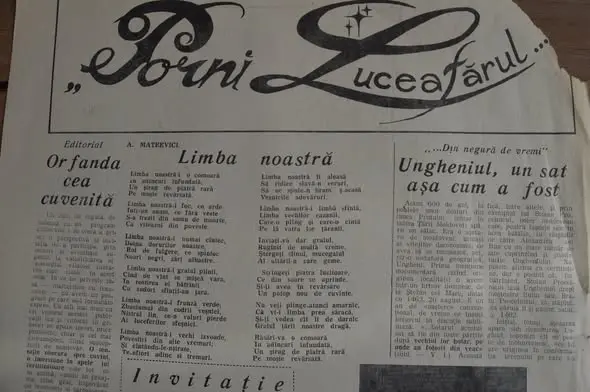
On August 31, 1990, the first Language Day, a supplement appeared in Ungheni with a title taken from Eminescu: “Porni Luceafărul”. It was the first publication in Latin script in the Ungheni press. Its four pages were printed as a supplement to the district newspaper “Octombrie” — the organ of the district Communist Party committee. The concept belonged to Ghenadie Nicu; the authors were Ghenadie Nicu and Vasile Iucal.
Scans of all four pages were published on August 31, 2026, 36 years later, by the Museum of History and Ethnography in Ungheni.
What the supplement contained
On the front page of “Porni Luceafărul” — the title in decorative cursive lettering — the centre carries the full text of the poem “Limba noastră” (“Our Language”) by Alexei Mateevici. Four years later, the poem would become the national anthem of the Republic of Moldova.
Beside it, an editorial titled “Orfanda cea cuvenită” (“The Deserved Orphanhood”) and, on the right, a local history article: “Ungheniul, un sat așa cum a fost” (“Ungheni, a village as it once was”), published under the rubric “Din negura de vremi” (“From the mists of time”).
The second page carries a text titled “In memoriam”, signed by Angela Moraru, on the Stalinist repressions and the duty to remember. A quotation from Ion Pillat, reproduced in the same pages, reads: “Orice limbă, la urma urmei, e oglinda sufletului nației care o crează” (Translation by the editors: “Any language, in the end, is the mirror of the soul of the nation that creates it”).
The supplement also contained a page in Russian — a bilingual publication, like the city in which it appeared.
The programme of the August 31, 1990 celebration
In an invitation addressed “Dragi consăteni!” (“Dear fellow villagers!”) — a form of address that speaks to Ungheni’s status as a locality at the time — the supplement published the full programme of the first Language Day:
| Time | What happened | Where |
|---|---|---|
| 9 | Divine service | ”Alexandru Nevski” Church |
| 10 | Blessing of the town | Eminescu, Veronica Micle, Ștefan cel Mare streets |
| 11–12 | Book donation, with authors present | Eminescu — V. Micle intersection |
| 12 | Benediction | Town central square |
| 12 | Literary and artistic programme | Town central square |
| 17–19 | Recital and dances | Improvised stage near secondary school no. 1 |
| 19–21 | Theatre performance | Town central square |
| 21 | Carnival | Town central square |
A full day, from the morning service to the evening carnival.
Why “Porni Luceafărul”
The title is the opening line of the poem “Luceafărul” by Mihai Eminescu — “Porni luceafărul în sus” (“The morning star rose”). A symbol of rebirth, chosen for the first page of a newspaper transitioning from Cyrillic to Latin script.
A year earlier, on August 31, 1989, the Supreme Soviet of the Moldavian SSR had adopted the law on the return to Latin script and the status of state language. On June 23, 1990, Parliament established August 31 as the national holiday “Limba noastră cea română” (“Our Romanian Language”). The “Porni Luceafărul” supplement appeared on the very day of the first celebration.
The newspaper “Octombrie” and the people behind it
The newspaper “Octombrie” was the organ of the district Communist Party committee in Ungheni — the name a direct translation of the Russian “Октябрь” (the month of the October Revolution). Its editor-in-chief was Victor Pîslaru who, according to the Media Ownership Monitor Moldova entry, later worked at “Vocea Satului” and “Vocea”, and in 1997 co-founded the newspaper Unghiul, which is still published today. Pîslaru died in a road accident in Poland.
No biographical details are available in accessible digital sources about Ghenadie Nicu and Vasile Iucal — the supplement’s authors. The museum credits Ghenadie Nicu with the concept.
Original scans of the “Porni Luceafărul” supplement were published by the Museum of History and Ethnography of Ungheni on its Facebook page. Local press from 1990 has not been significantly digitised; the supplement’s existence is confirmed by the institutional source (museum) and the physical document (scans).