
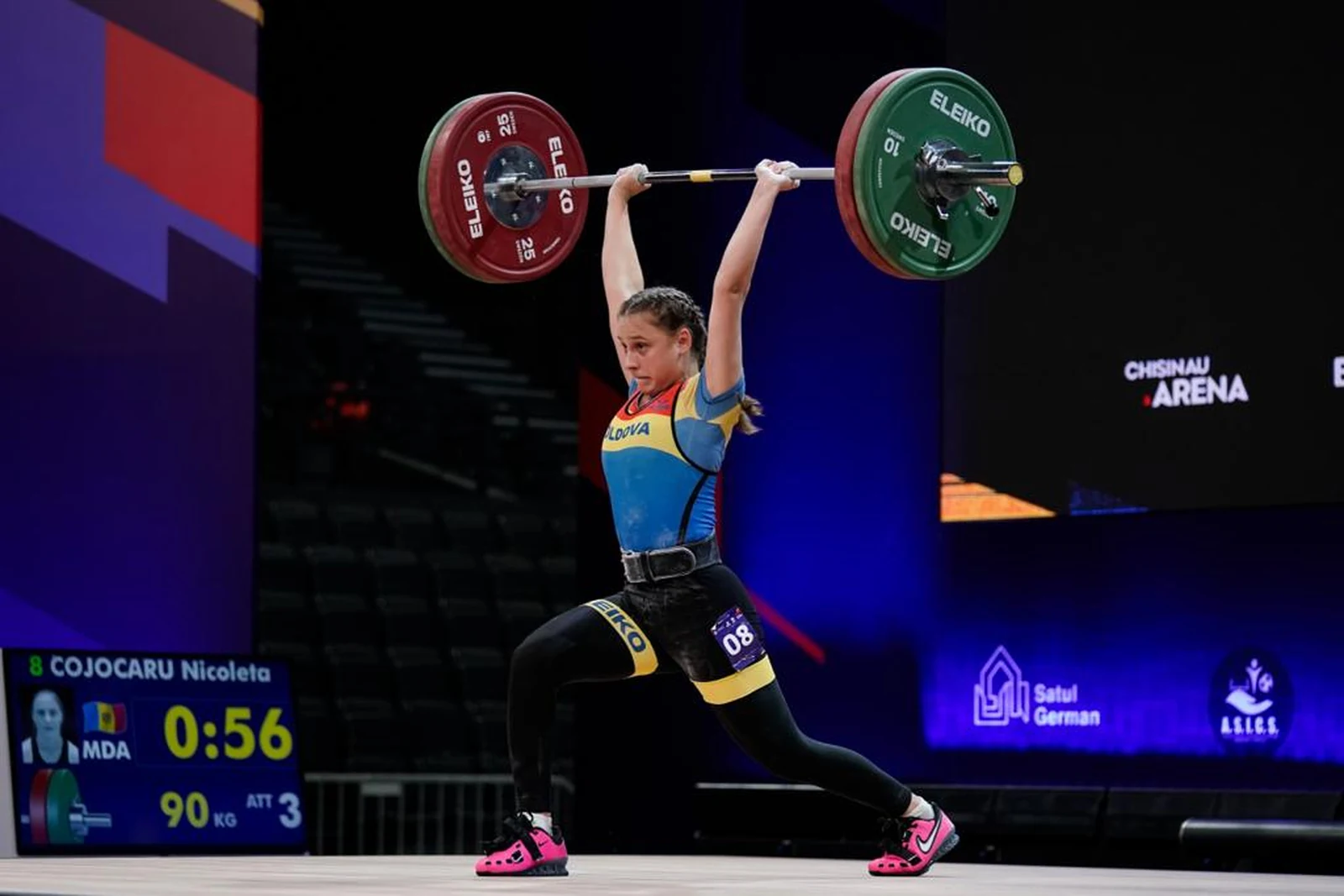
On Wednesday, 8 July, in a competition hall in Cali, Colombia, a 16-year-old from a village of fewer than 1,600 people in Moldova’s Ungheni district lifted more than any other girl in her category on the planet. Nicoleta Cojocaru, from Unțești, won three gold medals at the World Youth Weightlifting Championships and set two world records — at an age when most of her peers are only finishing lower-secondary school.
Her achievement has already been reported by several outlets. What follows here is not, once again, the news that “a local girl won gold”, but what lies behind the numbers: how big the result really is; where her road began; who pays for it; and what tradition it belongs to.
What she actually lifted
Cojocaru competed in the women’s 58 kg category. In weightlifting there are two lifts — the snatch (the barbell is raised overhead in a single movement) and the clean and jerk (the barbell is first brought to the chest, then pushed overhead) — and the total is the sum of the best successful attempt in each. That is why three sets of medals are awarded in every category: for the snatch, the clean and jerk, and the total.
In Cali, Nicoleta Cojocaru took all three:
- 88 kg in the snatch — gold;
- 114 kg in the clean and jerk — gold and a youth world record;
- 202 kg in the total — gold and a youth world record.
She made five of her six attempts (missing only once, at 92 kg in the snatch) and won comfortably: 12 kilograms ahead of the silver medallist, Türkiye’s Ilayda Etugrul. According to the official results database, her Sinclair score — the coefficient that allows athletes from different weight categories to be compared — was 279.43, the best women’s score of the entire competition.
A clarification is in order here, because it is often reported wrongly: this is not a “junior world championship under 17”. Officially it is the World Youth Championships, age category U17. In weightlifting, “juniors” means U20 — a different, older category. So Cojocaru competed at the under-17 age level.
Not one but two records — and, in fact, a full set
Many reports spoke of “a world record”. The official figures of the International Weightlifting Federation (IWF) say otherwise: in Cali she set two youth world records — in the clean and jerk (114 kg) and the total (202 kg). The difference between “one” record and “two” is not a quibble: each mark broken is a separate lift.
What is more, the Cali records complete a picture begun earlier this year. The youth world record in the snatch — 91 kg — Nicoleta Cojocaru had already set in 2026, at an earlier event, in Ismailia, Egypt. In Cali she did not match it (she snatched 88), but with the clean-and-jerk and total records she now simultaneously holds the youth world records in all three lifts of her category — what the IWF called “a full set of world records”.
A youth world record is not to be confused with the absolute, senior record — that belongs to mature athletes at the peak of their strength. But it measures precisely how high an athlete has reached for her age: no one under 17, anywhere, has ever lifted more in those lifts.
From a village gym to the national team
What turns an international result into a story of “our own” is the road. Unțești is a village of 1,127 people (2024 census), some 12 kilometres from the town of Ungheni. There, in a gym converted from a former garage, Nicoleta Cojocaru lifted her first barbell — under coach Gheorghe Gorencu, who built that gym with his own money and died in 2023.
Her path followed a route familiar to many talents from the districts: the start, in her home village’s gym — the national squad lists place her there as early as 2020, aged 11, in the 32-kilogram category, under coach Gheorghe Gorencu; then, in order to grow, a move — on a scholarship — to the Sports Boarding Lyceum in Chișinău, where she trains under coach Sergiu Crețu. This is not a story of “a province left behind”: it is proof that where there is a hall, a coach and a determined child, a village in Ungheni district can produce a world champion. That hall, though, was built by one man on his own — we tell its story separately.
That this is no accident is clear from her record. Cojocaru did not appear out of nowhere in Cali: she had become European champion in the U15 category as early as 13, in 2023, at an event hosted by Chișinău itself. From then until her current world titles she has gathered a string of international medals — a journey of several years, not a single day of glory.
Who paid for the trip to Colombia
A trip across the ocean, to a world championship, costs money. The athletes’ trip to Cali was funded by the Ministry of Education and Research — the state, therefore, covered the road.
Caution is needed here with the figures in circulation. Official statements often give cumulative totals that mix the medals from the U17 World Youth Championships (Cali, July) with those from another event — the U20 juniors, held earlier in Egypt — under a single label. That is how team totals of “7”, “10” or “13 medals” appear — which must not be read as the Cali result. What is certain, isolated and verifiable is Nicoleta Cojocaru’s result: three titles and two world records in Cali.
At the same competition in Colombia, Moldova’s delegation had other athletes too — among them Dan Betcă (67 kg), a medallist, and Gabriela Danilov (48 kg). In a sport where results are built over years, the question that remains for the authorities is not today’s, of congratulations, but a harder one: how much the state will invest in those on the way up, so they are not lost along the road.
A country with a weightlifting tradition
The result fits into a history. Moldova has a real weightlifting tradition: Tudor Casapu, from the Hîncești district, was world champion in 1990 and Olympic champion in Barcelona 1992 (in the −75 kg category, at the transitional Games after the collapse of the USSR, when he competed under the flag of the Unified Team). And the results of the youth team in Cali — Nicoleta Cojocaru’s and her teammates’ — show that the seam has not run dry.
In such a tradition, a three-time youth world champion at 16 is not just a pleasant summer headline — it is a name to follow. The next natural threshold is the move to the senior categories, where athletes compete in full physical maturity. The 2028 Los Angeles Olympics will find her at about 18 — the age at which weightlifters typically begin to fight for the big places. For now, the best girl in the world in her category, under 17, was formed in a gym in a village of Ungheni district.