

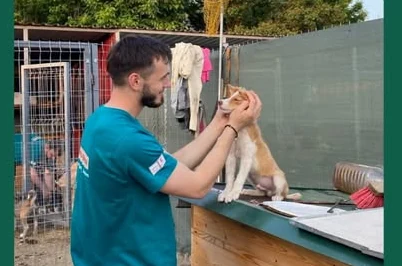
For his birthday, turning 30, Mihai Lazar — a veterinarian at the AlgaVet clinic in Ungheni and president of the ALGA association — did not wish for a party, but for something very concrete: to raise 30.000 lei to sterilise 30 dogs from the Ungheni shelter. „For my birthday, I made a single wish,” he wrote on the campaign page, plainly named „Dorința lui Mihai” (Mihai’s Wish). The wish came true and then some — 43.287,20 lei were raised, far above the target.
In a video thank-you message, Mihai Lazar says the way people rallied was „the most beautiful gift” of his life and promises that the hard part is coming — the sterilisations themselves. The reason behind the wish is, in fact, less romantic than the gesture seems. At an overcrowded shelter, dogs keep breeding because there are not enough resources for sterilisation, and the puppies born there — vulnerable to disease, stress and lack of space — have, he says, very slim chances of survival.
For my birthday, I made a single wish: to raise 30.000 MDL to sterilise 30 dogs from the Ungheni shelter and put an end to this cycle of suffering. Mihai Lazar, veterinarian
At first glance, it is a heart-warming story about rescued puppies. Looked at more closely, it is something else: one piece of a public-health problem that Ungheni has, in black and white, in the statistics.
Why it isn’t (only) about puppies
In Moldova, stray dogs are not merely a matter of pity or urban nuisance. They are the main reservoir of a deadly disease: rabies. And Ungheni fares badly on this front. According to the National Agency for Public Health, in 2025 Moldova confirmed 46 rabies cases across 18 territories — a two-and-a-half-fold increase over 2024. The Ungheni district was among the hardest hit in the country, with 4 cases, tied for second place with three other districts, after Hîncești (10). ANSP explicitly called for „urgent measures” from local authorities precisely to „manage the problem of stray dogs”.
Why do dogs matter? Because rabies is transmitted through bites, and globally dogs are the source of up to 99% of human cases, according to the World Health Organization. The disease causes around 59.000 deaths a year worldwide and is almost always fatal once symptoms appear — but it is entirely preventable through vaccinating animals. Every unvaccinated dog on the street is a potential link in the transmission chain. The same stake lay behind the partnership the AlgaVet clinic signed with the German Embassy earlier this summer, for the sterilisation of 50 community cats in the town.
Sterilisation, not shooting
This is where method comes in. The instinctive reaction to „too many dogs” has, historically, been to kill them — but international bodies say plainly that it does not work. The Terrestrial Animal Health Code of the World Organisation for Animal Health (WOAH) recommends an approach called CNVR — „catch, neuter, vaccinate, return”: the dogs are caught, vaccinated (including against rabies), sterilised and, if they cannot be adopted, returned to their community.
The reason mass killing fails even has a name — „the vacuum effect”: when the territorial dogs of an area are removed, their place is quickly taken by others, arriving from elsewhere, about whom it is unknown whether they are vaccinated or sterilised. The population recovers, and the risk remains. Sterilisation, by contrast, cuts the problem at its root — at reproduction.
The arithmetic behind a sterilisation
A dog or a cat reaches sexual maturity at around six months of age and can have two litters a year, of several pups each. Without sterilisation, a single pair and its offspring can fill an entire neighbourhood with stray animals within a few years — most of which never get a good life. A sterilised animal breaks this chain. On top of that, a canine population stabilised through sterilisation is far easier to keep at the 70% vaccination threshold that the WHO considers necessary to stop rabies from circulating: fewer new, unvaccinated dogs appear out of nowhere.
Sterilisation also has direct benefits for the animal — in females it prevents mammary tumours and serious uterine infections, and in males it reduces roaming behaviour and aggression. But on the scale of a town, the biggest gain is the one above: fewer abandoned puppies and ground that is easier to vaccinate.
From a personal wish to a public obligation
Mihai Lazar’s gesture does not come out of nowhere. In November 2025, ALGA opened in Ungheni the social clinic AlgaVet — presented as the first veterinary clinic with social impact in Moldova, where paid services fund interventions for vulnerable communities. In May, the association sterilised and vaccinated free of charge some 154 animals in the Nisporeni–Ungheni area, together with Kaufland, a city hall and ANSA; in June came the German partnership for the 50 cats. The sterilisation of the 30 shelter dogs, paid for out of a fundraiser on one man’s birthday, is the next step of the same effort.
In parallel there is also a public structure: the Ungheni municipality has its own dog shelter (azil), run by the City Hall — the Municipal Council reviewed its activity in December 2025, in a report presented by deputy mayor Nicolae Cevaga. And from September 2027, when the new Law on the protection of companion animals (adopted in July 2025) enters into force, the burden will shift firmly to the authorities’ court: local authorities will have to provide sterilisation centres, as part of a national capture, vaccination, sterilisation and microchipping programme. In effect, what an association and the people who answered Mihai’s call are doing now, from donations, will become, two years from now, a legal duty of the state.
Until then, the 43.287 lei raised on a veterinarian’s birthday remain proof that, behind every sterilised dog, there stands a cold public-health calculation — and that sometimes it begins with a single wish.