

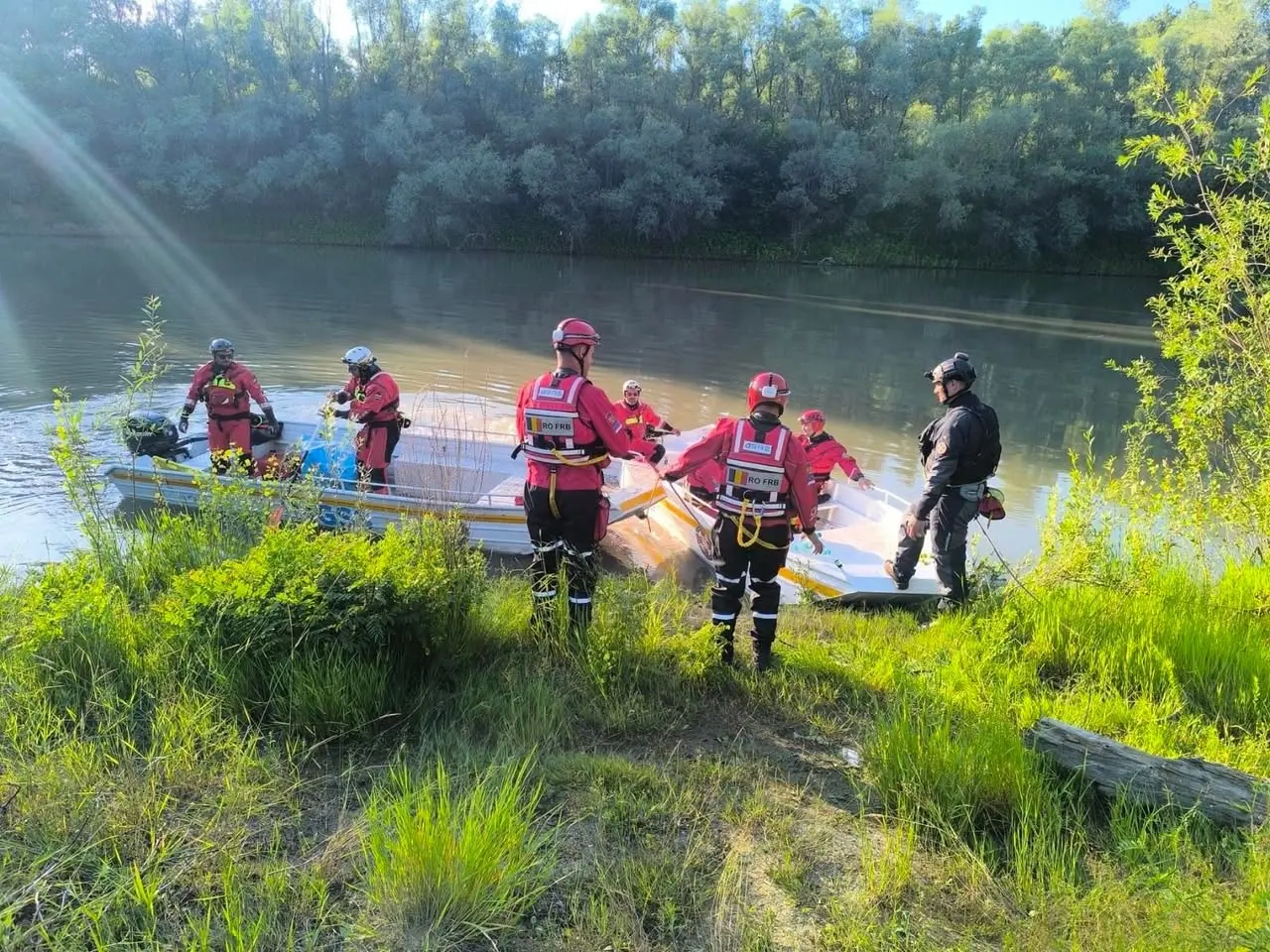
A major international civil-protection exercise, hosted by the Republic of Moldova, ended on 18 June. For three days, more than 250 rescuers from six European countries worked through realistic flood scenarios, and one of the chosen sites was the Prut river, in Ungheni district — the General Inspectorate for Emergency Situations (IGSU) announced in its closing statement.
For the people of Ungheni, the exercise is no abstract hypothesis. A month ago, in the last week of May, the Prut and the district’s streams really did burst their banks: part of Cornova village was flooded, while at Pîrlița, Vulpești and on Lake Delia rescuers carried out controlled water releases and reinforced dikes at risk of failing. The scenario rehearsed by the European teams is, in effect, what the district lived through in May.
What “MD–EU MODEX 2026” was
MODEX — short for “Module Exercises” — is the exercise programme of the European Union’s Civil Protection Mechanism, coordinated by the European Commission through its civil-protection and humanitarian-aid directorate. Their purpose is to test whether response teams from different states can work together, under a single command, when a disaster exceeds the capacity of any one country.
The edition hosted by Moldova brought together modules from Poland, Germany, Croatia, Romania, Bulgaria and the Kingdom of the Netherlands. The teams carried out water pumping, boat rescue, casualty recovery and securing access to drinking water through purification modules, as well as water-sample collection and analysis and the delivery of humanitarian aid to affected areas. The operations base was set up at Lake Dănceni, in Ialoveni district, while interventions took place in several locations — the Dănceni, “La Izvor” and Ghidighici lakes, the Chișinău mine and the Prut river, in Ungheni district. The teams operated in real field conditions, around the clock, under the observation of the European Mechanism’s experts.
The Republic of Moldova has been a participating state in the EU Civil Protection Mechanism since 29 September 2023, and IGSU is the body that represents the country within this framework. The exercise was therefore also a test of how Moldovan rescuers fit into an international operation.
The component on the Prut, at Ungheni
IGSU’s statement places one of the exercise sites “on the Prut river in Ungheni district”, but without naming the locality or the exact stretch. The types of missions rehearsed — boat rescue on water and water pumping — map directly onto the dominant risk of a border town set on the Prut.
The choice is not accidental. The Prut is a border river whose regime is controlled upstream by the Costești-Stânca dam, jointly managed by the Republic of Moldova and Romania; historically, major Prut floods have tested the dikes in the district’s floodplain. The fact that Romania came to the exercise with water-rescue modules adds a practical dimension: on the other bank of the same river lie the Iași and Botoșani counties, and cooperation on the Prut — from floods to the road bridge linking the two Ungheni towns — is a constant of district life.
Why it matters to the people of Ungheni
The risk rehearsed in June materialised in May. Between 22 and 28 May 2026, torrential rain put several districts under pressure, Ungheni among them, and IGSU activated a crisis cell. According to the agency’s tally, 933 people and 247 units of equipment took part in assessment, monitoring and response, of which IGSU mobilised 664 staff and 129 units. On Lake Delia, which had accumulated water from basins that had given way, the situation was described as alarming until the level dropped and the flow towards the Prut returned to its bed.
In a district of about 74,500 inhabitants, a good share of whom live in the villages of the Prut floodplain, the ability to respond quickly to floods is not a technical matter but a question of safety. An exercise in which teams from six countries pump water, rescue people by boat and secure drinking water, on the very river that runs through the district, is the kind of preparation measured only at the next flood.
What remains to be learned is the local part of the story: at which point of the Prut in the district the manoeuvres took place, whether Ungheni’s IGSU structures and local authorities were involved, and which “lessons learned”, announced by the organisers at the final evaluation, bear directly on flood defence in the district. These are questions only IGSU can answer.
The details of the “MD–EU MODEX 2026” exercise — the locations, participating countries and types of operations — come from IGSU’s official statements. The institutional framework and Moldova’s accession to the EU Civil Protection Mechanism are confirmed by the official page of the Ministry of Internal Affairs. The tally of the May 2026 floods, including the affected localities in Ungheni district and the response figures, comes from the report of the state agency Moldpres, which cites IGSU’s data. The district’s population is estimated from the National Bureau of Statistics’ provisional 2025 data. The exact locality in the district where the Prut component took place was not specified in the official statements.