

The Ungheni District Hospital announced on Tuesday, 8 July, that it is entering a cross-border project meant to strengthen the hospital’s response to health crises: equipping with emergency medical-care equipment, a unified logistics system and — the most concrete point — a unit for the safe neutralisation of hazardous medical waste.
The project is called «MEDCOOP-Bridge» and is led by Ordinul Asistenților Medicali din Iași (OAMGMAMR), with the Ungheni hospital in the role of partner. It falls under the Interreg VI-A NEXT Romania–Republic of Moldova Programme, funded by the European Union, on the line of projects dedicated to resilience and crisis response.
What the document actually says
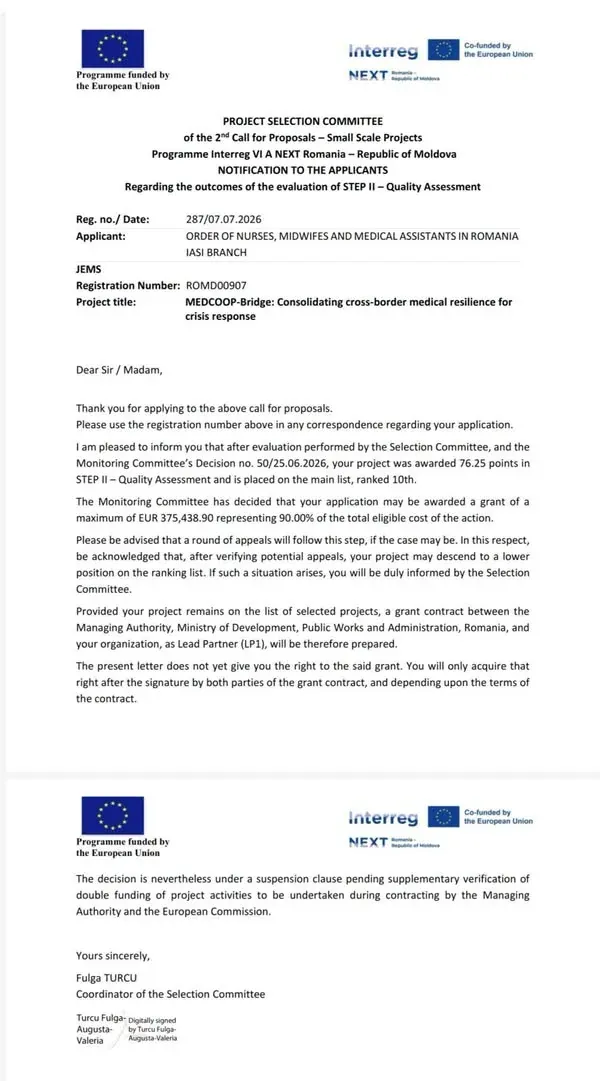
The hospital’s post sounds triumphant — «a new project!!!» — but the document the institution made public tells a more cautious story. It is a selection notification, issued by the programme’s Selection Committee on 7 July, by which the project passed the second stage of evaluation, with 76.25 points, and was placed 10th on the main list. The European grant is at most €375,438.90, that is 90% of the eligible costs — a sum that covers the entire Iași–Ungheni partnership, not just the share that goes to the Ungheni hospital.
Crucially, the letter states, in black and white, that it «does not yet confer the right to a grant». This arises only after the financing contract is signed between the Managing Authority — Romania’s Ministry of Development — and the lead organisation. The document also mentions a suspension clause, pending verification that the activities are not already financed elsewhere, and the programme’s rules provide that the position in the ranking can change following appeals. In other words: the project was selected, not contracted, and the money is not yet guaranteed.
Why the medical-waste unit matters
Beyond the procedures, the local stakes are real. The Republic of Moldova produces around 3,500 tonnes of medical waste a year, of which about 15% is hazardous — infectious, sharp-cutting and chemical materials. Specialised neutralisation services are almost entirely absent outside the large cities, and a national incineration centre is announced only for 2028–2029. In such a landscape, a district hospital’s own neutralisation unit is not a whim, but a piece that is missing from the system.
Likewise, the emergency medical-care equipment targets exactly the moments when a district hospital is put to the test — mass accidents, waves of patients, crisis situations — when the difference is made by the equipment and by a logistics flow set up in advance.
Another bridge over the Prut, in healthcare
«MEDCOOP-Bridge» adds to a series of projects through which institutions in Ungheni work with partners in Iași. This year we wrote about PREVENT, which equips 15 family doctors in Ungheni and targets the detection of the «silent» cancers, and about MedAccess, the €1.18-million project for the District Dental Centre. One distinction worth keeping in mind, because it is easily lost: this time the beneficiary is the District Hospital — the institution with beds and an emergency department — not the Health Centre nor the Dental Centre, which are separate structures.
The data on the project come from the notification of the Selection Committee of the Interreg VI-A NEXT Romania–Republic of Moldova Programme, published by the IMSP Ungheni District Hospital, and from the official guide for the call. The figures on medical waste in the Republic of Moldova come from public institutional-press sources. The exact sum that goes to the Ungheni hospital, the list of equipment and the implementation deadline have not been made public; at the time of publication, the official ranked list of the projects selected in this call was not yet available.