

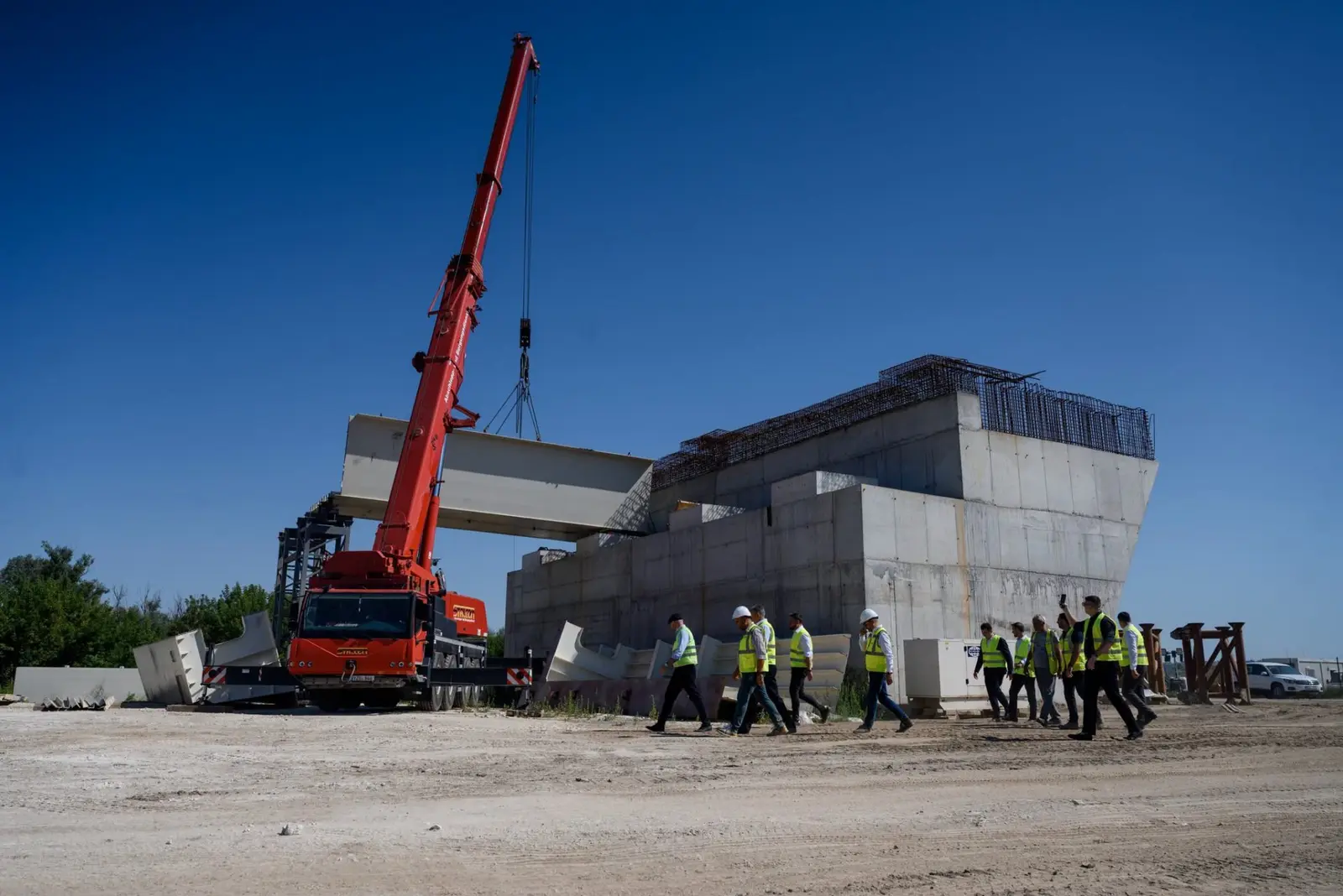
The road bridge over the Prut at Ungheni has passed the halfway mark. Physical progress on the works has reached 55%, and on the Moldovan bank installation of the first metal deck segment has begun — the steel structure that will carry the roadway. The announcement was made by the Ministry of Infrastructure and Regional Development (MIDR) on 11 August, after Deputy Prime Minister Vladimir Bolea, the Minister of Infrastructure and Regional Development, inspected the site together with state secretaries Mircea Păscăluță and Nicolai Mîndra.
The bridge is, in fact, a pair of parallel structures — one for each direction of traffic. According to MIDR, some 251 tonnes of metal deck have so far been delivered on the Moldovan bank for both carriageways, and installation has only just begun. On the Romanian bank, in Iași county, the work is further along: the deck is 70% installed on both carriageways, with about 732 tonnes delivered and put in place. The difference in pace has a logistical explanation: the whole deck comprises 20 modules, manufactured in Romania, at Satu Mare, and assembly started earlier from the Romanian side.
What is actually being built
It is the first motorway-grade road bridge over the Prut in more than 60 years — the Republic of Moldova end of the future Union Motorway (A8), which is meant to link Ungheni to Iași and, across the Carpathians, to the European transport network. The work is being carried out by the company NESS Project Europe, began on 26 April 2025 and has an 18-month execution term, with a ten-year guarantee. Its value exceeds 151.68 million lei without VAT. The project is funded by the European Union, which has allocated 35 million euro through the Connecting Europe Facility (CEF).
The 55% figure marks measured progress since spring: at the April progress meeting, the stage was estimated at about 45%. At this pace — roughly ten percentage points in four months — the deadline the project started with, July 2026, is no longer realistic; completion of the structure now looks set for this autumn.
A finished bridge does not mean the Prut can be crossed
One thing is worth keeping in mind, so that no false expectations arise: even once finished, the bridge does not open to traffic on its own. To cross the Prut over it, the customs post, the border checkpoint and the connecting roads still have to be built — a second stage with a 2028 horizon. On the Romanian bank, the customs complex is under contract and is seeking its permit; on the Moldovan bank, the crossing infrastructure was, this summer, still awaiting its builder and contract. The bridge, in other words, is arriving ahead of the roads and the customs post that would put it into service.
The same logic can be seen on land. On the Romanian bank, the A8 motorway section that is meant to reach the bridge is only at the design stage, with the actual works scheduled for the coming years. And across the Prut, alongside the road bridge, the modernisation of the railway bridge and the electrification of the Iași–Ungheni line is being prepared separately — a second strand of the same connection, not to be confused with the road one.
The minister’s 11 August visit to Ungheni, in fact, touched on several sites. It was also then that the transfer of the bus and railway station to the city hall, to be turned into a “multimodal station”, was announced — the piece that would tie the road, the railway and the bridge into a single hub.
For the people of Ungheni, the stakes are concrete. Today, a driver who wants to cross into Romania by car goes around via Sculeni, some 15 kilometres to the north. The new bridge brings the crossing right to the edge of the town, in the Zagarancea area. Ungheni thus becomes the “socket” through which Moldova connects to the west along three strands at once — road, railway and, since 2014, a gas pipeline. For now, however, only the steel structure is taking shape over the water.