
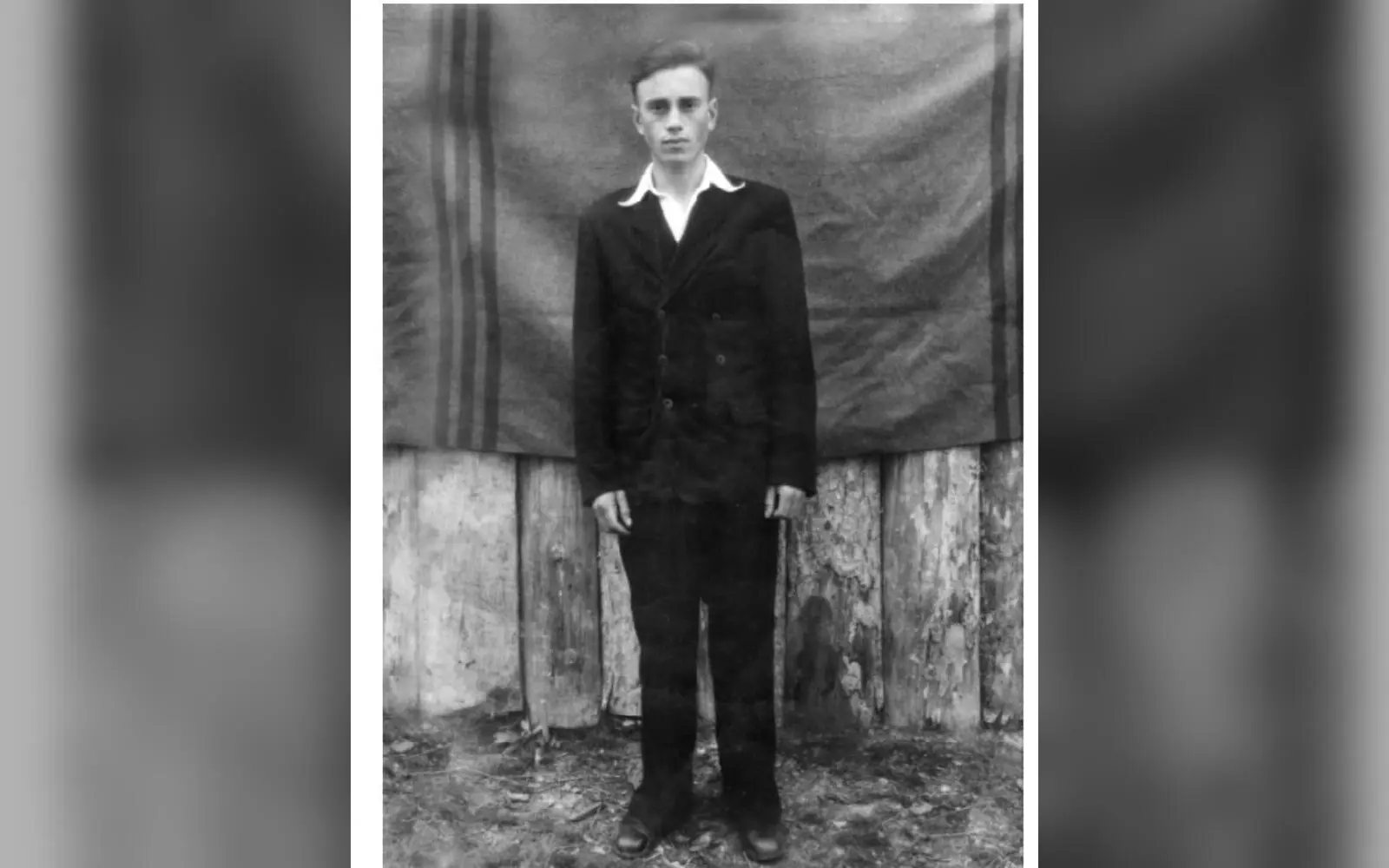
In a black-and-white photograph, a young man in a dark suit and white shirt stands upright, in front of a blanket stretched over a wooden wall. He is not smiling. Beneath the image, a single sentence: “Teodor Șișcanu from the commune of Măcărești, Ungheni district, deported in 1949 together with his family to the Irkutsk region.” His is one of the few faces we can still look upon from the wave of deportations 77 years ago — preserved in The Book of Memory (Cartea Memoriei), the official catalogue of the victims of communist totalitarianism, published by the National Museum of History of Moldova.
On the night of 5–6 July 1949, in the village of Măcărești in the Ungheni district, the Șișcanu family was among those taken from their homes. It did not happen out of nowhere. The head of the family, Zaharia Șișcanu (born in 1902), had already been sentenced in 1945 to 15 years in a labour camp on a charge of “collaborationism”. Four years later, the rest of the family was sent after him: his wife Alexandra and their four children — Ion, Teodor, Alexandra and the youngest, Andrei, who was only six. The archival photograph names him Teodor; in the family’s nominal list, the son born in 1934 is recorded under the Russified form of the name — “Fiodor”.
One family, in a single line of the catalogue
Everything that officially remains of their ordeal fits into one dry line of the catalogue:
ȘIȘCANU Zaharia A. (b. 1902). Sentenced in 1945 to 15 years of detention in a corrective labour camp. Charge: collaborationism. Rehabilitated in 1991. […] Entered on the list of “collaborationists”. Deported in 1949 to the Irkutsk region. Rehabilitated in 1991.
The Book of Memory, vol. IV, Ungheni district section
Rehabilitation came in 1991 — four decades later, when the state that had deported them no longer existed. What became of Teodor Șișcanu in those Irkutsk years, whether he ever returned to Măcărești, and who his descendants are today, the catalogue does not say. Those answers lie only in the individual rehabilitation file or in the family’s memory — not on the published pages.
The “address” of the Ungheni deportees of 1949: Irkutsk
The Șișcanu family’s story is not an isolated one; it is typical of their village and district. The deportation of July 1949, known in NKVD documents as Operation “Sud” (South), was the largest wave of forced displacement in the history of Bessarabia: in just a few hours, more than 11,000 families — declared “kulaks” or “enemies of the people” — were seized from across the republic, loaded into cattle wagons and sent, in 30 trainloads, to Kazakhstan and Siberia. The “legal” basis had been signed months earlier, through the Soviet decree of 6 April 1949.
For those taken from the Ungheni district in that wave, the destination repeats with an oppressive insistence. On the page devoted to the commune of Măcărești, family after family — Aftonachi, Buraga, Enachi, Gâncu, Moraru, Nichitin, Șișcanu — carries beside its name the same two words: “Irkutsk region”. For many families from Ungheni, the “address” of 1949 had a single name, more than 5,000 kilometres from home.
How vast the loss was can be seen in the figure this newsroom counted earlier in the same catalogue: in the Ungheni district section, The Book of Memory gathers around 2,900 names of victims of the repressions, from more than 60 localities, from both waves — that of 1941 and that of 1949. Teodor Șișcanu is one of them. His photograph puts a face to a statistic that, otherwise, we read without seeing.
Why it matters today
On Monday, 6 July, 77 years after that night, the people of Ungheni gathered at the Troița Martirilor Neamului to commemorate the victims of the Stalinist deportations. The ceremonies mark a number — thousands of broken lives. The face of Teodor Șișcanu is a reminder of what lies behind it: real people, with names, villages and ages, taken from a yard in Măcărești and carried off to Siberia, from where many never returned.