

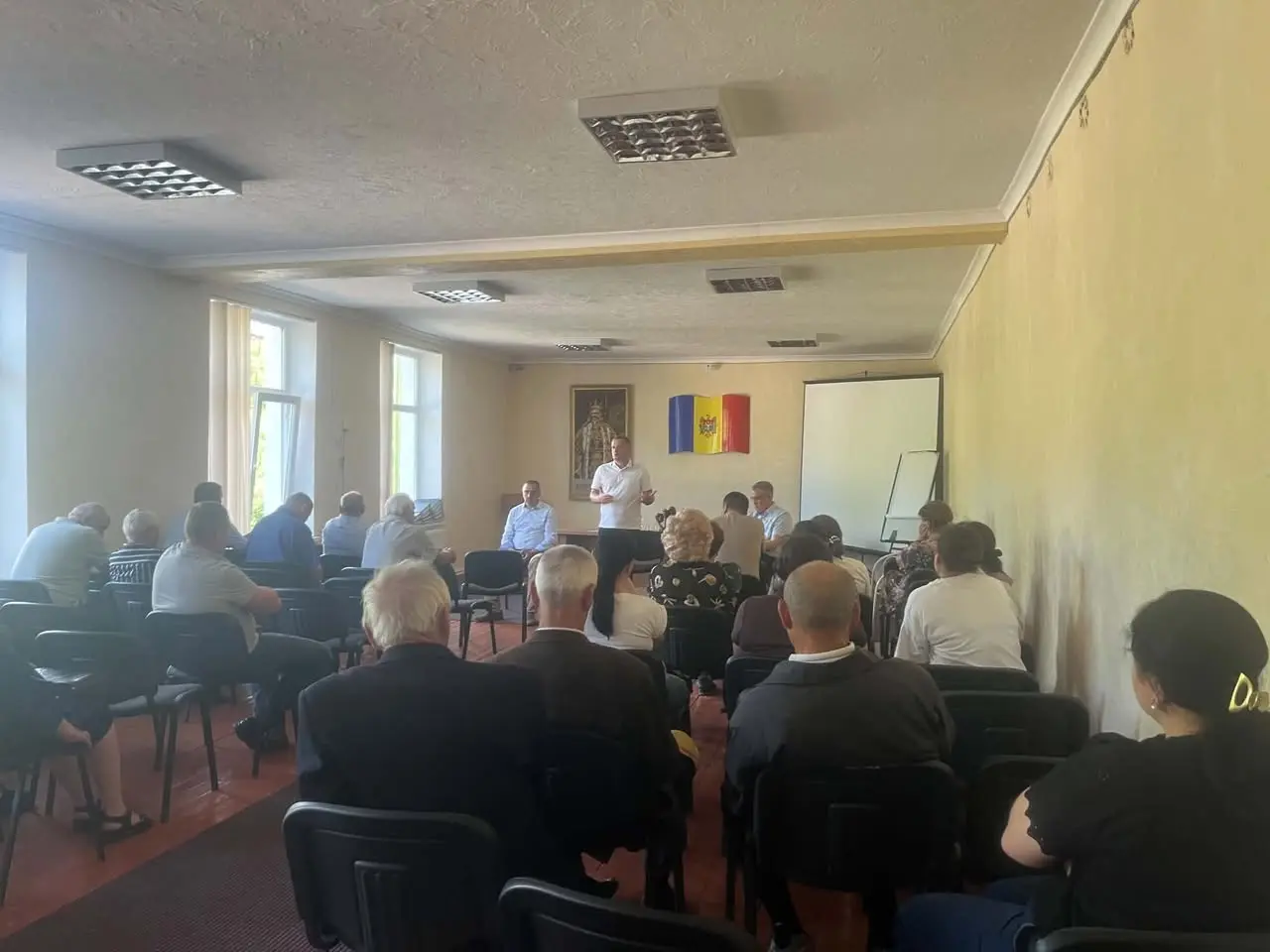
The commune of Măcărești has taken a step toward the municipality of Ungheni. A general assembly of residents voted in favour of a voluntary merger of the commune with the city, and the decision is set to be taken by the local council on Tuesday, 16 June, according to an announcement by the Măcărești town hall. If the merger is confirmed, the number of administrative-territorial units that would merge around Ungheni would rise to eleven — on top of the ten for which the city has already opened the procedure, on 10 June.
What the town hall announced
According to the town hall, about 50 residents took part in the general assembly devoted to “the opportunity of a voluntary merger with the municipality of Ungheni”. The guests were the mayor of the municipality of Ungheni, Vitalie Vrabie, and member of parliament Andrian Cheptonar (PAS), who “presented information about the merger process” and answered questions. For nearly three hours, the town hall says, arguments were voiced both for and against the merger.
Twenty-nine of those present remained for the vote. Of them, 24 voted for the merger, 3 against, and 2 abstained — according to the same announcement. The content of the arguments “against” is not given in the town hall’s post.
The town hall also notes that a first meeting on the subject had taken place in April, when the discussion was about a possible merger not with the city, but with the neighbouring village of Costuleni.
The eleventh locality: the merger map widens
The detail that lifts the announcement out of routine is that Măcărești was not on the list the municipality of Ungheni made public on 10 June. Back then, the municipal council opened the voluntary merger of the city with nine localities — Zagarancea, Mănoilești, Valea Mare, Morenii Noi, Florițoaia Veche, Cetireni, Unțești, the village of Costuleni and the commune of Brătuleni (from Nisporeni district) — a future municipality of about 44,000 inhabitants, as Triunghi reported. Măcărești was not among them.
The merger map has kept widening since the process began: eight units in May, ten on 10 June. With Măcărești, it would reach eleven.
And the commune’s trajectory says something about how the reform moves on the ground. In April, Măcărești was weighing a merger with Costuleni; in the meantime, Costuleni itself joined the city’s list. Left without the partner it had started with, Măcărești is now heading straight for Ungheni.
Why it matters
The merger is part of the most far-reaching local-government reform in years, built around a threshold: a town hall needs at least 3,000 inhabitants to be considered viable. In Ungheni district, 23 of the 33 town halls are below that limit, a newsroom calculation shows, based on population data.
What sets Măcărești apart is that it does not fit the pattern of “a village too small to survive”. The commune — made up of the villages of Măcărești and Frăsinești — had about 4,200 inhabitants at the 2014 census, that is, above the threshold, and it lies some 25 kilometres from the city, farther than the suburb-localities of the first wave. For it, the merger looks more like a choice than a necessity dictated by the numbers.
State money comes with the package, but not per commune. The reform concept announces a development incentive of 3,000 lei for each inhabitant of the new unit, and the Voluntary Amalgamation Methodology calculates it once, on the population of the unit resulting from the merger — not separately for each commune that joins it. The money would therefore go to the future municipality, not to Măcărești as such, and how it is shared among the villages is settled in the new town hall’s budget. The calendar is tight too: the voluntary-merger stage must be completed in 2026, before the 2027 local elections — hence the vote scheduled just days after the assembly.
How voluntary
The town hall’s announcement comes from only one side of the table — the administration that backs the merger. And the way the decision was taken touches precisely the nerve that the reform’s critics complain about. The Congress of Local Authorities of Moldova (CALM), which represents mayors, supports modernisation but asks that, when a town hall is to disappear, the community decide through a local referendum, not merely through an assembly.
In Măcărești, the step was taken through an assembly where 29 people stayed to vote — for a commune of more than 4,000 inhabitants. By comparison, in another commune of the district, Petrești, a far larger assembly, in the hundreds of participants, recently rejected the merger, according to local press. How representative a vote is, and where the line falls between consultation and decision, remain open questions.
In any case, the assembly is only advisory. The legally binding decision is taken by the local council — on Tuesday.
What comes next
If the councillors of Măcărești vote “for” on 16 June, the commune formally enters the merger process with Ungheni, with the next steps — the draft decision, possible new consultations and a confirming vote — to unfold in the coming months. Triunghi will follow Tuesday’s session and the decisions of the other local councils around the city.
This news item is based on the announcement published by the Măcărești town hall on its official Facebook page (reproduced and quoted in the article), on the list of localities in the merger process made public by the municipality of Ungheni on 10 June, on the Concept of the Local Public Administration Reform, and on population data from censuses and earlier estimates. The assembly figures — the number of participants and the result of the vote — come from a single source, the town hall’s announcement, and could not be independently confirmed before publication; we attribute them explicitly. The rule for granting the development incentive — once, to the administrative-territorial unit resulting from the merger — is the one in points 113 and 114 of the Voluntary Amalgamation Methodology, approved by Government Decision No. 925/2023 (Monitorul Oficial No. 472-473 of 8 December 2023, art. 1155). Triunghi will return with the result of the vote in the Măcărești local council.
Correction — 5 August 2026
In the original version of this article we wrote that the incentive would amount, “for a commune the size of Măcărești, [to] over 12 million lei”. The sentence contained two errors, both ours.
The first is one of category. The incentive is not calculated per commune. The Voluntary Amalgamation Methodology grants it to the administrative-territorial unit resulting from the merger, once, on its total population — not to each commune that joins it. A sum “for Măcărești” does not exist as such; what reaches the villages of the new unit is settled in its budget.
The second is one of arithmetic. The formula in point 114 of the Methodology — approved by Government Decision No. 925/2023 and published in Monitorul Oficial No. 472-473 of 8 December 2023 — has two terms: the population multiplied by 3,000 lei, plus a second term that grows with the number of town halls in the group. We applied only the first, the same error having been made in other articles of ours about amalgamation money, corrected on the same day.
The passage has been corrected. Up to 31 July 2026, the commune of Măcărești has no amalgamation decision in the State Register of Local Acts — so there is no group on whose population the calculation would be made. We correct our mistakes in public.