

Update — 31 July 2026. The municipality of Beekdaelen has answered the newsroom’s questions. Its actual budget is 124,046,318 euros in revenue and 120,548,746 euros in expenditure — not 240 million, as Ungheni City Hall announced. The municipality rejects the “very poor” characterisation and confirms that the visit took place within an Interreg project, which covered part of its costs. Ungheni City Hall did not reply to the request of 22 July. The sections below have been updated.
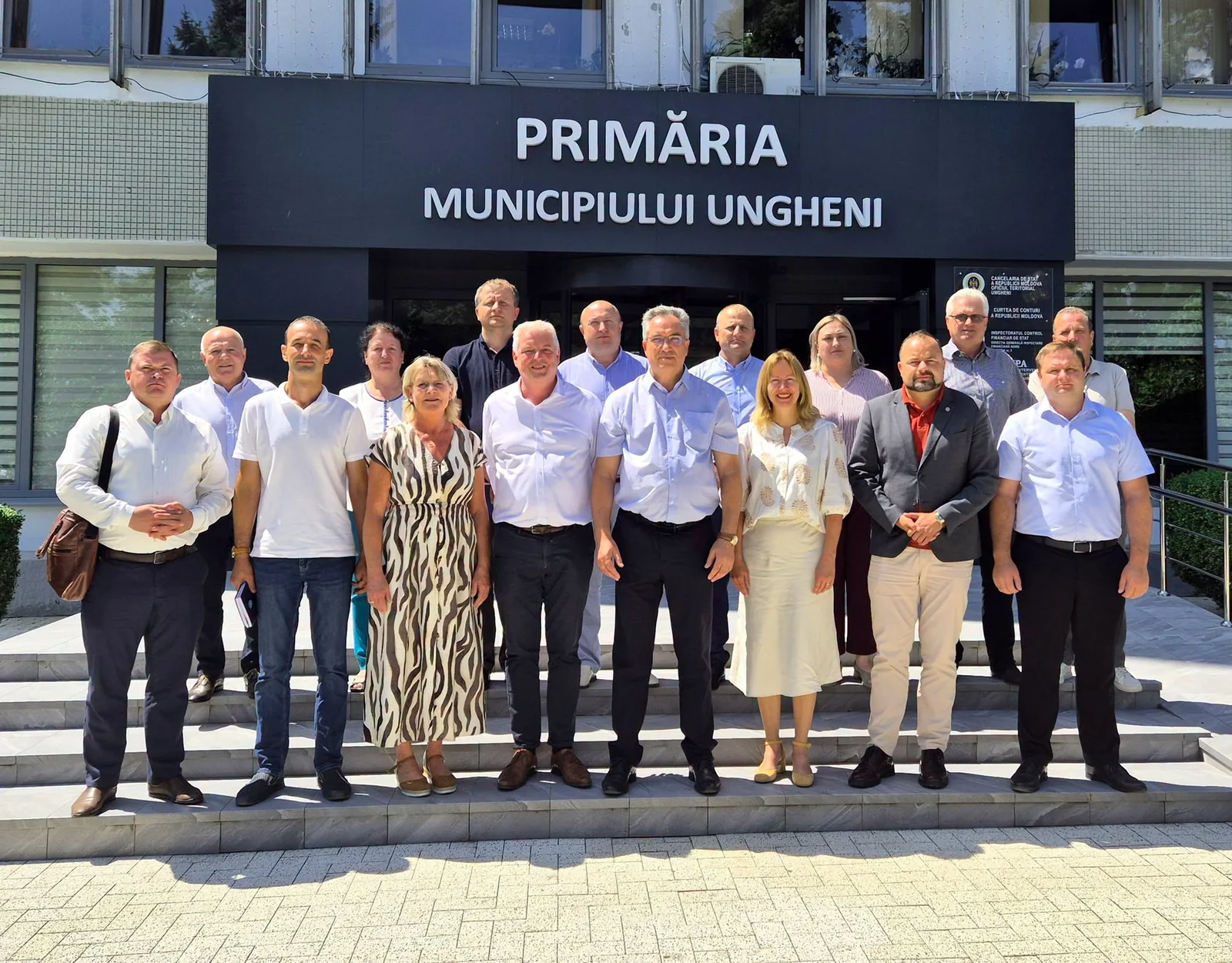
Eric Geurts, mayor of the municipality of Beekdaelen in the province of Limburg, in the south of the Kingdom of the Netherlands, met on Tuesday, 21 July, in Ungheni, with mayors from the cluster localities currently undergoing voluntary amalgamation and with other decision-makers. The town hall billed the meeting as a “transfer of good practice”, and the guest spoke about the process, the achievements and the challenges.
The meeting takes place one day before the close of the public consultation on the draft decision to merge the town of Ungheni with other localities, on Wednesday, 22 July, and ten days before 31 July — the deadline set by the State Chancellery by which town halls should finalise their decisions.
The Netherlands is indeed the European case most often invoked. It is worth looking at in full, though — including what the Dutch themselves measured after their own mergers.
The guest’s municipality is itself a merger. And one asked for from below
Beekdaelen was created on 1 January 2019, through the merger of three municipalities: Onderbanken, Nuth and Schinnen. According to its own official page, it has fifteen villages and over 36,000 residents across almost 8,000 hectares; a database drawing on official statistics gives 35,903 residents on 1 January 2026.
The detail that matters for Ungheni is how it was done. The merger was approved by an act of the Dutch parliament, and the text calls it explicitly voluntary: the three municipalities asked for it themselves. The reason given in the law’s explanatory memorandum was not poverty, but the question of whether they could still operate sustainably and professionally as independent units, at a time when the tasks placed on municipalities were growing. In other words, a problem of administrative capacity.
Eric Geurts has led the municipality since 22 August 2019, for the social democrats (PvdA), and was reconfirmed in August 2025 for a second six-year term. His portfolio includes inter-municipal and cross-border cooperation — precisely the theme of the meeting in Ungheni — plus tourism and recreation. One useful clarification: in the Kingdom of the Netherlands, mayors are not elected by citizens but appointed by royal decree, on the proposal of the local council.
The Dutch figures, checked
The town hall notice — a retelling by the institution, not a transcript — quotes Ion Poia, head of the Ungheni Territorial Office of the State Chancellery, as saying that the Netherlands has gone from 1,209 municipalities to 342 in 2026.
The second figure checks out exactly: on 1 January 2026, the Netherlands had 342 municipalities, according to the country’s Central Bureau of Statistics. The trajectory, also from official sources: 625 municipalities in 1996, 458 in 2006, 355 in 2019.
The first figure needs a correction of context. The historical benchmark published by Dutch statistics is 1,121 municipalities in 1899, against which the decline is about 70%. The figure of 1,209 corresponds to 1851 — the year of Thorbecke’s municipalities act — and circulates from encyclopaedic sources, not from official statistics. The difference does not change the idea, but it changes the era: the comparison is not with “a few decades ago”, but with the middle of the nineteenth century.
There is also a third number, missing from the presentation and perhaps the most relevant of all: since 2023, the Netherlands has stopped reducing the number of municipalities. 342 in 2023, 342 in 2024, 342 in 2025, 342 in 2026. Dutch statistics explicitly note that the continuous decline in the number of municipalities “has come to a halt”. The model shown in Ungheni as a process under way is, back home, a process that has reached a plateau.
What the Dutch measured after their mergers
This is where the genuinely useful part lies for a mayor in the Ungheni cluster, because the Dutch evaluated their own mergers with data, not with impressions.
The most-cited study, signed by Maarten Allers and Bieuwe Geertsema and published in Journal of Regional Science, compared Dutch municipal spending over 15 years. The conclusion: mergers had no significant effect on total spending per resident. Administration costs do fall in the long run — but the savings made there do not show up as an increase in spending on public services. The authors also checked an indirect indicator: house prices, which should have risen had services improved. They did not. The University of Groningen summed up the result without softening it: large or small, a merger has no effect on the level of spending.
The same team’s second study, published in Electoral Studies, measured the effect on voter turnout, across Dutch elections from 1986 to 2018. Municipal amalgamation reduces turnout in local elections by 2.2 percentage points and in national elections by 0.7 points. The effects are lasting: they persist for at least five elections after the merger. The most likely explanations, according to the authors, are a weakening of the social norm to vote and a growing distance between voters and politics.
And the other side
The reduction in administration costs is real and confirmed by the same studies — which is exactly the saving the reform in the Republic of Moldova is after. Beekdaelen itself commissioned an external multi-year evaluation of its own merger, and the conclusion published by the municipality is that the operation succeeded; the document cannot be cited directly, however, because the page hosting it is no longer accessible.
More importantly, Allers does not recommend abandoning mergers, but sets a condition: merged municipalities must actively reduce the distance between the citizen and the town hall, through village councils and by involving residents from every village. It is the criterion by which, a few years from now, it will be possible to measure whether the Ungheni merger succeeded.
A third study, comparative across ten countries, adds the nuance that concerns Ungheni directly: turnout falls most where the merger is imposed by central government, and holds up better where several municipalities with similar populations merge. The Ungheni cluster has a dominant partner — the town, with 26,500 inhabitants at the 2024 census, out of a total of 42,316 estimated in the draft decision — almost 63% — and a deadline set from the centre. Beekdaelen merged in exactly the opposite way: three comparable municipalities, at their own request.
Two claims the Dutch municipality rejects
The town hall notice attributes two claims to the Dutch guest that did not hold up in public sources. The newsroom asked the municipality of Beekdaelen to confirm or correct them; the answer came on 31 July, from the municipality’s communications team.
The first: that the municipality, “very poor previously”, became prosperous. “We would not describe ourselves as ‘very poor’, although our financial position is now healthier than it was before the merger,” the municipality replies. The reasons it lists itself are not financial: small municipalities struggle to attract enough qualified personnel for specialised tasks, the administrative burden has grown immensely because of digitalisation and complex legislation, and societal problems and infrastructure works do not stop at the municipal boundary. Which are the same reasons given in the explanatory memorandum to the 2018 merger act — administrative capacity, not poverty.
The second: an annual budget revenue of 240 million euros. The real figure, supplied by the municipality, is 124,046,318 euros in revenue and 120,548,746 euros in expenditure — the budget announced publicly in Ungheni was therefore almost twice the true one. The municipality notes that these figures “were also mentioned in the presentation”, which places the discrepancy in the reporting in Ungheni, not in what the guest showed. For 2026, Beekdaelen adopted a balanced budget, after its 2025 multi-annual plan had projected a small deficit for this year.
What actually links Ungheni to Beekdaelen
The relationship did not appear on Tuesday. Ungheni City Hall is a full partner in the European project TAAS — “Tourism as a Service”, funded through Interreg Europe, alongside the Zuid-Limburg region. In the project’s official stakeholder report, the municipality of Beekdaelen is listed as an associated partner, and at the study visit in Zuid-Limburg, on 6 and 7 May 2026, Eric Geurts personally welcomed the group of partners — Ungheni among them.
Asked whether the visit took place within a formal framework and who covered its costs, the municipality of Beekdaelen replied that it is part of “the Interreg project” and that “part of the costs are covered by the project”. It did not specify which project, nor who covered the rest. Ungheni City Hall, sent the same questions on 22 July, did not reply. The official list of Ungheni’s twin towns includes no town in the Kingdom of the Netherlands.
The public consultation on the draft merger decision closed on Wednesday, 22 July, in the evening.