

Two new services are entering the morning peak of Ungheni’s public transport. City Hall announced that routes No. 1 and No. 3 will each be reinforced with one more vehicle, and the times are already set: an extra bus leaves at 7.20 from the „Biovit” stop and another at 7.15 from Zagarancea.
On route 1, the 7.20 departure from „Biovit” is added to those at 7.00, 7.13 and 7.36. On route 3, the one coming from Zagarancea, the 7.15 service joins those at 7.04, 7.20 and 7.34.
The difference shows in the longest gap between two buses within the window of announced departures — 7.00-7.36 on route 1 and 7.04-7.34 on route 3: on route 1 it drops from 23 to 16 minutes, and on route 3 from 16 to 14 minutes (calculation by Triunghi.md based on the times announced by City Hall).
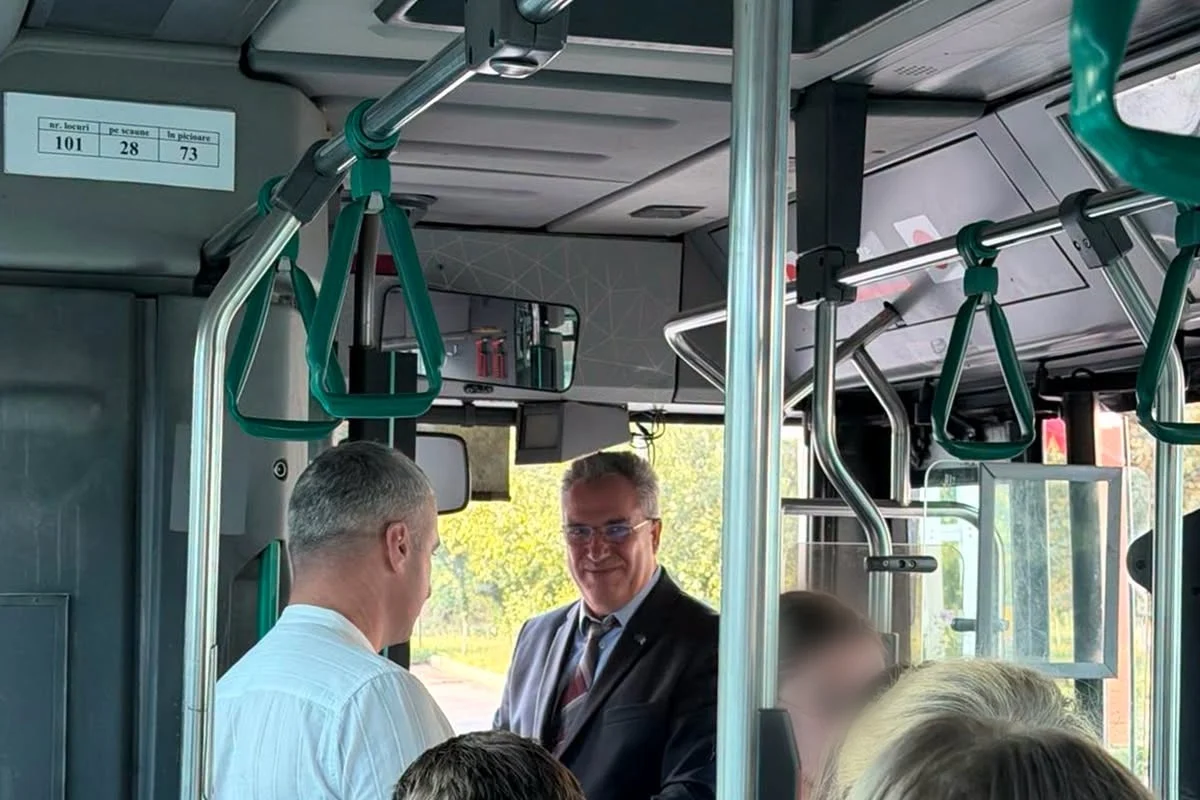
City Hall links the decision to the two mornings when mayor Vitalie Vrabie inspected the running of urban transport on the two routes — Tuesday and Wednesday, 1 and 2 September — starting at 6.30, during the first week of school.
This addition will allow all passengers and, in particular, pupils to reach the institutions where they study on time and safely.
Ungheni City Hall
The municipality also said that all routes will be monitored and adjustments will be made „as needed”.
What the passports of routes 1 and 3 say
Both lines are described in detail in the municipality’s road transport programme, approved by the Ungheni Municipal Council through decision No. 1/4 of 29 January 2026. The route passports annexed to the decision show two very different lines.
Route No. 1 links Dănuțeni street to Oleg Ungureanu street, is 15.3 km long and runs daily, with the first departure from the terminal at 06.00 and the last at 23.28. It can be served both by medium-capacity city buses — 45/60 passengers, according to the passport — and by 25-seat minibuses. The passport provides for 10 drivers and a maximum of four vehicles on the line.
Route No. 3 starts on Grigore Vieru street, in Zagarancea, and ends on Haiducilor street. It is the longest of the four lines approved in January — 20.5 km — runs daily between 06.08 and 23.43, and its passport provides for small-capacity buses, with 25 seats. It has 15 drivers and a maximum of six vehicles on the line.
For comparison, route No. 2 is 19 km long and route No. 4 is 18.6 km; both also have a maximum of four vehicles on the line. Route No. 5 was added later, through decision No. 4/22 of 15 May 2026.
The passports set the approved type of rolling stock and the ceiling on the number of vehicles for each line, not which vehicle is assigned to a particular service or how many buses are running at any given moment.
Who runs the service and what it costs
All urban routes are operated by Servicii Comunale Ungheni LLC, a company founded entirely by the Municipal Council, which took the service over from the previous private operator on 28 February 2026. The company’s manager is Igor Casian, according both to the route passports and to the decision by which the council noted, on 26 June, the company’s activity report for March-May 2026.
A journey on Ungheni’s urban routes costs 6 lei, set by Municipal Council decision No. 1/6 of 29 January 2026. Through the same decision, the council noted a cost of 18.66 lei per kilometre travelled — a figure measured per kilometre, not per journey. The costs included in the fare are compensated from the local budget: for 2026 the council allocated 6 million lei from the balance available on 1 January, through decision No. 3/22 of 27 March, and the chief accountant of City Hall is required to submit quarterly reports on how the money is spent.
What passengers are asking for next
Below City Hall’s announcement — more than 900 reactions and 70 comments by Thursday morning, 3 September — one request concerns not the morning peak but the journey home. A passenger writes that „between 13 and 14 would also be desirable”, when classes end, because that is when people wait 30-40 minutes and that the buses arrive overcrowded.
Other requests in the comments concern a payment option for those who take the bus once a month, and cycle lanes to the high schools as an alternative for pupils.