
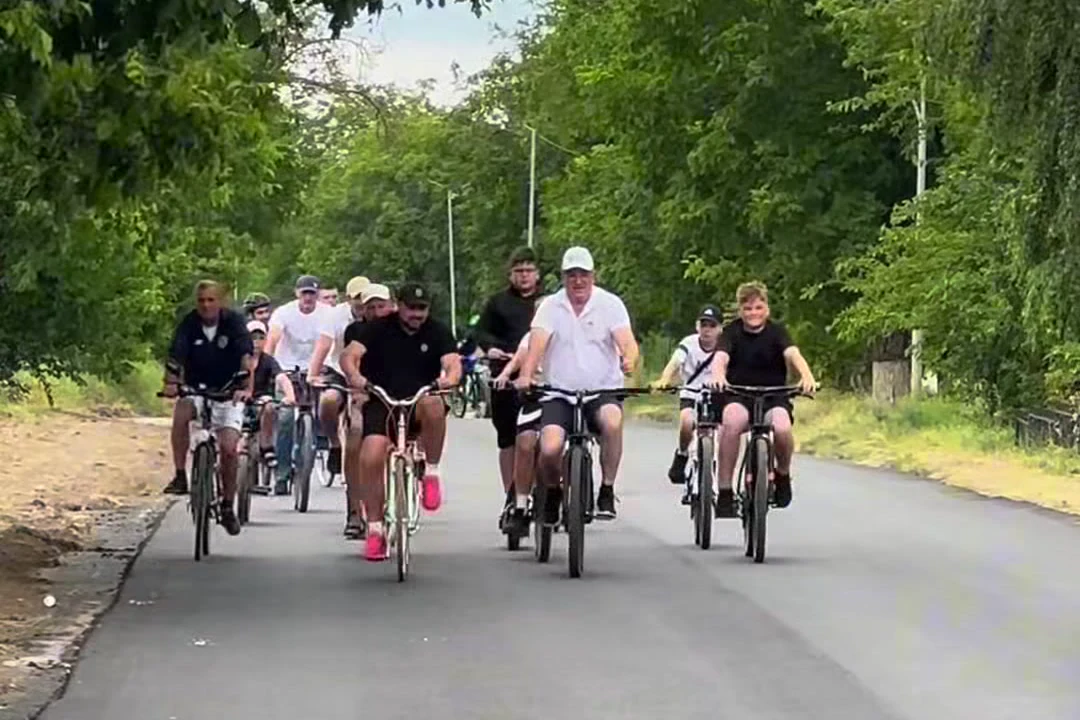
On Friday, 10 July 2026, Ungheni’s „VeloVineri” ride gathered not only recreational cyclists but also representatives of the town’s deconcentrated institutions — the state’s territorial branches. Mayor Vitalie Vrabie gave the start outside the town hall of Ungheni Municipality, alongside Ion Poia, head of the Ungheni Territorial Office of the State Chancellery, who — according to the town hall — „took on the challenge of bringing the institutions together for a bike tour through the municipality”.
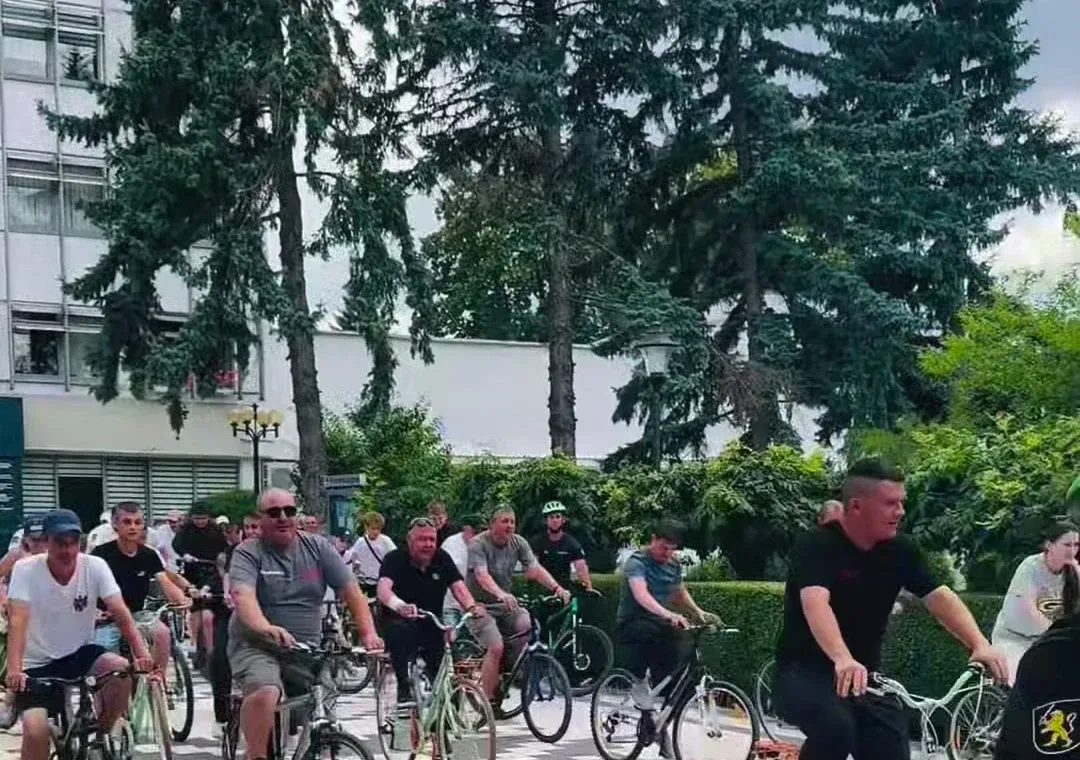 The start of the 10 July ride, outside the town hall of Ungheni Municipality. Source: video still, Ungheni Municipality.
This time, the route took the group to the Dănuțeni neighbourhood, where participants cycled along Burebista street, „recently rehabilitated” according to the town hall. It is the same artery on which the local administration concentrated major road works this summer: a 10.3-million-lei project, whose completion the mayor demanded by the end of the summer, and a second stretch of more than 700 metres, paved separately from the local budget. The ride thus also became a tour of the freshly finished works.
„Every kilometre travelled by bicycle means more health, less pollution and a friendlier city for everyone,” the town hall said, urging residents „to turn every Friday into a day dedicated to movement and sustainable mobility”. The message is no accident: at the end of June, the administration announced that „VeloVineri” would no longer be a one-off event, but a community ride every Friday, from 4 p.m., starting outside the town hall. The 10 July edition shows the initiative has survived its first weeks.
Beyond the ride itself, the stakes remain substantial. „VeloVineri” is part of the European project CycleRight (Interreg Europe), in which Ungheni is a partner city, and the town has set itself a target through its Sustainable Urban Mobility Plan: by 2030, one in ten trips through the town should be made by bicycle. It is an ambitious goal in a municipality with 311 cars per 1,000 inhabitants — around 40% above the district average — and with narrow cycle lanes of about 1.2 metres, not separated from traffic. One ride a week will not change these figures on its own, but bringing the state’s institutions onto bikes is exactly the kind of gesture that tries to normalise cycling on the town’s streets.