

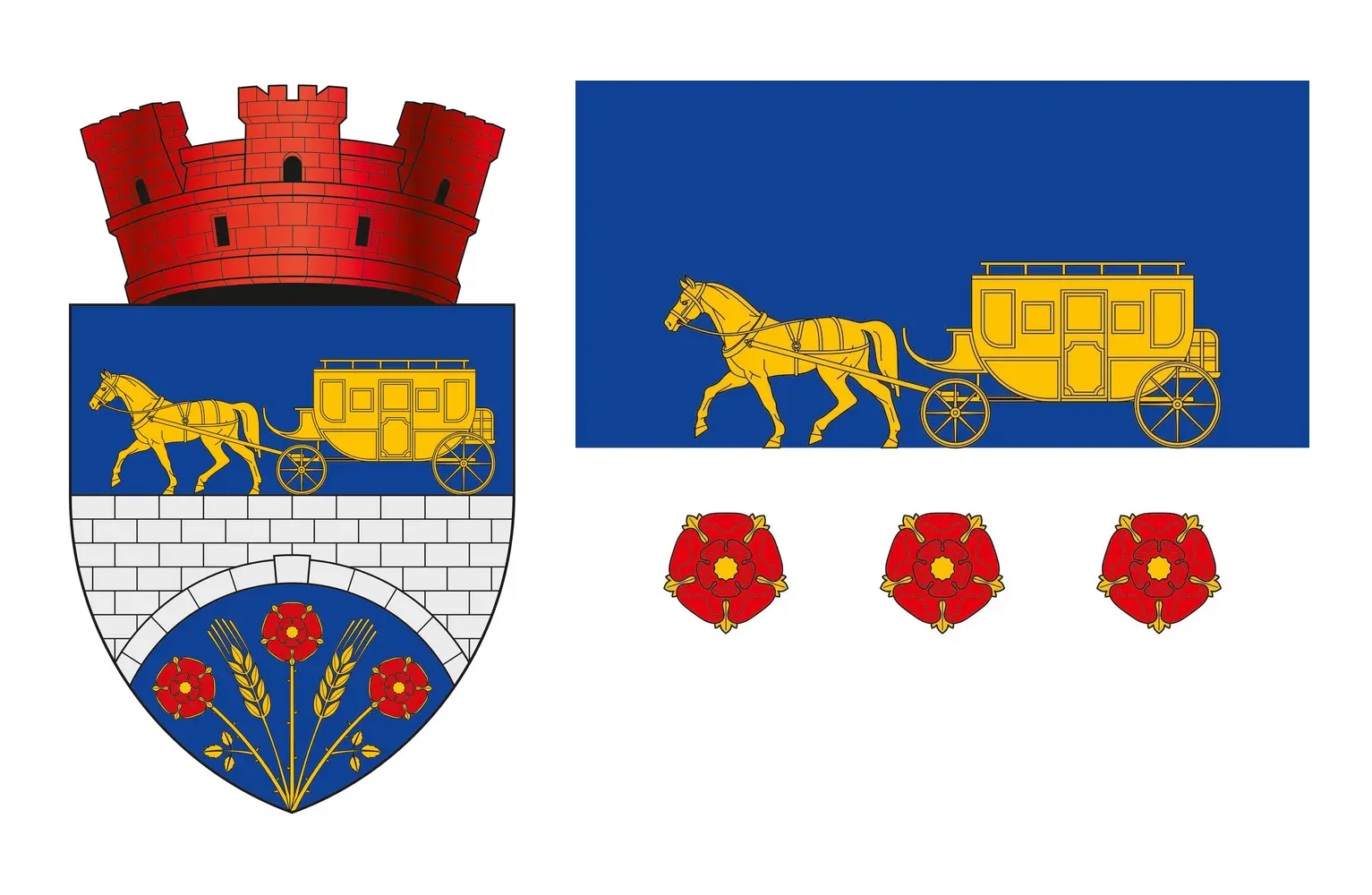
Since the start of this year, the village of Sculeni in Ungheni district has had its own official insignia: a coat of arms and a flag. They are not a mere decorative drawing — they are symbols entered into a state register, after a bureaucratic journey that passed through the local council, through the National Heraldry Commission and, finally, through a presidential decree.
What is on the shield
The village’s coat of arms is, in heraldic language, a story in miniature. On an azure (blue) field stands an arched stone bridge, in silver, issuing from the flanks of the shield; over the bridge passes a horse-drawn stagecoach, all in gold. Under the arch are three red roses, and from the top of the shield grow two golden wheat ears. The shield is topped by a mural crown with three towers — the heraldic mark of a locality’s status.
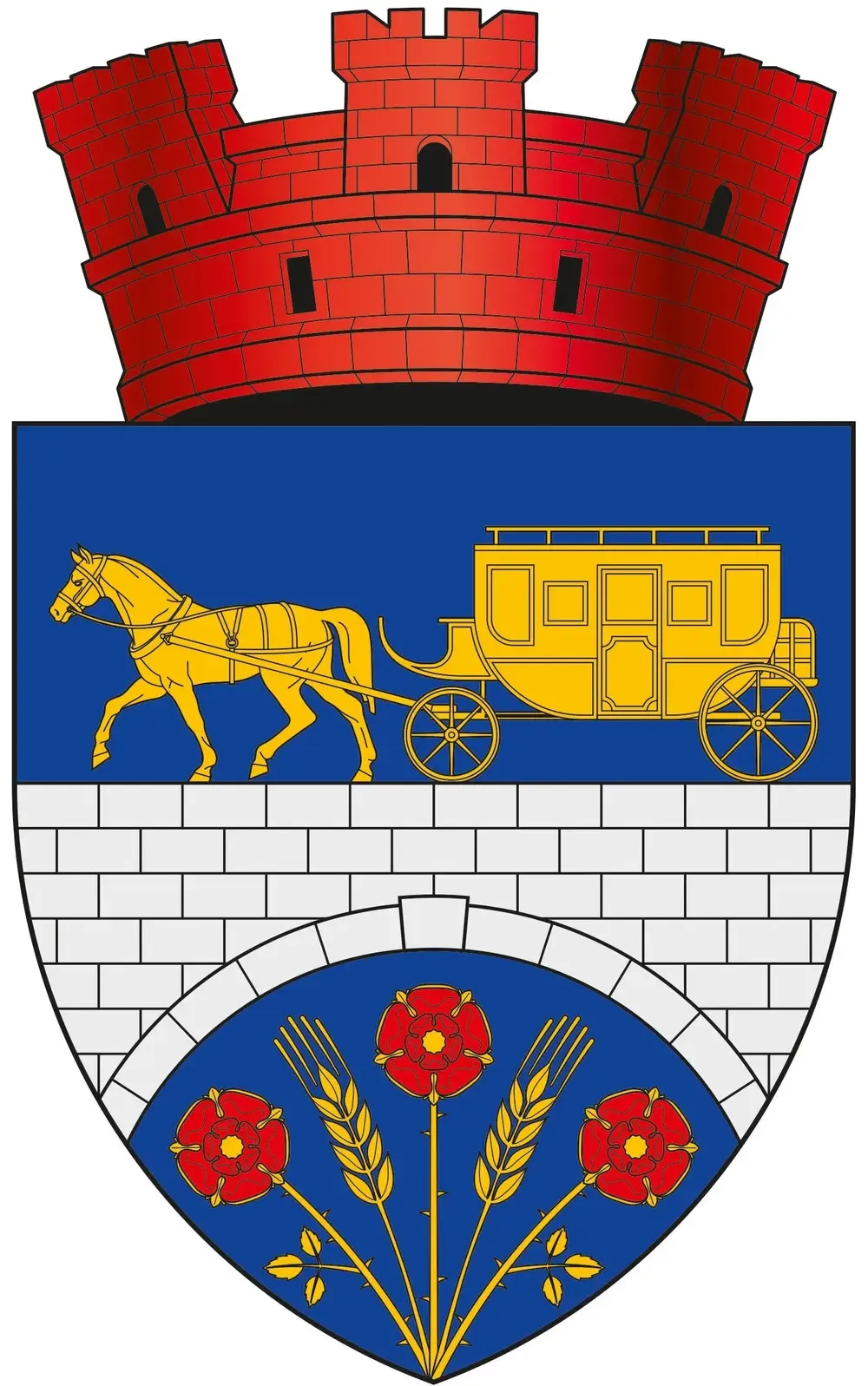
Each element says something. The bridge and the stagecoach are not ornaments chosen at random: they point directly to Sculeni’s identity as a crossing point over the Prut — a village that, throughout its history, was a customs post, a ford and a staging stop on the road between the two banks. The roses and the wheat ears speak of the farming settlement and of the community that grew here, on the left bank of the Prut, documented as far back as 1432.
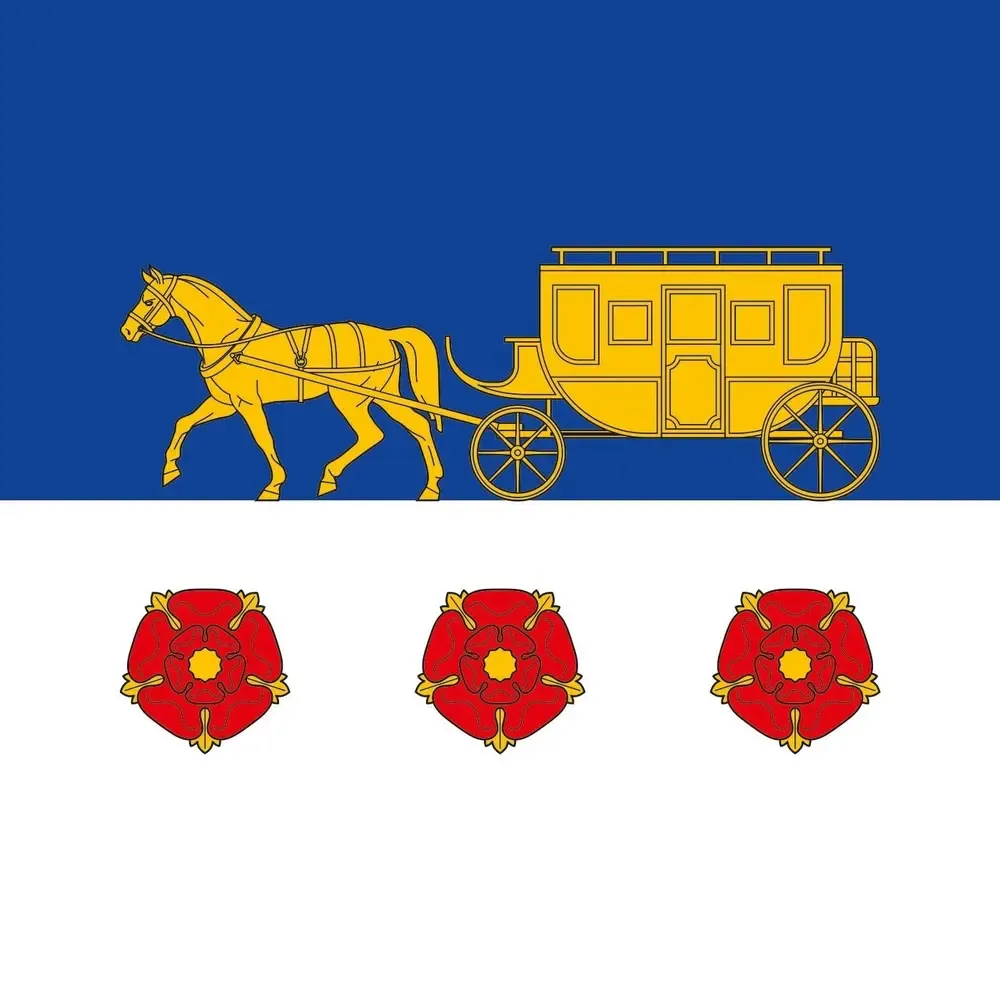
The flag takes up the same symbols on a blue-and-white cloth, with the stagecoach and horse on the dividing line and the roses in the lower part — so that the village has not only a coat of arms on paper, but also a banner that can be flown at celebrations and official occasions.
From idea to decree
Local heraldry is not approved overnight. In Sculeni’s case, the insignia were drawn by state heraldist Silviu Andrieș-Tabac together with Andrei Gaidașenco — specialists who have worked on dozens of locality coats of arms in Moldova.
The project received the opinion of the National Heraldry Commission under the President of the Republic of Moldova at its session of 5 December 2025. Three days later, on 8 December, the Sculeni Commune Council adopted the decision approving the coat of arms, the flag and the regulation on their use — with 11 votes “for” and none “against”. The final step, the official entry in the General Armorial of the Republic of Moldova, came by presidential decree in January 2026.
Why a coat of arms matters for a village
For a village of a few thousand inhabitants, a coat of arms may look like a protocol luxury. In reality, it is part of a broader wave in Moldova in recent years, in which more and more localities are registering their own symbols — a kind of visual identity document alongside the administrative one.
For Sculeni, the moment carries an extra relevance. The commune is going, in parallel, through a delicate discussion about the voluntary amalgamation of localities — that is, about how the area’s villages will be arranged administratively in the years to come. Against that backdrop, a coat of arms and a flag of one’s own fix something that administrative reforms do not touch: the historical identity of the place. However the city halls come to be named or grouped, the bridge over the Prut and the stagecoach are, from now on, the coat of arms of Sculeni.
The description of the coat of arms and flag, the endorsement and approval procedure and the data on the authors come from Decision No. 07/31 of 8 December 2025 of the Sculeni Commune Council (consulted in the State Register of Local Acts) and from the records of the National Heraldry Commission / General Armorial of the Republic of Moldova. The images reproduce the village’s official symbols, which are in the public domain as public symbols.