

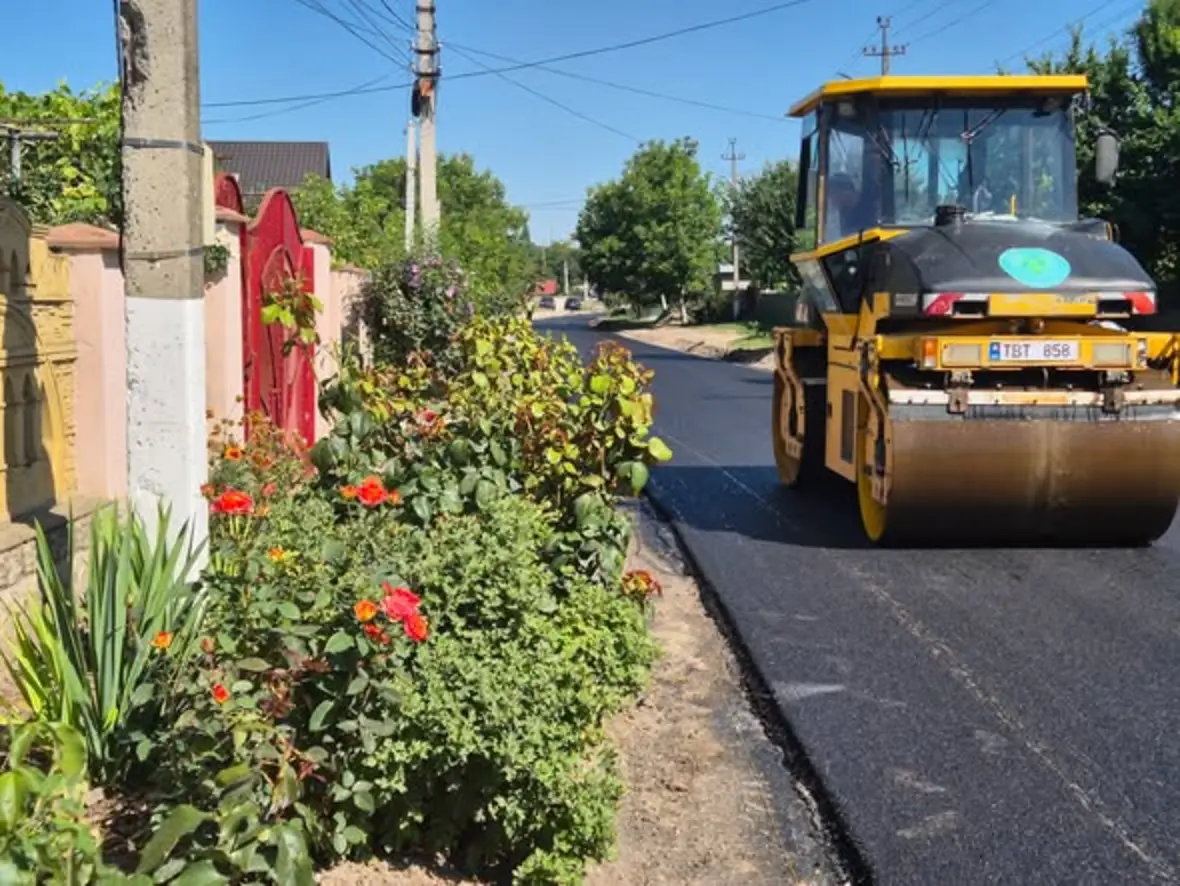
Ungheni City Hall announced on Thursday, 23 July, that it is repairing a new stretch of street: 500 metres of Mihai Viteazul street, from the junction with Oleg Ungureanu street to the grocery shop locals know as “La Maricica”, in the Berești-Vasilica neighbourhood. The work, the administration says, is carried out by the municipal company Servicii Comunale Ungheni, “from the local budget fund”, and deputy mayor Nicolae Cevaga inspected the site. Next in line, according to the same announcement, is the street leading to the railway crossing, past the Apă-Canal headquarters, and the grounds of the Dănuțeni terminus stop. Not long ago, Burebista street had been paved, on the segment between Petru Rareș and Zamfir Arbore.
This is the third such announcement in about a month, after the paving of streets in the Ungheni Vale neighbourhood and of the second segment of Burebista — all presented as work done “from the local budget”. Behind each individual site, however, lies a plan and a financing mechanism that the public records set out in detail.
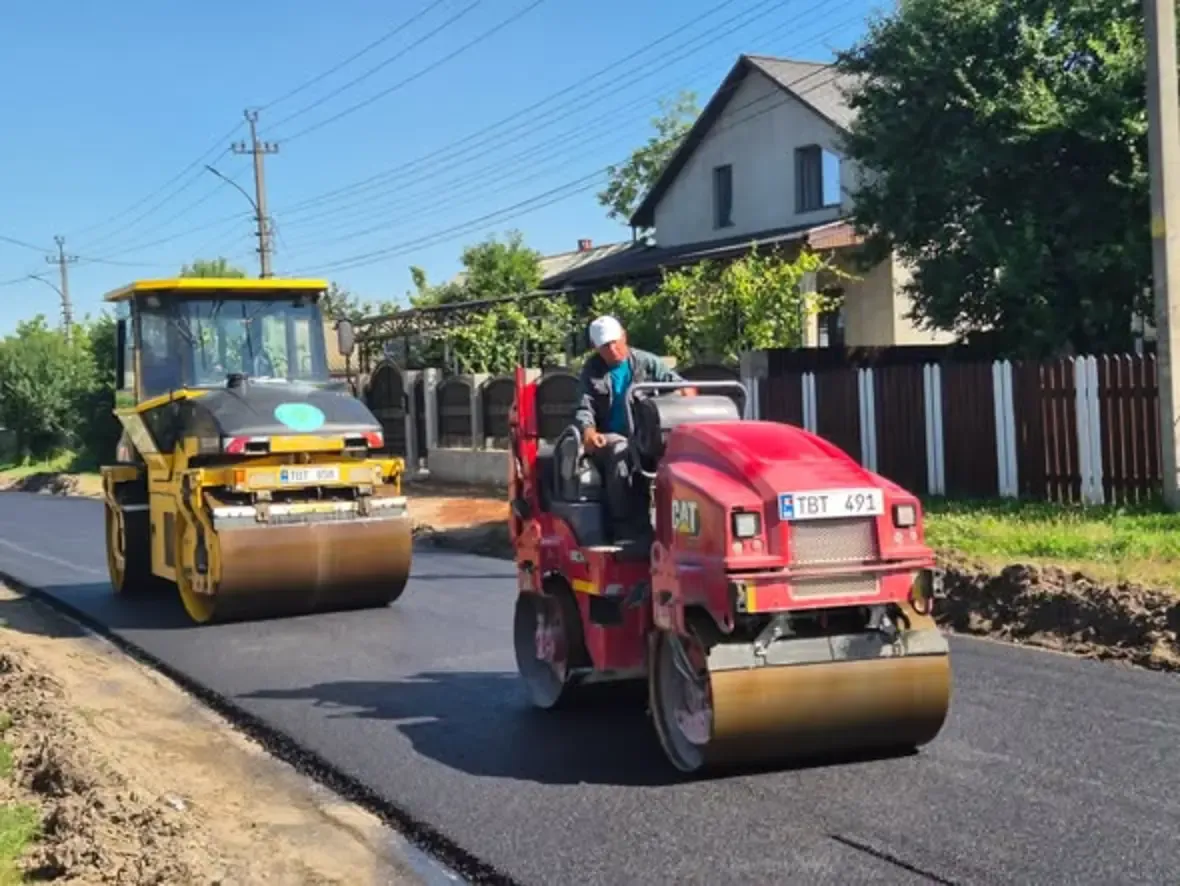 The machinery laying the asphalt on Mihai Viteazul street, in images published by City Hall. Foto: Primăria municipiului Ungheni.
The street is one of 14 on the 10-million list
Mihai Viteazul is not appearing in a city document for the first time. The street figures, by name, in Ungheni Municipal Council Decision no. 4/25 of 15 May 2026, which approves the list of local roads to be modernised this year. In the annex to the decision, at position 14, is entered “Str. M. Viteazu” — 500 metres, 2,500 square metres, paving. The length matches exactly the one in the 23 July announcement.
There are 13 more objects on the same list: Burebista street (700 metres), Arcașii lui Ștefan cel Mare, C. Stamati, Națională, A. Plămădeală, Decebal lane, the pavement on Ștefan cel Mare and others. Among them is also a “Str. Feroviară” of 524 metres — the most likely candidate for “the street toward the railway crossing” now announced as the next one in line, although the decision does not use the “near Apă-Canal” landmark. The grounds of the Dănuțeni terminus stop, by contrast, do not appear on the 2026 list; the last documented repairs there date from 2020 and 2024.
What the decision approves is a ceiling sum, not costs per street:
Se aprobă utilizarea sumei de până la 10 000 000,00 lei, mijloace ce urmează a fi atrase prin emisiunea de valori mobiliare (obligațiuni municipale) în anul 2026, pentru modernizarea drumurilor locale din municipiul Ungheni, cu îmbrăcăminte rigidă sau cu suprafață dură, conform anexei. Ungheni Municipal Council Decision no. 4/25 of 15 May 2026
For each object, the annex lists the physical dimensions and the type of work — but no value in lei. In other words, the public record shows how many metres are being paved on each street and that all of it falls within the 10-million ceiling, but not how many lei Mihai Viteazul, Burebista or any of the others cost. It is the same limit we flagged over the paving of Arcașii lui Ștefan street, also on this list.
”From the local budget” and a “10-million loan” — how they fit together
The phrase “from the local budget” and financing “through municipal bonds” seem, at first glance, to contradict each other. They do not — and the explanation, too, lies in a Council act.
Through Decision no. 3/36 of 27 March 2026, the city approved contracting a long-term loan “in the amount of a maximum of 10.0 million lei, term a maximum of 36 months”, for rehabilitating the road network. The money is raised through an issue of municipal bonds — debt securities that people and firms can buy, a mechanism we explained at length when the city announced it. And the same decision provides, at item 6, that the proceeds obtained from the issue are included in the municipal budget, through a budget amendment.
Thus, a piece of work paid for with borrowed money appears, in accounting terms, to be financed “from the local budget” — because that is where the money formally lands. The phrasing is not false. What it does not say is that the source of that money is a 10-million-lei loan, over three years, which will be repaid, with interest, by the residents of Ungheni themselves — nor how much of it goes to each street.
Who does the work: the city’s own company, in-house
The contractor, Servicii Comunale Ungheni, is a limited-liability company whose sole shareholder is Ungheni Municipal Council — a company with entirely municipal capital, managed by Igor Casian. The same company handles the city’s sanitation, funeral services and, since February 2026, urban public transport on route 5, and among its registered activities is also road construction.
The link between the company and asphalt is not improvised: through Decision no. 5/7 of 20 June 2025, the Municipal Council delegated to the company the management of the maintenance and rehabilitation of the city’s road infrastructure. The decision provides that City Hall “will annually plan in the municipal budget the financial resources needed” for the contract, that the company procures materials “in strict accordance with Law no. 131/2015 on public procurement”, and that responsible for overseeing execution is deputy mayor Nicolae Cevaga himself — the one who inspected the Mihai Viteazul site.
In practice, this means the city does not put the work on each street out to tender, but does it with its own company, which procures the material by tender. Servicii Comunale Ungheni has an ongoing public procurement for “road-surface materials” — asphalt concrete — with an estimated value of around 5.5 million lei; a single bid was entered, slightly above the estimate, and the procedure had not been finalised as of the check. It is the closest public figure to the cost of this year’s paving campaign — but it concerns the material bought, not how many lei go to each street.
This is a lawful model, and a common one for a municipal company. It differs, however, from the city’s other road works, which run on other money flows. Burebista street was modernised by a firm from Strășeni, the pavement on Națională by one from Bălți, and the rehabilitation of Decebal street, toward the free economic zone, is being done through a works contract of nearly 22 million lei, with the firm Aedificator, from government money managed by the Centru Regional Development Agency. There, the contract value is public. For the in-house works of the city’s own company, it is not.
What fits within a 234-million budget
For context: Ungheni’s 2026 municipal budget, approved in December, projects revenue of about 234.8 million lei and stipulates that the city’s debt “will not exceed 10.200,0 thousand lei” — almost as much as the ceiling of the 10-million loan for roads. The 10 million on the paving list therefore represents nearly the entire borrowing margin the city has taken on for this year.
How many lei of that ceiling go to Mihai Viteazul, to Burebista or to Arcașii lui Ștefan remains the one piece of information the published records do not contain. It is not found in the decision approving the list, nor in the public-procurement data, nor in the budget voted by the councillors — and it can be provided, broken down, only by City Hall and the contracting company.
Residents ask for pavements — and for streets already on the list
Under City Hall’s announcement, the reactions also brought a list of requests. A few residents asked when the pavements’ turn would come — on Alexandru cel Bun street, but also, more generally, for the children and pedestrians who walk to school or toward the park. Others asked for the paving of other streets, among them C. Stamati.
The requests touch on two concrete points. First: the work on Mihai Viteazul, like the earlier ones, is on the roadway, not the pavement — and Mihai Viteazul street itself was among the streets for which people were asking for pavements in June, when City Hall announced the pavement on Ștefan cel Mare. Second: C. Stamati street, requested in the comments, is already on the list of roads the Council approved in May — one of the 14 items financed from the same 10-million loan.