
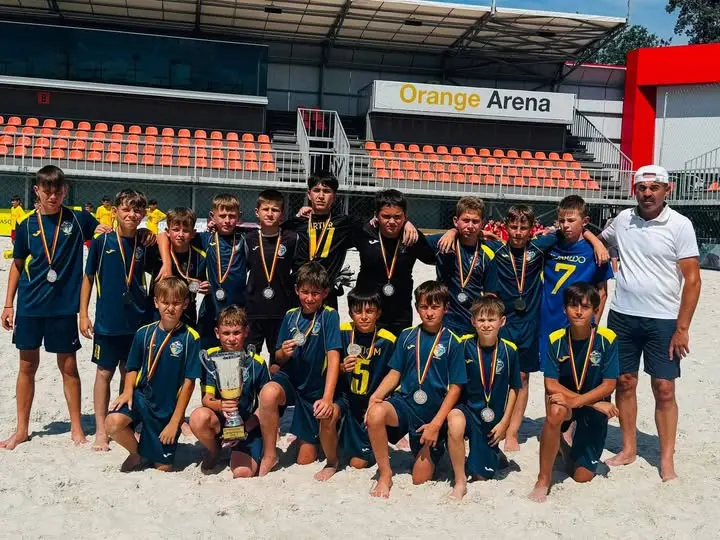
The children who carry the name “Viitorul” Ungheni came back from Chișinău with silver medals around their necks. The U13 age group of the Ungheni District Sports School finished 2nd at Moldova’s national beach soccer championship, 2026 edition — a result announced on 24 July by the club and by the players’ parents, and confirmed the same day by the Sports School, which publicly congratulated the children. The tournament was played at “Orange Arena”, the only sand arena in the country, in the capital’s “La Izvor” park, and the team was coached by Ghenadie Bereghici.
Out of a starting field — which both the club and a parent put at 16 teams — the Ungheni boys climbed to the second step of the podium. The photo published by the club shows them on the sand, lined up with their medals and the runners-up cup, with the “Orange Arena” stand behind them; other images, taken by a parent, are from the official media wall of the “Euro Beach Soccer League Moldova 2026” event, set up at the same arena. The competition’s full standings — who took gold, who played in the final, what the scores were — had not been made public by the organisers at the time of this article; Ungheni’s result rests, for now, on the announcement by the club and the parents and on the Sports School’s confirmation.
A step above the 2023 bronze
For Ungheni’s players on the sand, silver is no one-summer fluke. This team’s start in the 2026 edition we reported in July, back then with no public results. But the roots go deeper: two years ago, the same school reached the podium with a younger squad — at the 2023 edition of Moldova’s national children’s beach soccer championship, the “Viitorul” Ungheni District Sports School took 3rd place (bronze) in the U11 category (players born in 2013–2014), according to the official standings published at the time by the federation that organises the competition. At that same edition, another team from the district, CS Petrești, took 4th place at U17.
From U11 bronze in 2023 to U13 silver in 2026, this is a progression of the same district sports programme — not necessarily the same children on the pitch, since the squads are not public, but certainly the same school, the same sport and the same arena. And the leap is also measured in opponents: in 2023, the three children’s categories — U11, U13 and U15 — were all won by a single club from the capital, CS Atletic. In a competition where clubs from Chișinău have set the tone for years, a team coming from a district that reaches 2nd place does not go unnoticed.
A sport played barefoot, in three periods
Beach soccer resembles classic football only at first glance. It is played five against five — a goalkeeper and four outfield players — on a much smaller sand pitch, roughly 37 by 27 metres, with lower goals and no offside. A match has three periods of 12 minutes each, not two of 45, and the clock stops at every goal or foul. It is played barefoot, with no boots and no studs, with a somewhat lighter ball (around 400–440 grams) that is water-resistant. And a match cannot end in a draw: if the score is level after the three periods, three-minute extra time follows and, if needed, a penalty shoot-out.
These rules make it a physically tough sport — a detail the parents stressed more emphatically than a club press release usually does:
Out of 16 participating teams, after exhausting trips, training at the crack of dawn and heavy scorching heat — and beach soccer is extremely demanding — the Viitorul Ungheni boys still managed to climb onto the podium! Giku Moroșanu, parent
It is not just a figure of speech. Specialist studies confirm that running on sand requires more energy than on a hard surface, that beach soccer is a high-intensity intermittent effort — sprints, jumps, changes of direction — held, for much of the match, above 90% of maximum heart rate, and that it is played in summer, at temperatures that can exceed 40 degrees on the sand. For children of U13 age, a tournament with several matches on such a surface and in such heat is a serious test of endurance, not just technique.
A single arena, in the whole country
All of this happens, in Moldova, in a single place. “Orange Arena” — officially named the FMF Beach Soccer Arena — is the only arena dedicated to beach soccer in the country, built in 2019–2020 in the “La Izvor” park in the capital’s Buiucani district. It was funded for the most part by FIFA — around 80% of a total cost of roughly one million euros — and is described as the first construction of its kind in Moldova and the region. In summer the pitch is sand; in winter it is covered with artificial turf for mini-football.
The fact that there is only one such arena, in the capital, indirectly shows how locally rooted the phenomenon remains: clubs from Chișinău play “at home”, while a children’s team from Ungheni reaches the sand only through travel, accommodation and everything that comes with it. The podium, in this context, is paid for in kilometres too, not just in training.
Who runs the championship
The competition the Ungheni children played in is not organised by football’s main governing body, but by a separate federation: Moldova’s Beach Soccer Sports Federation (FSFPM), a standalone national sports structure, successor to the former Beach Soccer Association and led by Eduard Crețu. It runs the championships — from seniors down to the children’s categories — with the support of the Moldovan Football Federation, which provides the arena. That is also the explanation for the label the club and the parents used when they announced the result.
Beach soccer, moreover, has a longer history than it seems: the first championships were played in Moldova as far back as 2008, and the 2026 senior edition, under way at the same “Orange Arena”, is already the 19th. Ungheni district also has a representative in the seniors on the sand — the FC Real Petrești team.
A youth football “conveyor belt”
The U13 silver finally fits into a bigger picture. In the same summer, the Ungheni District Sports School promoted its U16 junior team to the National League — that is, into the same league as the big clubs’ academies — and came back with the silver from the “Junior Mamaia Cup” with its youngest group, those born in 2018, coached by another coach, Constantin Lungu. Three results across three age groups, within a span of a few weeks, from a single district sports school.
Behind each of them stand the same ingredients that the current posts also list: hours of training, long trips to the capital and parents who accompany their children on their own. These are children, coaches and families from a district that, match after match, are making room for themselves among the capital’s clubs — on grass and on sand alike.
As for the full official standings of the 2026 U13 edition — the champion, the opponents, the scores — those remain to be provided by the federation. For now, in Ungheni there are two more silver medals to count and a new line in the record of a school that, for several years now, has been turning out results on a conveyor belt.