
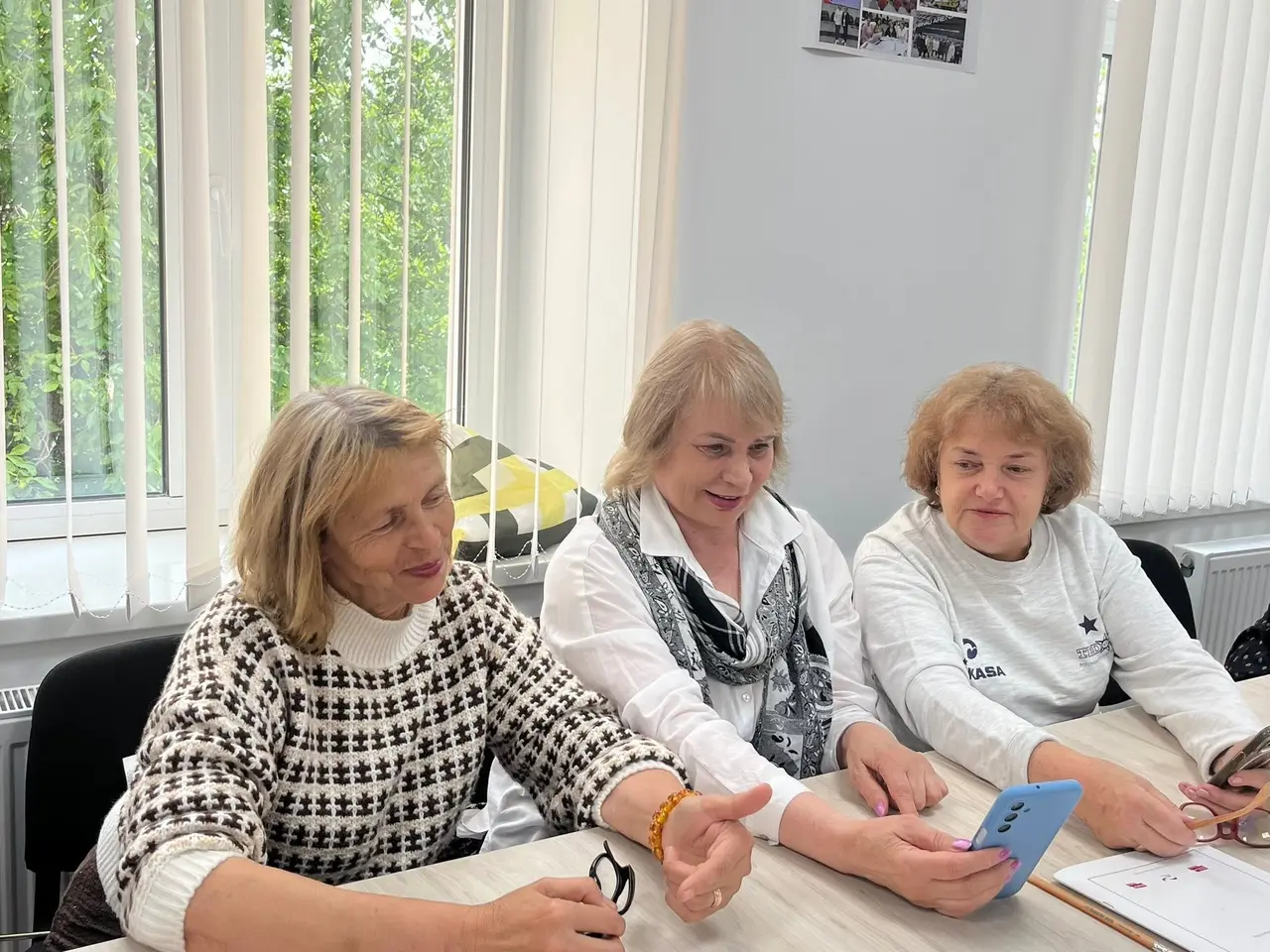
A few older residents from a mutual-support group in the town of Ungheni sat down around a table, phones in hand, to learn something that comes as a reflex to younger generations — how to use apps, the internet and electronic services. The session, titled “Seniors in a Modern Rhythm,” was organised by the HelpAge Mutual-Support Group of Ungheni, which presented it as a way to fight the social isolation of the elderly.
“Digital skills for seniors aim to fight social isolation through learning mobile devices, the internet and electronic services,” the organisers wrote. Around the table, participants also tried their hand at making short videos.
For those who took the step, the stake is personal. “There is always room to learn more, especially for people our age — those of us who did not study technology at school but are eager to keep up with the times,” one participant wrote in the comments on the post. The session’s facilitator, in turn, described an experience in which “together we discovered how easy and useful technology can become in everyday life.”
A district that is emptying out — and ageing
A digital-skills lesson for pensioners looks like a minor event. Read against the district’s figures, though, it touches one of the sharpest realities of today’s Ungheni.
According to the National Bureau of Statistics, almost a quarter of the district’s residents — 24.5%, or about 18,300 people — are over 60 (2025 data, preliminary). A decade ago, that share was 15.9%. More telling still is the direction the numbers are moving in: while the district’s population fell by more than a fifth between 2014 and 2025 — from 96,292 to 74,507 residents — the number of people aged 65 and over went the opposite way, rising by almost a third (from around 9,600 to more than 12,600).
In other words, the district is not only shrinking — it is ageing. Young people leave, and those who stay are, increasingly, the older ones. The same statistic that a graduation ball shows from the side of those stepping onto the stage, a group of seniors lives from the other side of life.
Services are moving online. They risk being left out.
The stake is not only social. The state is moving more and more services onto the internet — from paying bills and taxes through the government’s MPay platform to the citizen’s electronic cabinet or the electronic signature. For someone who has never used a smartphone, each such online step becomes a barrier to very concrete things — an appointment, a payment, a certificate.
And the elderly are precisely the least connected group. National Bureau of Statistics data show that people aged 66–74 use computers and the internet less than any other age group. A sharper picture is on the way: in June–July 2026 the NBS is running a pilot survey on the use of technology in households, which will measure exactly how deep that gap is, broken down by age.
Not an isolated gesture, but the local lever of a wider effort
The Ungheni session is not a one-off. “Mutual-support groups” are the core model of HelpAge — older people organised at community level who help one another — an organisation present in Moldova since 2005. Across the Sângerei, Telenești and Ungheni districts, such groups have been set up in 15 communities, as part of a project dedicated to age-friendly communities.
Ungheni is, in fact, among the 10 districts included in a national active-ageing initiative run with the support of the United Nations Population Fund (UNFPA) and its partners — one that has an explicit digital-literacy component: mobile phones, social networks, online payments. It was in Ungheni, too, that the country’s “first Elderly Club” opened in March 2024, a space where young volunteers teach seniors to use phones and electronic services.
At the national level, the stake is also quantified: the state programme on active and healthy ageing for 2023–2027 sets a target of 25,000 older people gaining digital skills and devices by 2027. The E-Governance Agency, together with HelpAge, has already trained hundreds of seniors to use the public services portal and to pay through MPay.
The town is better prepared than the village
The gap runs not only between generations, but also between town and village. According to Tatiana Sorocan, executive director of HelpAge Moldova, accessibility for the elderly is much better in the town of Ungheni — which she rated 75 out of 100 — than in the district’s rural communities, where the score drops to 20–30. For a pensioner from a village in the district, even getting to such a lesson can be one more obstacle.
How many people took part in the “Seniors in a Modern Rhythm” session, and under which specific project it was organised, were not made public. Beyond the figures, the gesture itself says something simple: in an ageing district, teaching those who remain to use a phone is not a whim, but a way of keeping them connected — to family, to services and to the community.
The “Seniors in a Modern Rhythm” session is described on the basis of the public post by the HelpAge Mutual-Support Group of Ungheni; the quotes are from the comments on the same post. The demographic data come from the National Bureau of Statistics (population by age group, Ungheni district — 2025 preliminary data; concept: usually resident population). Information on the HelpAge and UNFPA programmes, the Elderly Club in Ungheni and the national target of 25,000 seniors comes from official sources (HelpAge Moldova, UNFPA Moldova, the E-Governance Agency, the national active-ageing programme 2023–2027). The figures on internet use by age group are national. The number of participants in the session and the project under which it was held were not made public.