

As of 1 July 2026, 34,700 vehicles were registered in Ungheni raion, of which 23,527 were cars — over two thirds of the total. The figures were confirmed to the newsroom by the Public Services Agency (ASP), in a reply to an information request, and match exactly the data the institution publishes every month, by raion, in its open-data section.
On top of this figure a reform is about to settle, passed by Parliament in first reading on 9 July: the law that will require homologation for every vehicle brought into the country, with the ASP designated as the national homologation authority. And Ungheni is a border raion, one of the gateways through which cars from the European Union enter Moldova.
What the raion’s vehicle fleet is made of
The 34,700 vehicles fall into seven categories. Cars dominate by a wide margin, with 23,527 units — 67.8% of the entire fleet.
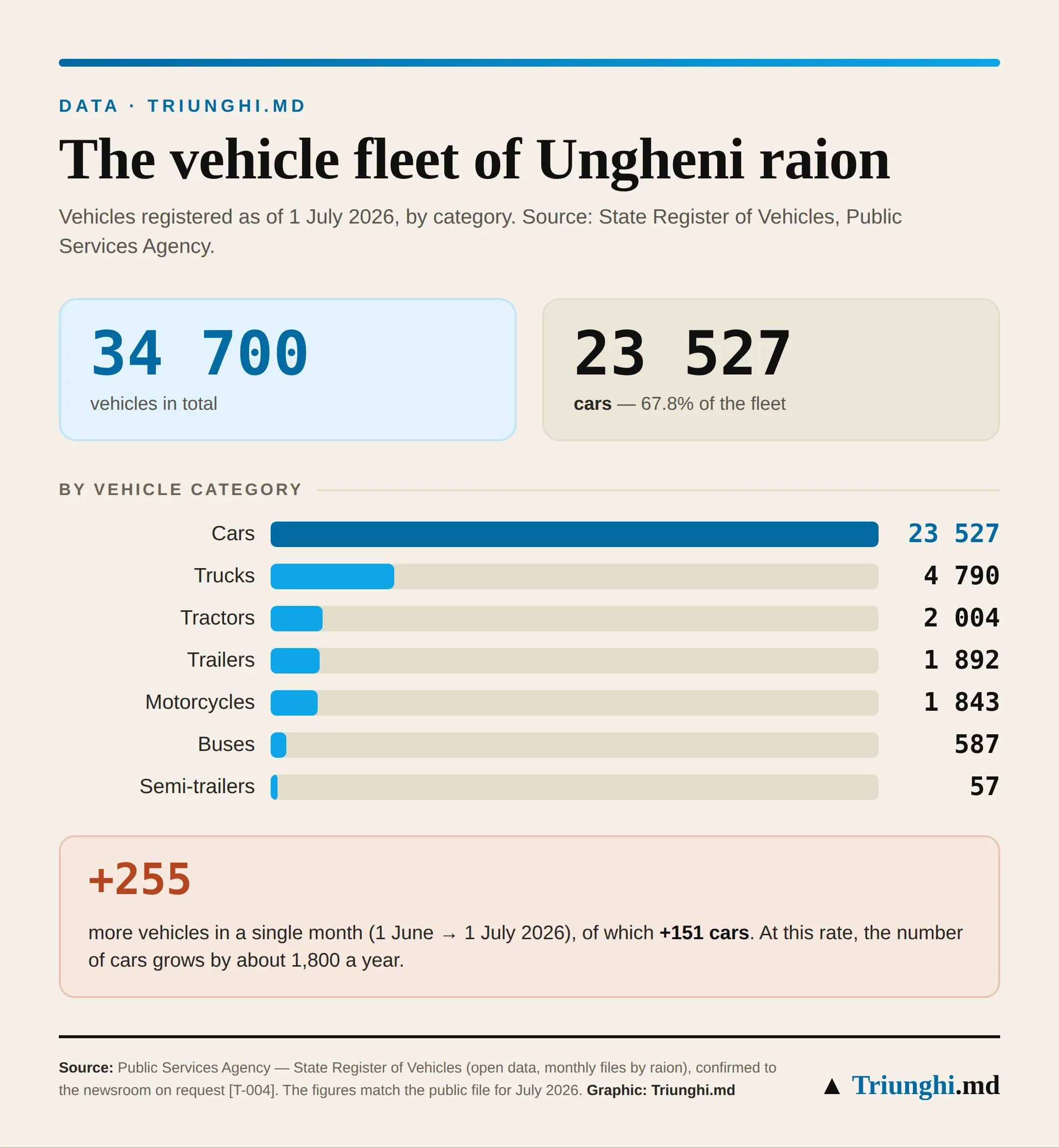
Ungheni raion’s vehicle fleet as of 1 July 2026, by category. Graphic: Triunghi.md. Source: State Register of Vehicles, Public Services Agency.
After cars come trucks (4,790), tractors (2,004), trailers (1,892) and motorcycles (1,843). Buses number 587, and semi-trailers — 57. The sum of the seven categories gives exactly the total reported by the ASP.
The fleet grows month by month. As of 1 June 2026, the raion had 34,445 vehicles and 23,376 cars; in a single month 255 vehicles were added, of which 151 cars. At this pace, in a year the raion’s car fleet would grow by about 1,800 units.
Why this figure was hard to find
Moldova’s motor vehicle fleet is published by the National Bureau of Statistics only at country level — table TRA020100, supplied by the ASP itself, has no breakdown by raion. The raion-level data exist, but elsewhere: in the monthly files the ASP posts in its open-data section, one per raion. The newsroom requested them specifically for Ungheni, and the Agency confirmed them in writing; checking against the public file for July 2026 gives the same figures, down to the last unit.
What the homologation law changes — and what it does not
Here is the nuance that matters for any Ungheni resident with a car. The homologation law does not apply to the existing fleet. Under the text passed in first reading, it enters into force on 1 January 2029 and covers vehicles placed on the market after that date; homologations already in place remain valid. The 34,700 vehicles of today therefore do not go through any re-homologation — they are the backdrop, not the object of the procedure.
What changes is the regime for future imports. In the government’s medium scenario, there would be 36,400 individual homologations a year nationwide — that many used cars brought in as imports that will have to be individually homologated before they can be put into circulation. What this would mean for Ungheni and what it would cost, we detailed in the article about the law: in the government’s tariff table, all eight services still read «x lei» for now, and the only benchmark is the European one — 80–180 euros for an individual homologation.
Where it will be done and what it will cost: the ASP says it is «premature»
The two questions the newsroom put directly to the Agency — whether the registration section in Ungheni (164 Ștefan cel Mare street), one of the nine specialised sections in the country, will be among the subdivisions that carry out individual homologation, and whether there is a tariff estimate — received the same answer: it is premature.
The reason, according to the ASP, has to do with the stage the legislation is at. The draft law is still under examination in Parliament, and the government decision that would approve the regulation is «only at the endorsement stage». Only after these are adopted will the Ministry of Infrastructure, the ASP and the National Road Transport Agency set the package of implementation measures — including «the list and the exact location of the competent ASP subdivisions» and the tariffs.
In other words, how many cars the raion has is known exactly — 23,527. Where those arriving after 2029 will be homologated, and how much their owners will pay, will be decided only after Parliament adopts the law and the government approves the regulation.