

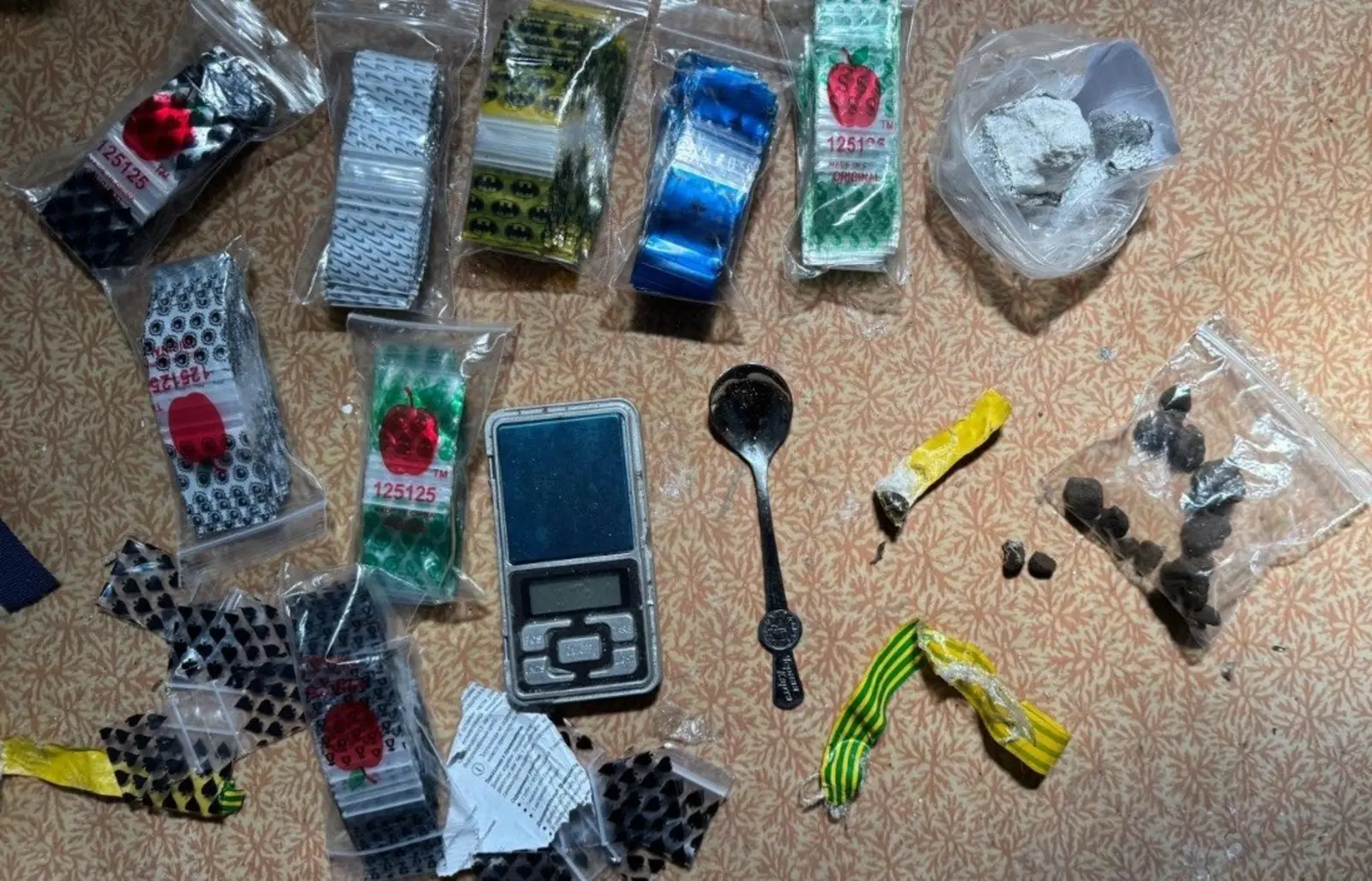
An 18-year-old was detained at his home in Ungheni and placed under pre-trial arrest for 30 days, accused of working as a “courier” for a drug shop that sells through the Telegram app, the Police of the Republic of Moldova announced on Monday, 13 July. According to the press release, officers of the Anti-Drug Directorate of the National Investigation Inspectorate, together with police and prosecutors from the Botanica sector, documented his activity for about a month.
Police say the young man had rented a flat in Chișinău and used it as a warehouse: he collected the drugs in bulk from stashes, took them to the flat, portioned them into doses of 1–2 grams and put them back into stashes, from where they were picked up by users. During the searches, police seized hashish and cocaine, zip-lock baggies, a precision electronic scale, a phone and cash. The value of the drugs taken out of circulation is said to exceed 50,000 lei.
None of this has been proven so far. It is the prosecution’s version, in a case still under criminal investigation, and the young man benefits from the presumption of innocence until a final court ruling. Police have not published his name.
Police also released footage from the searches.
The second 18-year-old in twelve days
The case is not an isolated one, and that is the part that matters. On 1 July, twelve days earlier, police had announced another 18-year-old, detained on 25 June in Chișinău “while he was on his way to place a new batch of drugs in stashes”.
The description in the two press releases is almost identical: courier for an online shop, a rented flat used as a warehouse, doses of 1–2 grams, zip-lock baggies, a precision electronic scale, goods valued at over 50,000 lei, 30 days of pre-trial arrest.
These are two separate cases — different investigations, different sectors, different drugs — and police have not said they are linked. But the pattern is the same, because the business model is the same. The press releases repeat because the scheme repeats: the bottom role in the chain is filled with 18-year-olds, and when one falls, he is replaced.
What decides the sentence: the grams, not the lei
Police write that the young man faces between 7 and 15 years in prison. That figure has an exact source in the Criminal Code, and it says more than it seems.
Selling drugs, in itself, carries 2 to 5 years in prison — art. 217¹ para. (2) of the Criminal Code. The 7–15 year range appears in a single place: para. (4) of the same article. And it is reached only in two situations — either the offence is committed “by an organised criminal group or a criminal organisation, or for their benefit”, or the drugs are “in especially large quantities”.
In other words, what could cost this young man three quarters of his youth is not the fact that he allegedly sold drugs, but the fact that he allegedly did so for a network. The lowest link pays for the size of the whole scheme.
Between the two tiers sits one more, para. (3), carrying 3 to 7 years, for aggravated forms — among them an offence committed by two or more people, in “large quantities”, or on the grounds of an educational institution or in its immediate vicinity.
As for “especially large quantities”, Government Decision no. 79/2006 sets exact thresholds: more than 50 grams of hashish, and more than 5 grams of cocaine. This is where the gap in the press release appears. Police published how much the goods are worth in lei, but not how much they weigh in grams — even though the law looks at grams, not lei. From the published information it is impossible to check which tier the case falls under, meaning not even whether the sentence starts at 2 years, at 3, or at 7.
Police also did not specify which of the two variants of para. (4) he is charged under.
Why the networks look for couriers who are exactly 18
Here is the mechanism worth understanding for every parent in Ungheni, and it is written in black and white in the Criminal Code.
For this offence, criminal responsibility begins very early: art. 21 para. (2) provides that even a 14-year-old child can be held criminally responsible for the illegal circulation of drugs for the purpose of sale. It is one of the few offences for which the law goes that low.
But art. 70 para. (3) says something else: if at the time of the offence the person had not turned 18, the sentence is set “from the maximum penalty provided by criminal law for the offence committed, reduced by half”.
The arithmetic is brutal. At 17, the ceiling for this charge would have been 7 and a half years. At 18, the ceiling is 15. The day you come of age doubles the maximum sentence — but it changes absolutely nothing about what the person carrying the package knows, earns, or how easily they can be replaced. For whoever runs the scheme, an 18-year-old courier is just as available as a 17-year-old, except that the state hits him twice as hard. The risk shifts entirely onto his shoulders.
The network, on the other hand, stays anonymous. In a report presented in Parliament in February, the Ministry of Internal Affairs showed that payments in such shops are made in cryptocurrency, and that Telegram, although it blocked channels flagged by the authorities, did not provide the administrators’ data.
The seized goods are worth more than four Ungheni salaries
It is worth putting side by side what each link in the chain earns. The figures are official; the comparison is ours.
The “over 50,000 lei” in the press release means more than four average monthly wages in Ungheni raion — that is, more than four months of work. The average monthly gross wage in the raion in 2024 was 11,321 lei, according to the National Bureau of Statistics.
How much the courier was paid for this is not known: we found no public figure on the pay of a drug courier, neither in the police press releases, nor in the Police activity report for 2025, nor in the national anti-drug report. What is known is how much the other end of the chain earned. In a 2021 case, police announced that the administrator of a Telegram drug shop was making “daily revenues of over 10,000 lei” — nearly a month’s average wage in Ungheni raion, every day.
What is known for certain is what happens to the couriers. Two men who picked up drugs for an online shop run by an anonymous person on Telegram were sentenced to 11 and 8 years in prison, the Prosecutor’s Office announced. A 21-year-old got 10 years. The anonymous figure on Telegram appears in none of the sentences.
And the economic gravity is real and measurable. In 2024, an employee in Ungheni raion earned an average of 11,321 lei gross per month, compared with 16,955 lei in the municipality of Chișinău — a third less. The young man detained now lived in Ungheni and, according to police, worked in Chișinău.
The market has shifted to synthetic drugs
What kind of goods these shops sell can be seen in police seizures. Comparing the Police activity report for 2025 with the previous year, the picture is clear:
| Substance | Seized in 2025 | In 2024 | Change |
|---|---|---|---|
| Amphetamine | 12,473.7 g | 847.3 g | 14.7 times more |
| MDMA (ecstasy) | 12,347.5 g | 3,480.3 g | 3.5 times more |
| PVP | 36,812.5 g | 12,698.5 g | 2.9 times more |
| Mephedrone | 21,998.4 g | 10,278.3 g | 2.1 times more |
| Cocaine | 3,662.1 g | 1,517.3 g | 2.4 times more |
| Hashish | 20,391.5 g | 20,499.1 g | practically unchanged |
Synthetic drugs — precisely the goods that split neatly into doses of 1–2 grams and are delivered through stashes — have exploded. Hashish, the “classic” drug, has stayed flat.
In parallel, drug-related offences rose from 1,033 in 2024 to 1,301 in 2025, according to the Police activity report. Data from the National Bureau of Statistics, which counts slightly differently, show the same direction: 1,347 offences in 2025, and the first quarter of 2026 — 478 cases — is the heaviest quarter in the entire statistical series that began in 2015.
It is also worth saying what the data do not show. The 2024 national anti-drug report analysed 692 people investigated for drug trafficking: 395 of them (57%) were over 30, 145 were between 18 and 24, and 29 were minors aged 16–17 — almost double the 16 recorded in 2023. The data are not broken down by role, so it cannot be said that “most couriers are young”. What can be said is that the number of minors investigated almost doubled in a single year.
Ungheni is not off the map
The temptation is to treat this as a Chișinău story that just happened to touch an Ungheni resident. The data say otherwise.
In 2024, 17 drug-related offences were recorded in Ungheni raion, according to official statistics — 1.6% of the 1,075 nationwide, a level comparable to Soroca (17) or Briceni (16), and among the highest of the raions. The capital concentrates the market: 674 of the 1,075 cases, that is 62.7%. This is exactly the geography of the current case — the courier from home, the market in the capital.
And Telegram shops have not bypassed the raion. In May 2025, the Ungheni Prosecutor’s Office, the raion police and the National Investigation Inspectorate detained three people, aged 38, 24 and 22, accused of setting up an illegal shop on Telegram through which they allegedly put drugs into circulation on the territory of Ungheni raion. More than 4.5 kilograms of substances were seized then, valued at around 2.5 million lei.
There is also silent proof that the problem is old and entrenched: Ungheni raion is one of the 29 territories in the country where harm-reduction programmes (needle exchange) operate, and Ungheni District Hospital hosts one of the few opioid-dependence treatment points in the Republic of Moldova, according to the national anti-drug report. Services like these do not open where they are not needed.
Not least, the “courier” role is already familiar to us. In June, two “couriers” of an online investment scam were detained in Ungheni — one of them was also 18 — who physically collected the money from an Ungheni woman defrauded of 436,620 lei. The same architecture, different goods: the organisers stay anonymous, behind the apps, while on the ground works a young man who can be caught.
What changes from 28 August
The law under which this case is being judged is about to get tougher. On 9 April, Parliament passed in first reading, with 89 votes, new penalties for drug dealing and for the online promotion of banned substances: 2–4 years for online promotion, 4–7 years for offering and distributing, 10–12 years when the offence is committed by an organised criminal group. The penalty for drawing in minors would rise from 3–7 years to 5–8 years. Entry into force is planned for 28 August 2026.
In the explanatory note to the bill, MPs cited 7,106 offences and 20,044 administrative violations related to drugs, recorded between 2019 and 2025.
What is being done in schools, and where to call
The Ministry of Internal Affairs and the Ministry of Education and Research have launched a joint plan for preventing drug use in schools, in which “more than 400 police officers with psycho-pedagogical training” are to be directly involved, alongside form teachers, medical staff and addiction doctors, in order to spot the signs of drug use early.
The joint plan for preventing the use and distribution of banned substances in schools aims to protect every pupil and to maintain the safety and well-being of children and young people. It sends a clear message: protecting children and preventing drug use in the educational environment is a national priority.
Daniella Misail-Nichitin, Minister of Internal Affairs
The Minister of Education, Dan Perciun, linked prevention to pupils’ capacity “to make responsible decisions and to cope with the pressures of the social environment”.
For a parent in Ungheni, the signals worth a conversation at home are not exotic: money or new belongings the child cannot explain, a phone he will not part with and turns screen-down, short and frequent trips with no reason, or a vaguely described “job” in which it is unclear who pays and for what. In one case where police dismantled a drug “call centre”, people were recruited through ads “that did not specify the nature of the activity”, and were then threatened with violence if they spoke about the work.
Reports can be made by calling 112. The Ungheni Police Inspectorate, headed by chief commissioner Vasile Burlacu, is the structure that handles such cases in the raion.
Until a final court ruling, the 18-year-old remains an innocent person before the law. The arrest warrant in his name expires in August.