

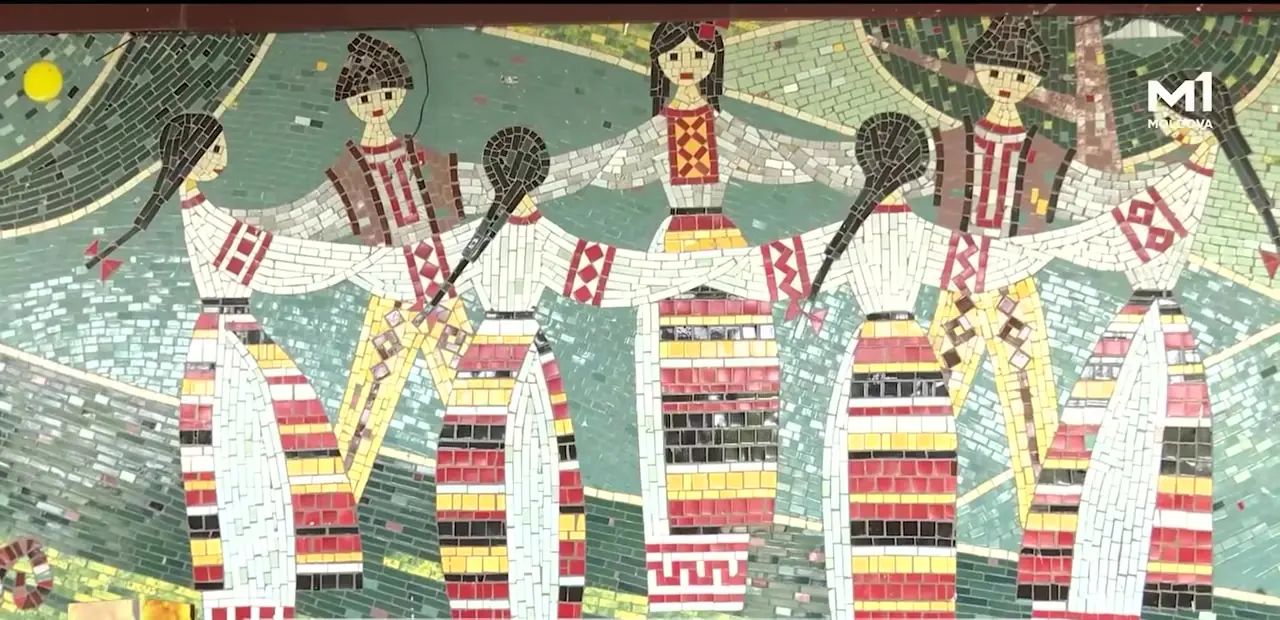
Five girls in blouses with red embroidery and red-striped skirts hold hands in a round dance that has not ended for over half a century. The mosaic is simply called «Hora cu cinci fete» — the round dance of five girls — and it is the best-known artwork of Măcărești village, in the Ungheni district. Except that this round dance stands on the wall of a building that is collapsing, and in the eyes of the state neither the dance nor the building exists: the Măcărești House of Culture is not listed among the state-protected monuments.
A recent reportage by the «Live Studio» show on Moldova 1 and a public appeal to the Minister of Culture have brought the ruined building back to people’s attention. Below the reportage, a post signed Alina Matei asks Minister Cristian Jardan to include the House of Culture in a heritage conservation and restoration programme. It is a necessary gesture — but the underlying question, which neither the reportage nor the appeal touches, is another one: how do you save a heritage the law does not recognise as heritage?
A round dance set in stone, with faces from the village
«Hora cu cinci fete» is not a painting but a monumental mosaic — thousands of coloured tiles composing, on a green background, five young women in folk costume. It is part of a larger ensemble of mosaics covering the façade and portico of the House of Culture, with village scenes, pipers, a lyre and musical notes.
According to the Moldova 1 reportage, the mosaic depicts the faces of real girls from Măcărești and was supposedly made by students who came from Moscow on internship. This last point — the authorship of the work — is not documented in the public sources about the mosaic and should be taken for what it is: an oral testimony from the village, not an established historical fact.
What can be said with certainty is that the work has already entered literature. «Hora cu cinci fete» is also the title of a book by writer and photographer Ștefan Susai, published by Junimea in Iași in 2017 — documentary fiction in which the Măcărești mosaic becomes the emotional centre of a story. On his own website, Susai places the mosaic «in the lobby of the Măcărești House of Culture». A provincial mosaic from a village on the Prut thus came to give its name to a book printed abroad — a notoriety few works of this kind in Moldova enjoy.
The reportage «Casa de cultură din Măcărești – între patrimoniu și ruină», produced by the Live Studio show on Moldova 1 (TRM).
How the heart of the village became a ruin
The Măcărești House of Culture was built in 1972 and, according to a TVR Moldova reportage from December 2022, has never been repaired since. The last show was held in 2005, after authorities determined the building was no longer safe. Since then, the hall where round dances were danced, plays were staged and films were screened has become what the camera shows: a collapsed ceiling, broken chairs, fallen plaster. Above the stage, a single inscription has survived — the old slogan «ARTA APARȚINE POPORULUI!» («Art belongs to the people!»).
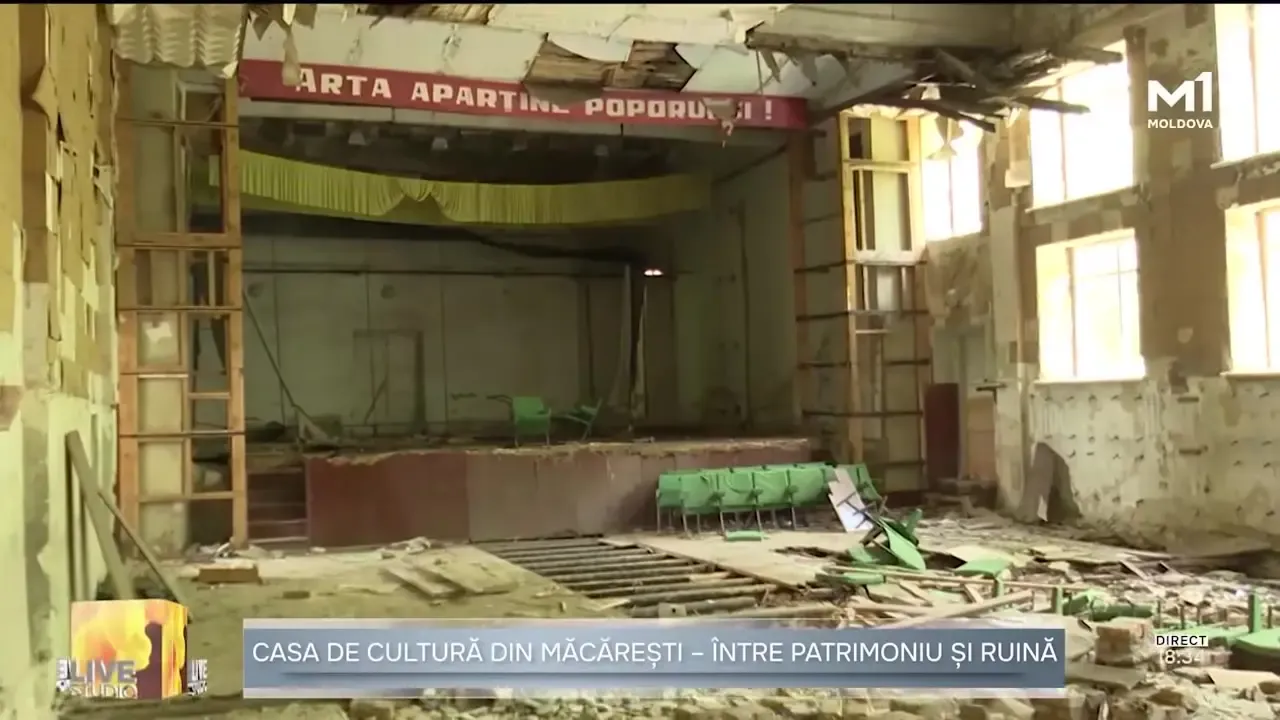
The interior of the Măcărești House of Culture, in the Live Studio / Moldova 1 reportage.
The building was not, however, left entirely to its fate. The TVR Moldova reportage noted that in 2013 the Ungheni district council — then led by Iurie Toma, a former district president — allocated money for a partial roof repair, and in 2015 for replacing the windows. Mayor Sergiu Manciu likewise links the roof repair to the former district president. These are exactly the works the public appeal invokes: roof redone, windows replaced — and, for all that, a building still deteriorating.
What is missing is the hard part. In the Moldova 1 reportage, Mayor Sergiu Manciu describes a works estimate prepared for the rest:
The project provides for sound systems, a fire-protection system, a heating system — five systems. But the project also involves a huge sum of money that the Măcărești town hall does not have. We are talking about 30 million lei. Sergiu Manciu, mayor of Măcărești
For comparison, in 2022 TVR Moldova estimated the repair cost at over 750,000 euro. Whatever the exact figure, the order of magnitude is the same — far beyond a local budget. The solution the mayor sees is either outside funding or small steps:
We have to find extra-budgetary funding somewhere in Europe, in Brussels. Or a solution to renovate it in stages: we have a little funding, we do one stage, we move to the next. Sergiu Manciu, mayor of Măcărești
The treasure the law does not see
Here comes the fact the appeal does not state. To ask for a building to be included in a heritage restoration programme, that building usually needs to be recognised as heritage. Yet the Măcărești House of Culture and its mosaics do not appear in the Register of monuments of the Republic of Moldova protected by the state.
The register, approved by a Parliament decision back in 1993, contains for Măcărești village only three entries: the wooden church «St. Gregory the Theologian», from 1808, and two monuments to soldiers fallen in World War II. No house of culture, no mosaic. In other words, the village’s best-known artwork — the one that gave a book its name and is listed as a tourist landmark — has, for now, no legal protection status at all.
This is not a bureaucratic detail. Without monument status, a building has no priority in conservation programmes, and a botched intervention on the mosaic — a «they fixed it as best they could» — breaks no rule, since the work is not, in the eyes of the law, a heritage asset. The first battle for «Hora cu cinci fete» is therefore not one of money, but of recognition.
The money that came — and where it went
Măcărești is not a village bypassed by public money. Through the government’s «European Village» programme, the commune has drawn over 8 million lei in recent years: about 1.76 million for insulating the «Izvoraș» kindergarten and 6.35 million for a water main in Frăsinești, the neighbouring village in the same commune. Real, useful investments — a warm kindergarten, water at the tap.
Except that not a single leu of that money reached the House of Culture. It is a choice few would openly contest — between a functioning kindergarten and a mosaic, the town hall went with the kindergarten. But that is precisely what shows how fragile cultural heritage is when it competes with basic needs: when money is scarce, the dance on the wall always loses to the water pipe.
What can realistically be done
For buildings like this there are, in theory, funding vehicles. «European Village 2» aims, nationwide, to renovate 77 houses of culture. And the National Strategy for Culture and Heritage 2025–2035, approved by the government, has an implementation plan for 2026–2030 that includes the inventory and restoration of monuments.
One nuance, however, is essential. These programmes target, as a rule, the building — roof, walls, installations. Repairing the mosaic itself, a monumental work of art, is a separate operation of specialised restoration, requiring different craftsmen and different money than an ordinary renovation. Saving the hall without touching the mosaic correctly, or the other way round, would mean solving the problem by half.
The Minister of Culture, Cristian Jardan, appointed at the end of 2025 in the government led by Alexandru Munteanu, is the one the appeal addresses. For now, the most concrete thing Măcărești has is not an answer from the ministry, but a mosaic that has, paradoxically, held up better than the building around it: the round dance of five girls stands whole on a cracked wall, beneath a rusted slogan that still says, without irony, that art belongs to the people.