

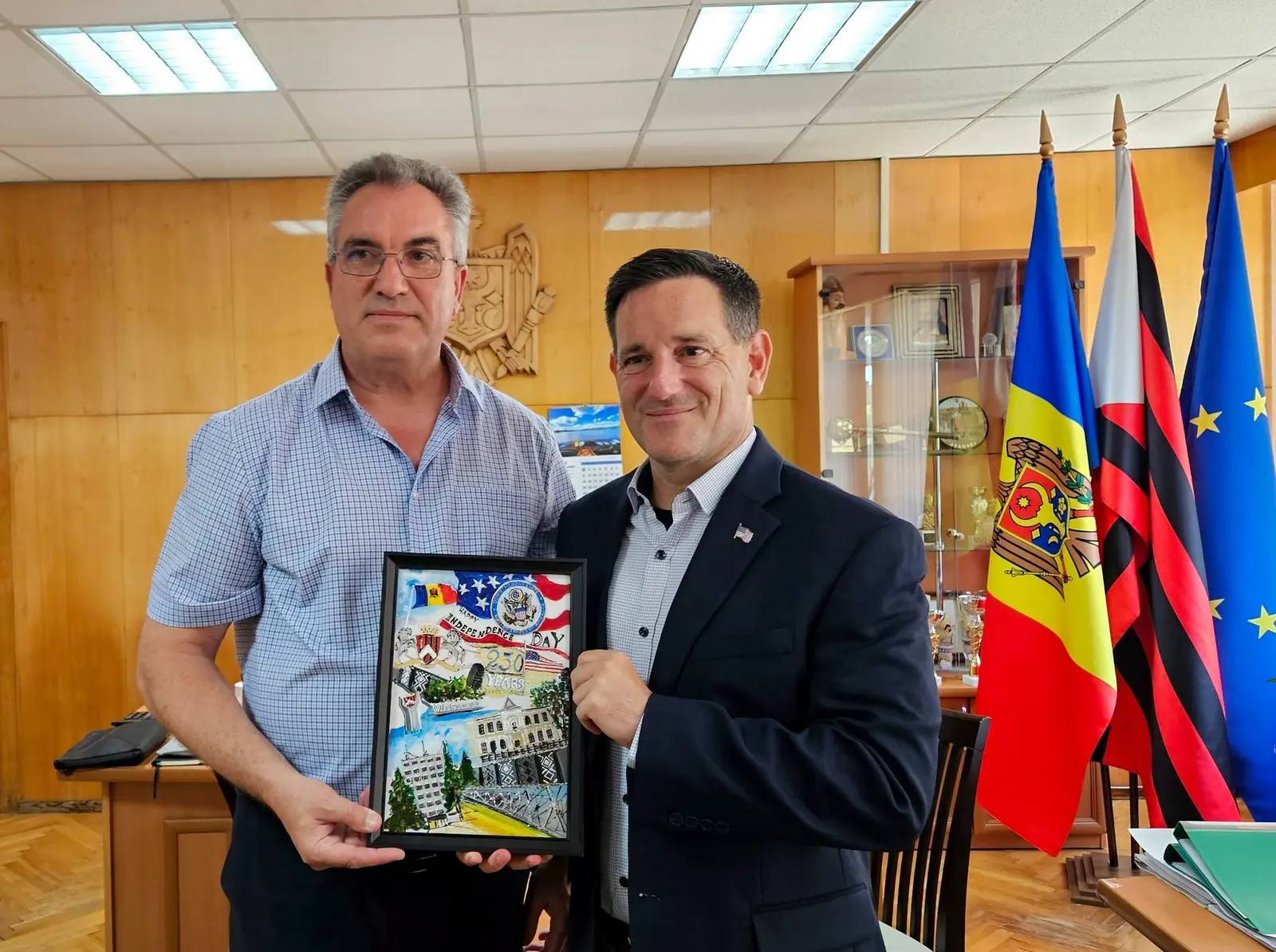
On 16 July, Mayor Vitalie Vrabie welcomed a high-ranking guest to Ungheni: Nick Pietrowicz, the U.S. Embassy’s Chargé d’Affaires a.i. in the Republic of Moldova. According to the City Hall, the discussion touched on voluntary amalgamation, economic development and road infrastructure, and the American diplomat spoke about “commercial diplomacy” and the United States’ interest in partnerships with companies. Beyond the protocol photo, the useful question for the people of Ungheni is a different one: what, concretely, does America mean for their town in 2026?
According to the City Hall’s account, the official said:
The United States is interested in partnerships with commercial companies and sees Ungheni as having great potential for commercial diplomacy. Nick Pietrowicz, U.S. Embassy Chargé d’Affaires a.i., as quoted by Ungheni City Hall
He thanked the local administration for its willingness to implement new projects and, again according to the source, told his hosts: “You are efficient, with a positive attitude” — a message he says he will carry to American companies. A necessary clarification: as of this article, the meeting was confirmed only by Ungheni City Hall, the U.S. Embassy not having yet issued its own statement.
Who the diplomat is — and why “acting”
Nick Pietrowicz has led the American diplomatic mission in Chișinău as Chargé d’Affaires a.i. since 4 August 2025. “Acting” is not a protocol detail: the post of full U.S. ambassador to the Republic of Moldova has been vacant since 2024, when Kent Logsdon left it. Since then, the embassy has been run by a succession of chargés d’affaires, and Pietrowicz is at the same time the mission’s deputy chief.
“Life as a Diplomat,” at the American Corner
The visit also had a public component: a session in the “Meet U.S.” series on “Life as a Diplomat,” hosted on Thursday, July 16, at 14.00, by the American Corner at the “Dimitrie Cantemir” District Public Library. According to the announcement published by American Corner Ungheni, participants learned how the U.S. Embassy in Moldova works, what role diplomacy plays in international partnerships, and what a diplomat’s job concretely involves; the session ended with a Q&A round.
“Commercial diplomacy” has, in Ungheni, a single address
When an American diplomat speaks in Ungheni about commercial partnerships, the tangible local reference point is a single one: the Lear Corporation factory in the “Ungheni-Business” Free Economic Zone. Opened in 2010, it makes covers and upholstery for car seats — not wiring harnesses, as is sometimes believed — a segment that reaches, through the sister plants in Poland and Hungary, brand-name cars.
Is it “American”? Yes and no. The parent company, Lear Corporation, is headquartered in Southfield, Michigan, and appears in the Fortune 500 ranking. The investor of record, the one listed in the documents, is however a Dutch holding of the group — which is why, in the official statistics of free-zone investment by country of origin, the capital in Ungheni appears as Dutch, not American.
How much does it weigh, in jobs? Here the figures call for caution. The number of Lear employees in Ungheni has not been public for a long time: the last official figure, around 1,500, was stated by the factory’s management over a decade ago. The reliable, up-to-date data are those of the whole zone: as of 31 December 2024, the “Ungheni-Business” FEZ counted 2,610 employees — the second largest of the country’s six free economic zones, after Bălți — and cumulative investment of 121.4 million USD, according to the Ministry of Economic Development’s report. For reference, the whole Ungheni raion had about 16,349 employees in 2024, according to the National Bureau of Statistics: the free zone alone accounts for nearly one in six.
A real core, but not without cracks: the zone’s industrial output fell by 20.9% in 2024, and nearly two thirds of its land remains undeveloped. Here, “commercial diplomacy” would make sense if it brought new orders or investors. For now, it is an announced intention, not a signed contract.
What America meant until now — and the chapter that closed in 2025
The American traces in Ungheni are not a legend; they are things you can touch. 146 modern bus stops, from a 13.9 million lei project, of which about 8.6 million came through the USAID “My Community” program. A fire station built from the ground up with over 470,000 dollars from the U.S. Government’s Humanitarian Assistance Program, inaugurated in 2022, which serves 72 localities. The “Model Court” reform at the Ungheni Court, a 5.6 million dollar USAID project. The irrigation system at Blândești, part of the large American MCC program.
Except that this list is, in good part, in the past tense. In 2025, the Washington administration froze and then dismantled USAID, the agency through which most of this money came, and its responsibilities were taken over by the State Department. One Ungheni project felt it directly: the multimodal terminal at Berești, launched with American support, is now seeking funding from the European Union. This, in fact, explains the change of vocabulary — from American “aid” to “commercial diplomacy”: from public grants to private trade and investment.
Two American cities on Ungheni’s map
The relationship is not new. Ungheni has been twinned with Winston-Salem, in North Carolina, since 2000 — the first city the municipality twinned with after independence, from a list that has today grown to over twenty. A second agreement, with Mankato (Minnesota), dates from 2011; it appears, however, only in Ungheni City Hall’s records, without confirmation on the American side.
The bottom line is, therefore, a sober one. A courtesy visit, with warm words and no signature. A single investor with American roots holds the bulk of the industrial jobs in the free zone, but is going through hard years. And the legacy of American public projects came to a halt along with USAID. The “great potential” invoked by the diplomat has not, for now, been accompanied by a concrete commitment — and that is precisely why what follows the handshake matters.