
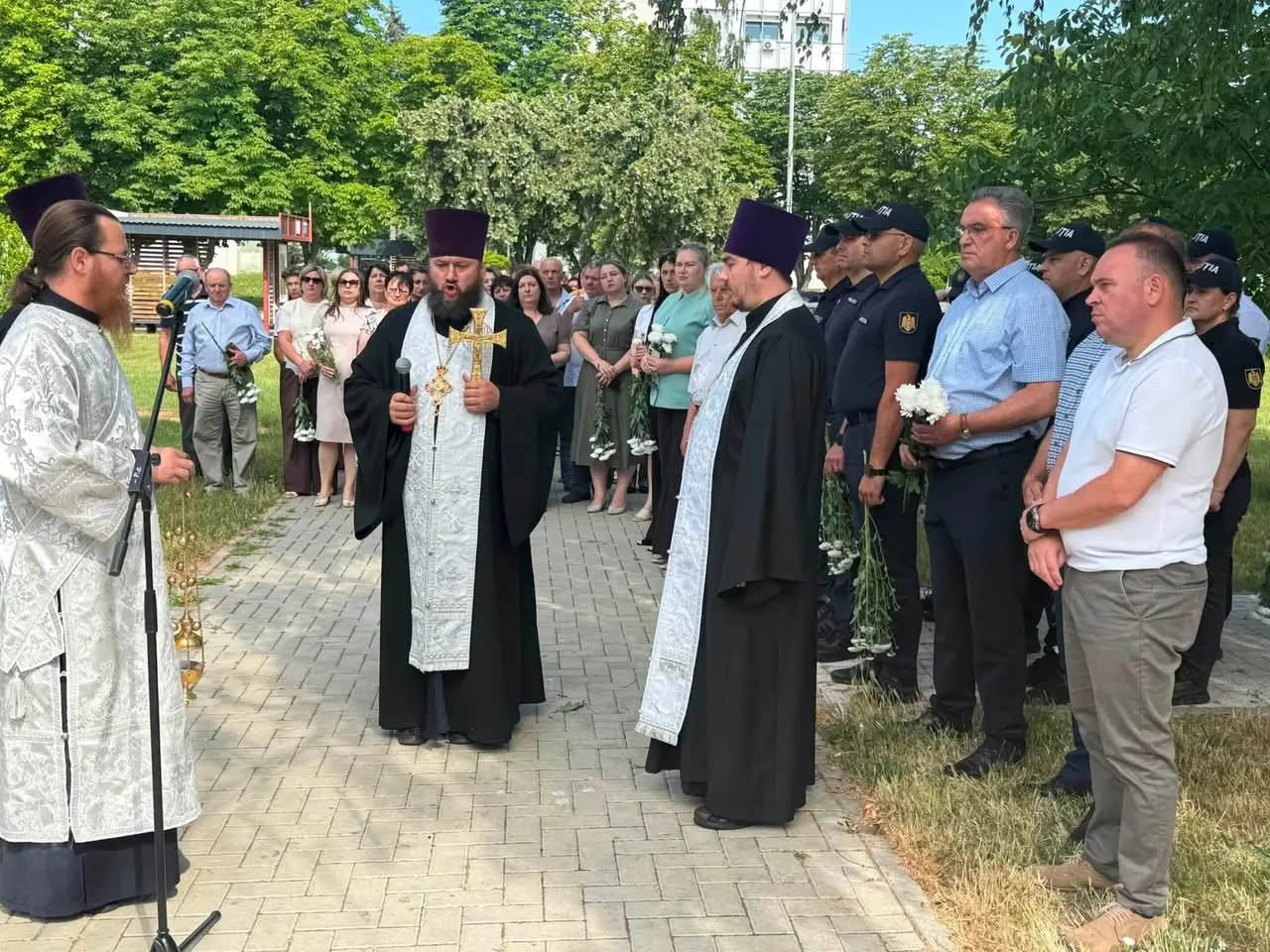
On Monday, 6 July, dozens of Ungheni residents gathered at the Martyrs’ Cross of the Nation in Ungheni, white flowers in hand. The date is no accident: it marks 77 years since the largest wave of deportations in the history of Bessarabia, the one on the night of 5–6 July 1949. In the Republic of Moldova the day is officially observed as the Day of Remembrance for the Victims of Stalinism and a day of national mourning.
Priests, officials, police officers and ordinary residents attended the ceremony. Three clergymen held a memorial service for those deported, persecuted and denied the right to a free life, while people listened, flowers in their arms. The ceremony ended with the laying of flowers at the cross and a moment of silence.
”A moral duty of every generation”
Ungheni district head Dionisie Ternovschi, present at the ceremony together with the District Council team, tied the memory of the past to the responsibility of the present.
Keeping alive the memory of the victims of deportations and Stalinist repression is a moral duty of every generation, and honouring the past is the foundation for building a future based on freedom, dignity and respect for human rights. Dionisie Ternovschi, head of Ungheni district
”A night that has not ended yet”
The heaviest moment of the commemoration was not a speech but a monologue. Actor Edgar Bunea, artistic director of the Ungheni Palace of Culture, delivered a text about the night of the deportations before those gathered: “How can I tell you about a night that has not ended yet?”. Ungheni City Hall published the performance:
The thousands of names behind the date
In just a few hours, on the night of 5–6 July 1949, the Soviet regime pulled thousands of families from their homes across Bessarabia, loaded them into cattle wagons and sent them to Siberia and Kazakhstan. It was the second major wave, after 1941, when it was mainly the village elites who were deported.
For Ungheni district, the local scale of the tragedy is measured in the “Book of Memory”, the official catalogue of the victims of totalitarianism: the district’s section alone gathers around 2,900 names from more than 60 localities. These were people whose only fault was that they had worked hard or had been someone in their village.
The Monday ceremony had been announced by City Hall a few days earlier, with the message “Let us not forget”. What 6 July means for Ungheni and why the memory of the deportations counts thousands of names we explained at length in the announcement article.