

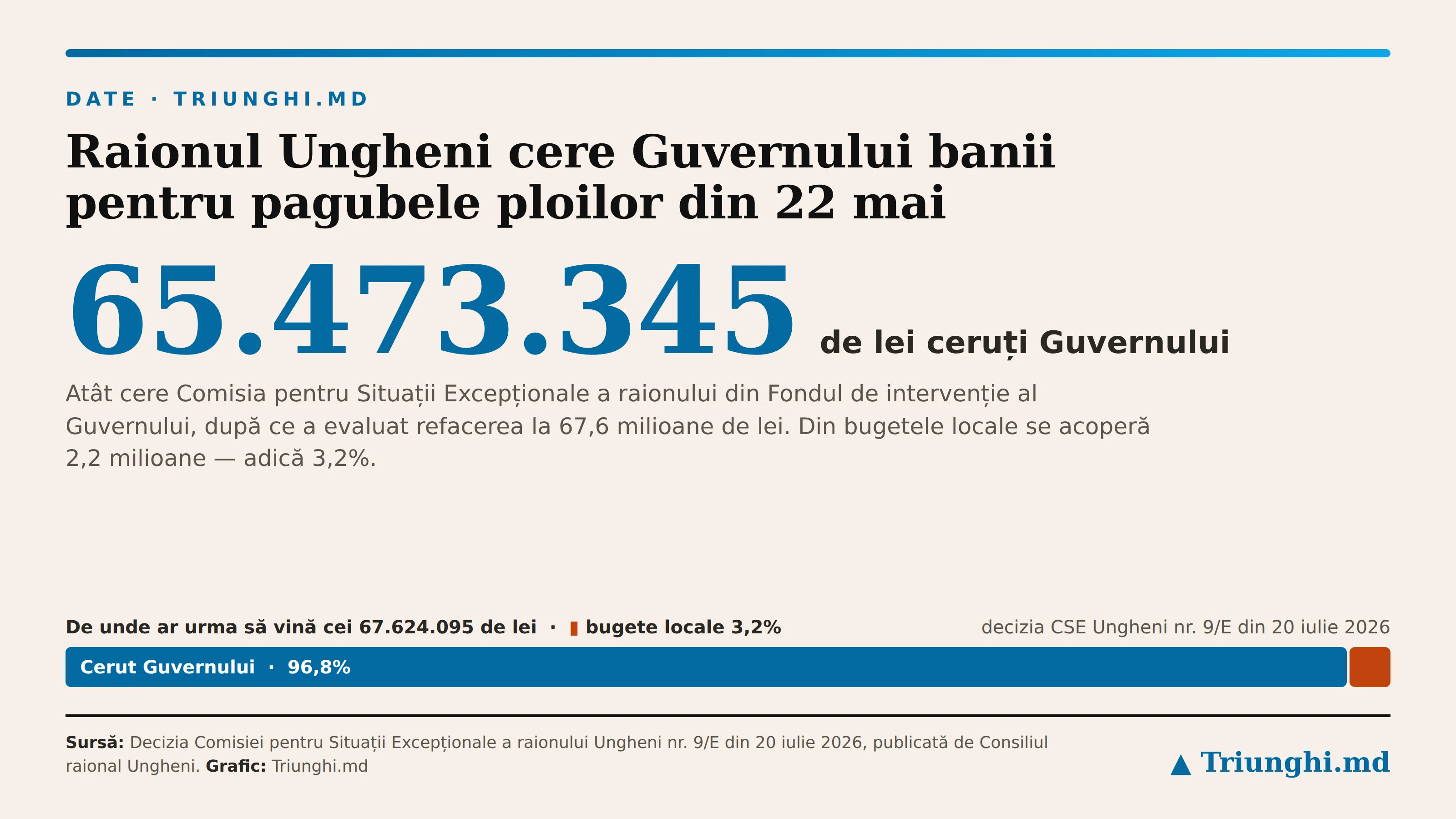
On 20 July, the Ungheni raion Commission for Emergency Situations approved the figures for the damage left by the torrential rain and strong wind of 22 May: direct material damage assessed at 39.923.838 lei and a requirement of 67.624.095,03 lei to bring the damaged facilities back into working order. Of that sum, the budgets of the town halls and of the Raion Council cover 2.159.750 lei, that is 3.2%. From the government, through the Intervention Fund, 65.473.345,03 lei are being requested.
At the same meeting, almost two months after the storm, the phenomenon was officially classified:
the hydrometeorological phenomenon that occurred on 22 May 2026 on the territory of Ungheni raion is classified as an emergency situation of a natural character Ungheni raion Commission for Emergency Situations, decision no. 9/E of 20 July 2026, point 4 (translated)
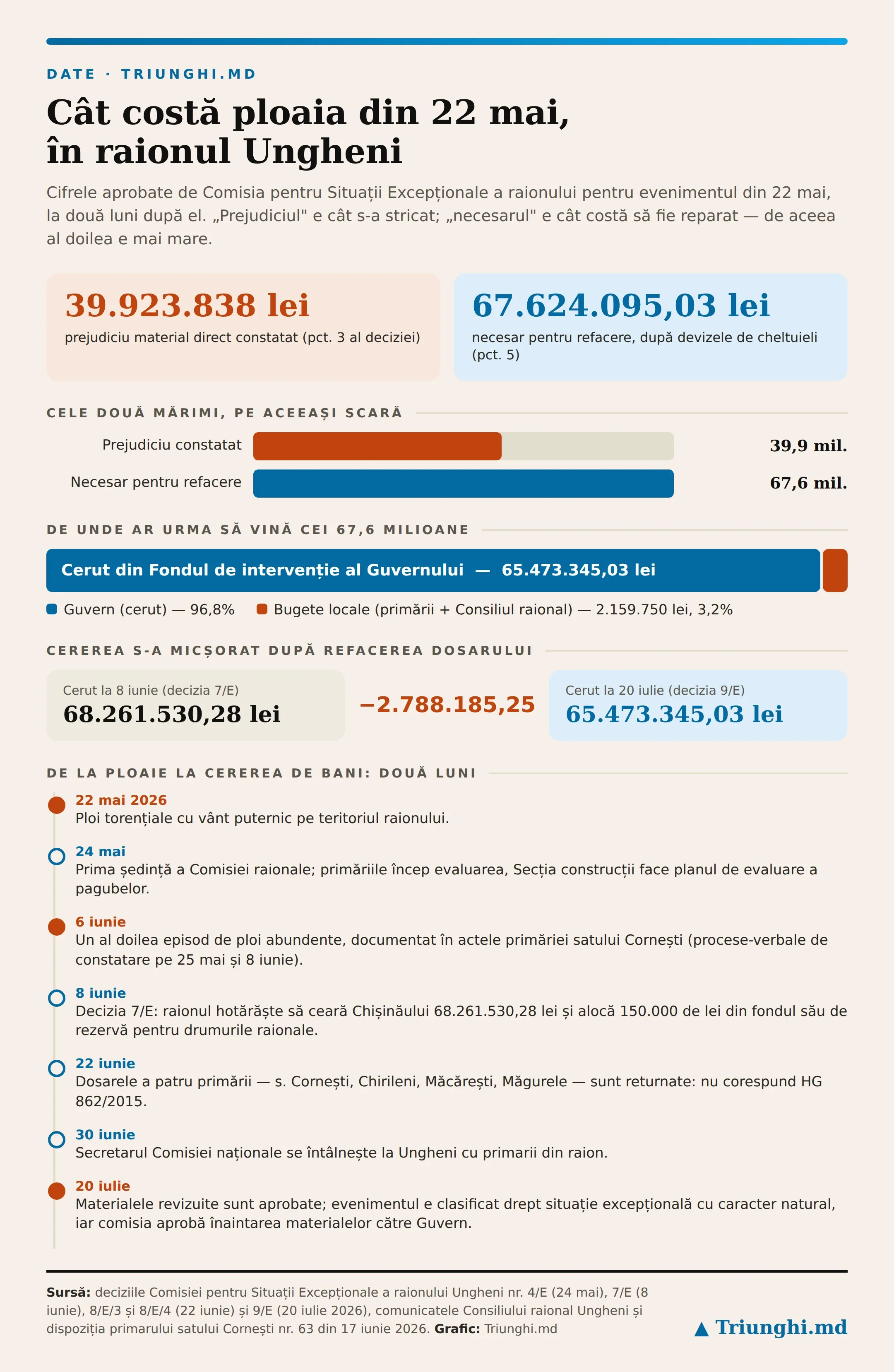
What the 22 May 2026 rain cost Ungheni raion: the assessed damage, the repair requirement and who is to cover it. Graphic: Triunghi.md. Source: decisions of the Ungheni raion Commission for Emergency Situations.
Damage and repair cost: two different measures
The two large sums in the decision do not measure the same thing, and the difference between them explains why the second is almost 28 million higher.
Direct material damage — the 39.923.838 lei — is the value of what was destroyed, established through assessment reports drawn up for each affected facility. The requirement for remedying the situation — the 67.624.095,03 lei — is what the repair works cost, calculated from the cost estimates submitted by the town halls and by the Raion Council. A damaged bridge can be worth less than it costs to rebuild it in 2026, at today’s prices for materials and labour.
That is also where the fit with the interim assessment comes from: on 8 June, the Raion Council announced damage of approximately 70 million lei, a figure close to the final repair requirement rather than to the assessed damage. That statement is also the source of the description of the facilities hit: local road infrastructure, damaged bridges and harm to people’s homes.
There is also an arithmetical mismatch in the text of the decision itself: the requirement of 67.624.095,03 lei minus the local contribution of 2.159.750 lei gives 65.464.345,03 lei, while the sum requested from the government is 65.473.345,03 lei — 9.000 lei more. The difference would correspond exactly to a local contribution of 2.150.750 lei.
What broke, concretely: the list is in the town halls’ own acts
The raion decision approves total sums, without the list of facilities. The list does exist, however, in the town halls’ acts, published in the State Register of Local Acts.
The Agronomovca Commune Council adopted its own on 25 May, three days after the rain. The document lists 16 positions — 14 stretches of road and two culverts in the village of Agronomovca, with lengths and widths: between strada Livezilor and strada Trandafirilor, 100 metres; between strada Câmpului and strada Pădurii, 200 metres; strada Câmpului, 450 metres; the road between the cemetery and strada Trandafirilor, 800 metres, past the old kindergarten building; strada Trandafirilor towards the Chișinău–Ungheni highway, 1.700 metres. The mechanism repeats at almost every item: „the gravel was washed away”, and in places „a ditch has formed”. On strada 1 Mai, along 400 metres, „mud was brought in from the field”. The two culverts are identified by the neighbouring households.
The damage, calculated from the cost estimates, is broken down in the commune decision itself: roads — 3.397.428,44 lei, culvert no. 1 — 568.202,67 lei, culvert no. 2 — 689.324,61 lei. Total: 4.654.955,72 lei — from a single commune. In the village of Negurenii Noi, in the same commune, the decision finds that „on strada Independenței the road needs to be graded with added material”.
There was a second rain as well, on 6 June
The raion decision of 20 July concerns a single event: 22 May. The town halls’ acts, however, show a second episode.
In the village of Cornești, mayor Iurie Țurcanu signed an order on 17 June releasing diesel vouchers for works „to unblock the bridges, clear the junctions on the central road and reinforce the dyke of the water basin”. The basis invoked: the inspection records of 25 May and 8 June, drawn up, the document states, „following the heavy rains of 22.05.2026 and 06.06.2026”. The fuel — between 15 and 50 litres per person — is settled from the reserve fund of the local budget.
The first request was larger
The one of 20 July is not the first. On 8 June, through decision no. 7/E, the same commission had decided to ask the Commission for Emergency Situations of the Republic of Moldova for 68.261.530,28 lei — a sum which, it wrote at the time, „constitutes the shortfall of financial means for remedying the situation following the rains of 22 May 2026”. At the same meeting, the Raion Council allocated 150.000 lei from its own reserve fund for the raion roads — its own money, which also appears in the report on the execution of the raion budget for the first half of the year.
Between the two figures — 68.261.530,28 lei in June and 65.473.345,03 lei in July — there are 2.788.185,25 lei less. The difference appeared after the materials were redone on the observations of the General Inspectorate for Emergency Situations and of the Ministry of Infrastructure and Regional Development.
What the sum means for a raion of 74.507 people
Ungheni raion had 74.507 inhabitants in 2025, according to the preliminary data of the National Bureau of Statistics. Set against them, the sum requested from the government works out at about 879 lei for every inhabitant — from infants to pensioners.
The second measure comes from the raion’s own budget. For the whole of 2026, the Raion Council planned 28.113,7 thousand lei for „road repair and maintenance” — 28.1 million. The 65.5 million requested from the government therefore amount to more than twice the raion’s annual road budget, and to around 14% of the entire raion expenditure budget for 2026, as revised, at 462.744,1 thousand lei. In the first half of the year, 9.639,9 thousand lei were actually spent on roads — 34.3% of the plan. The comparison is one of order of magnitude rather than of the same perimeter: the request also covers village-level objectives, which are not part of the raion’s road budget.
And the local contribution shows the limit of the budgets here: out of the whole requirement, the town halls and the Raion Council put together 2.159.750 lei. The rest depends on a decision taken in Chișinău.
Two months from the rain to the request for money
The timeline is documented in five decisions of the raion commission and in the communiqués of its meetings.
24 May. Two days after the rains, the commission meets and puts the assessment on the town halls, and the drawing up of a damage assessment plan on the Construction, Communal Services and Roads Section.
8 June. The commission examines the town halls’ submissions, announces a preliminary assessment of approximately 70 million lei and adopts decision 7/E: it decides to ask Chișinău for 68.261.530,28 lei and allocates 150.000 lei from its own reserve fund for the raion roads.
22 June. Four town halls — the village of Cornești, the village of Chirileni, the commune of Măcărești and the village of Măgurele — get their files back:
the document sets submitted do not comply with the provisions of Government Decision no. 862/2015 approving the Regulation on the management of the Government’s emergency funds Ungheni raion Commission for Emergency Situations, decision no. 8/E/4 of 22 June 2026, point 2 (translated)
On the same day, through a separate decision, the commission makes a new step compulsory: before submitting a file, the town halls must take the materials through the Emergency Situations Directorate of Ungheni municipality, for methodological support, and the set submitted must be accompanied by confirmation that this support was given.
30 June. The secretary of the Commission for Emergency Situations of the Republic of Moldova, colonel Sergiu Junea, comes to Ungheni and works with the raion’s mayors.
20 July. The commission approves the revised materials — redone, the decision states, „in accordance with the observations formulated by the General Inspectorate for Emergency Situations and the Ministry of Infrastructure and Regional Development”. The file can leave.
Where the request goes from here
The decision of 20 July also sets the route. The Emergency Situations Directorate of Ungheni municipality was to send the revised reports to the General Inspectorate for Emergency Situations by 21 July, 14.30. The complete set of documents is finalised and forwarded by the secretary of the raion commission, Octavian Rusu, to the Commission for Emergency Situations of the Republic of Moldova — not directly, but through the State Chancellery.
Only there will it be decided whether the 65.5 million lei come, come in part, or do not come at all. The government’s Intervention Fund is governed by Government Decision no. 862/2015, in the wording given by Government Decision no. 776/2024 — the same act that the files of the four town halls failed to comply with in June. It also explains where the observations that led to the materials being redone came from: the file is submitted through the State Chancellery, and the Chancellery „will identify and designate” the central authorities that examine it.
The regulation lays down a single deadline, and that one is for filing: applications „are accepted for examination within up to 90 days from the date on which the emergency situation occurred”. For the event of 22 May, that deadline expires on 20 August — the raion commission therefore approved forwarding the materials roughly a month before the limit. For the examination itself, that is for how long the file may sit in Chișinău before a decision is taken, the regulation sets no deadline at all.
There is one more measure that puts the request in proportion. For the whole of 2026, the Government’s Intervention Fund holds, under the state budget law, 230.000,0 thousand lei — 230 million. The request of Ungheni raion, of 65.5 million, therefore amounts to around 28% of the entire national fund, for a single raion and a single event.
The decision also fixes who answers for the figures sent onward: point 11 places the responsibility for „the veracity of the information presented, the accuracy of the calculations made and the authenticity of the documents” on the local authorities of both levels — the town halls and the Raion Council.
The decision entered into force on the day it was adopted. Until the government rules, the roads, bridges and houses damaged on 22 May remain in the care of budgets that cover 3.2% of what their repair costs.