
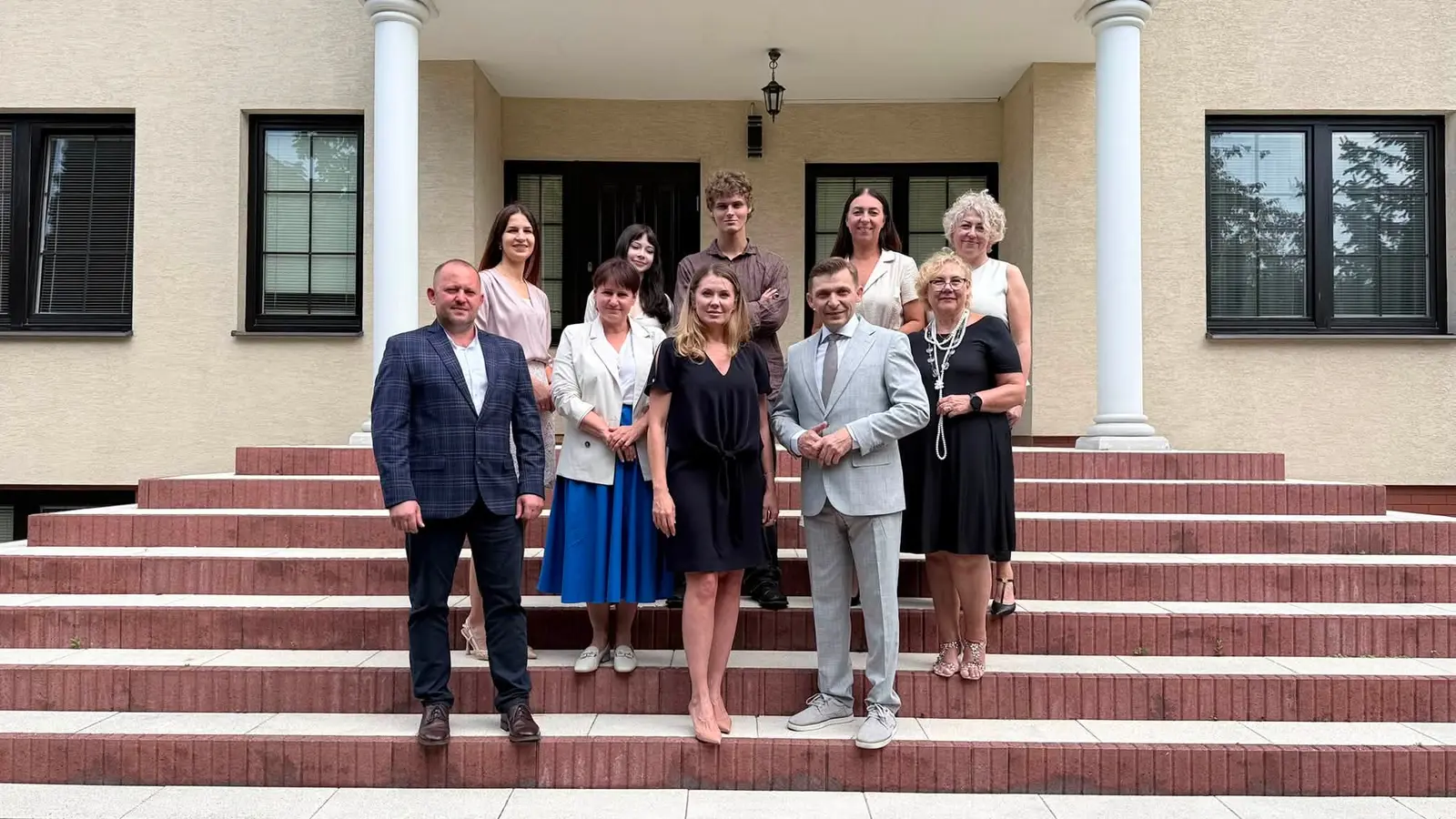
On 6 September, representatives of Ungheni District will be at the harvest festival organised by Kalisz County (powiat), in central Poland. At the end of the same month, the journey runs the other way: a Polish delegation comes to Ungheni. The two visits were announced on Friday, 31 July, by the Embassy of the Republic of Moldova in the Republic of Poland, after Ambassador Violeta Agrici received in Warsaw a delegation led by starosta Jan Adam Kłysz.
Behind the exchange of visits stands a cooperation agreement approved by the Ungheni District Council in November 2025 and signed in Kalisz a month later.
What was actually signed
The Ungheni District Council approved the Cooperation Agreement with “the Kalisz District of the Republic of Poland” through decision no. 7/1 of 5 November 2025 and gave the district president, Dionisie Ternovschi, the mandate to sign it. Implementation was assigned to the Economy and Reforms Division, headed by Ludmila Ursatiev. The full text of the agreement is annexed to the decision and published in the State Register of Local Acts.
The agreement lists eight areas of cooperation: exchange of experience in the working of local public administration, support for the economic sector, contacts between educational institutions with “the exchange of young people”, environmental protection, tourism, the activity of cultural institutions, cultural exchange — including of “artists, folk groups, brass bands” — and an open heading for other activities. The parties may set up joint commissions and working groups.
Funding, however, is left for later, project by project:
The specific terms of cooperation on the planned projects, including an indication of the sources and methods of financing them, shall be established on the basis of detailed plans and budgets for those projects, agreed between the parties. Ungheni–Kalisz cooperation agreement, §3 point 2
In other words, the agreement comes with no sum at all. It is a framework: it opens the door, and the money is discussed separately. The document is concluded for an indefinite period and may be terminated by either party with three months’ notice, taking effect at the end of the calendar year in which the notification was sent. It was drawn up in four copies, two in Romanian and two in Polish, and enters into force on the date of signing.
Who made the first move
The initiative came from the Polish side. On 27 August 2025, at its XVII session, the councillors of Kalisz County decided to establish the partnership with Ungheni District, by resolution no. XVII/168/2025. Their document mirrors ours: it lists the same eight areas, authorises the starosta and the wicestarosta to sign the agreement — and provides for no sum at all. On 11 September, the Polish administration sent Ungheni the letter and the draft agreement — both invoked in the preamble of the district decision. The Ungheni District Council voted on 5 November.
The signature came a month later, in Kalisz. Between 5 and 7 December 2025, a district delegation — Dionisie Ternovschi, District Council secretary Liliana Țîncu and the head of the Economy and Reforms Division, Ludmila Ursatiev — was in Poland; on 6 December, at the county administration’s headquarters, the agreement was signed.
The Polish administration’s statement from that day records that the document was signed “at the headquarters of the Kalisz County administration, in the presence of the Ambassador of the Republic of Moldova to Poland, Violeta Agrici” (translated from Polish by the newsroom). For the Polish side it was signed by starosta Jan Adam Kłysz and wicestarosta Paweł Kaleta, and for the Moldovan side by the district president. The ambassador, who in July hosted the review meeting in Warsaw, had also been present at the signing.
A point of vocabulary: the embassy calls the document a “cooperation memorandum”. Both official acts — the District Council decision and the county’s statement — call it a cooperation agreement.
Who Kalisz County is
“Powiat” is, in Polish administration, the level between the commune and the region — the functional equivalent of our raion. Kalisz County lies in the Wielkopolska (Greater Poland) voivodeship, in the centre of the country, has 81,689 inhabitants (official figures for 2025) and comprises 11 gminas, that is, commune-type units. The elected head of the administration is called the starosta, and his deputy the wicestarosta; in the Romanian text of the agreement the two appear as the “president” and the “vice-president” of the district.
Here a distinction is needed that is easily lost: the city of Kalisz — 91,059 inhabitants, one of Poland’s oldest cities — is an administrative unit separate from the county that surrounds it. Ungheni District’s partner is the county, that is, the rural area around the city, not the city itself.
Two agreements with the same county, two institutions from Ungheni
The link between Ungheni and Kalisz did not begin in 2025. The county’s foreign contacts page lists, among its partners, the city of Ungheni, with an agreement signed on 21 July 2016 by the then starosta, Krzysztof Nosal, and the then mayor of the city, Alexandru Ambros.
That document describes its object in three components: the exchange of experience, strengthening the capacity of local authorities and, explicitly, “supporting actions intended to increase the safety of residents by creating and strengthening the Voluntary Fire Service” (translated from Polish by the newsroom). The last one is unusually concrete for a twinning agreement.
Volunteer firefighters are, in Poland, an old and powerful rural institution: the local units have their own brass bands, which play at the harvest festival of 6 September as well. The 2016 agreement has unlimited validity.
So “Ungheni” has two distinct links with the same Polish partner: one belonging to the city, from 2016, and one to the district, from 2025. They are different institutions, with different documents. A second detail, also from the Polish page: all four foreign partners listed there are from the Republic of Moldova — Orhei District (2014), the city of Ungheni (2016), Rîșcani District (2017) and Camenca District (2019, letter of intent).
What the link has produced so far
Eight months after the signing, the public communication of the two administrations shows no completed joint project, no funding and no exchange of pupils or specialists arising from the district agreement. In its announcement of 31 July, the embassy speaks of “the joint projects” and of their implementation, without naming any of them.
The only concrete result publicly documented in the relationship of the two “Unghenis” with Kalisz belongs to the city line and to European money: in June 2023, two county employees took part in the “Ungheni Tourist City” camp, held in Ungheni through the Photovoice method and funded from European Union funds, alongside young people from the partner cities of the city — Cluj-Napoca, Kutaisi, Konin and Kalisz.
Nor does the Polish budget for this year name the partnership. In Kalisz County’s 2026 budget, adopted on 19 December 2025, the words “Ungheni” and “Mołdawia” do not appear at all, and the two budget amendments checked by the newsroom — in December 2025 and in May 2026 — touch neither the promotion chapter nor the foreign-travel line. The funds from which a trip or a reception could be paid for are general ones: 10,000 zloty for all the administration’s foreign travel across the whole year, and 111,700 zloty for promoting the county, a chapter that explicitly covers “visits by foreign delegations” as well. For scale, the county’s administrative apparatus has a budget of 27.8 million zloty.
At the level of what the two administrations have decided and communicated publicly, the partnership is therefore still at the stage of contacts.
What happens in September
The embassy’s announcement does not name the host locality in Poland. The only event of this kind in the county’s calendar on the date of 6 September is the Dożynki Powiatowo-Gminne, the harvest festival of the county and the gmina, at Rychnów, in the gmina of Blizanów — a village some 880 kilometres from Ungheni in a straight line.
The official invitation was published on 29 July, two days before the announcement in Warsaw, and sets out the full programme: the harvest procession forming in front of the church at 12.45, the liturgy at 13.00, the harvest ritual performed by the “Wielkopolanie” folk ensemble at 14.45, the brass bands of the volunteer firefighters from three villages, the arrival of the cyclists of the XXVI county tour, concerts and a ball until midnight.
“Dożynki” is not a festival invented by the administration, but the harvest feast of the Polish rural calendar, with a church service, a procession and a wheat wreath — close in purpose to our own autumn celebrations. Every gmina holds it in August; the county crowns it in early September, by rotation, in a different locality.
The Polish invitation makes no mention of guests from abroad, and the county’s calendar of events for 2026 contains no trip to the Republic of Moldova — although that calendar lists the events organised inside the county, so a trip abroad may legitimately be absent from it. Both September visits are announced, for now, only by the embassy in Warsaw.
On the other side, the embassy links the Polish visit to “reciprocal participation in the Harvest Festivals” — that is, to Ungheni FEST, the Festival of the Harvest, Wine and the Promotion of National Traditions, organised by the district administration. The working group preparing it was set up by an order of the district president on 31 July 2026 itself, the day of the meeting in Warsaw, and it is only that group that has yet to approve the venue, the date and the programme and to set the spending estimate; no exact date had been announced as of 31 July either. The group is chaired by Dionisie Ternovschi and includes, among others, the district vice-president, Corina Slupețcaia, the mayor of the city, Vitalie Vrabie, the head of the Agriculture and Food Division, Viorel Scutaru, and the head of the Economy and Reforms Division, Ludmila Ursatiev.
For a sense of scale: for the 2025 edition, 337,213 lei were allocated from the district budget — 185,213 lei from the funds of the Agriculture and Food Division and 152,000 lei from those of the district president’s Office.
The district administration has made public neither the composition of the delegation travelling to Poland on 6 September nor the source from which the trip is covered.
The text of the agreement and the quotations from it come from decision no. 7/1 of the Ungheni District Council of 5 November 2025 and from its annex, published in the State Register of Local Acts; the data on the Polish side come from the statements and official pages of the Kalisz County administration, in the newsroom’s translations. The two September visits have a single source, the announcement of the Embassy of the Republic of Moldova in the Republic of Poland of 31 July 2026, and are not confirmed by the Polish documents consulted; the identification of the events — the harvest festival at Rychnów and Ungheni FEST — belongs to the newsroom. The population figures are those of Poland’s Central Statistical Office for 2025; the distance to Rychnów is calculated by the newsroom, in a straight line; Resolution no. XVII/168/2025 of the Kalisz County Council and the county’s 2026 budget were consulted in full text, on the Polish council’s eSesja platform.