
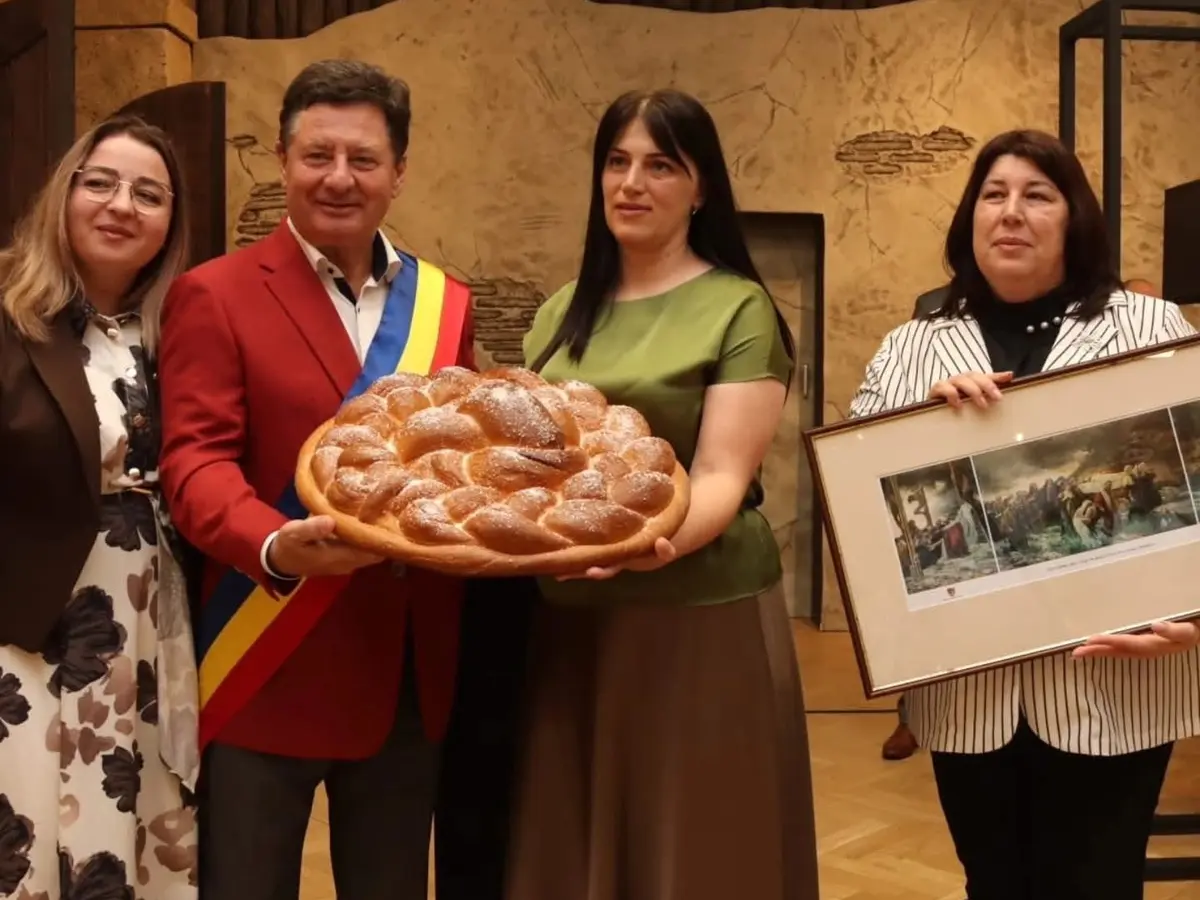
The Ungheni District Council marked 15 years of twinning with the county across the Prut at Arad — and turned the anniversary into a starting point for new partnerships, this time reaching as far as Hungary and Serbia.
A delegation led by district president Dionisie Ternovschi took part in the Days of Arad County, 2026 edition (18–21 June), and handed its hosts an anniversary diploma. The visit’s programme included the inauguration of the newly arranged history section of the Arad Museum Complex, opened on 20 June, and a trip to Ineu — a town the Arad administration holds up as an example for attracting funds and implementing development projects.
A twinning with a precise date: 26 May 2011
The partnership that has now reached 15 years has a documented origin. On 26 May 2011, the then-leaders of the two administrations — Ion Harea for Ungheni District and Nicolae Iotcu for the Arad County Council — signed a framework agreement on cooperation in the economic, social, cultural and tourism fields, with the support of the Ministry of Foreign Affairs in Bucharest. The document, conceived as a platform for concrete projects between the two banks of the Prut, was later renewed as it expired.
Over the years, the link with Arad has remained one of the district’s most active institutional bridges across the Prut — from joint economic forums (Ialoveni, Ungheni and Arad presented their business opportunities together as early as 2018) to reciprocal working visits by elected officials.
What’s new: letters of intent for Hungary and Serbia
The genuinely new part of this edition, however, was not the anniversary but what Ungheni built around it. At Arad, the district delegation held meetings with Sándor Molnár, president of the Békés County Council in Hungary, and with Tomislav Žigmanov, vice-president of the Government of the Autonomous Province of Vojvodina in Serbia. To both officials, Ungheni District handed letters of intent — a first, formal step toward possible partnerships.
The two did not end up in Arad by chance. The county is part of the Danube–Criș–Mureș–Tisa Euroregion, a cross-border cooperation structure linking western Romania with southern Hungary and the Vojvodina province in Serbia. Through the bridge built over 15 years with Arad, Ungheni thus reaches the edge of a tri-national cooperation space — where cross-border projects and European funds circulate.
What Ungheni stands to gain
For now, what the delegation brought home are intentions, not signed partnerships. But the stake for Ungheni residents is concrete: access to the experience of administrations that know how to attract European money — the example of Ineu being precisely the reason for the trip — and to networks through which the district can finance development projects. It is the logic the district president summed up publicly as early as last year.
Ungheni can become a regional pole of development, through modern infrastructure, strategic partnerships and smart investment.
Dionisie Ternovschi, president of Ungheni District (statement made in 2025, at the Regional Economic Forum of Moldova)
For a district on the eastern border of the European Union, every such connection counts. The twinning with Arad has been, for 15 years, Ungheni’s main institutional bridge across the Prut. Now the district is testing whether the same bridge can carry it further — into Hungary and Serbia.