

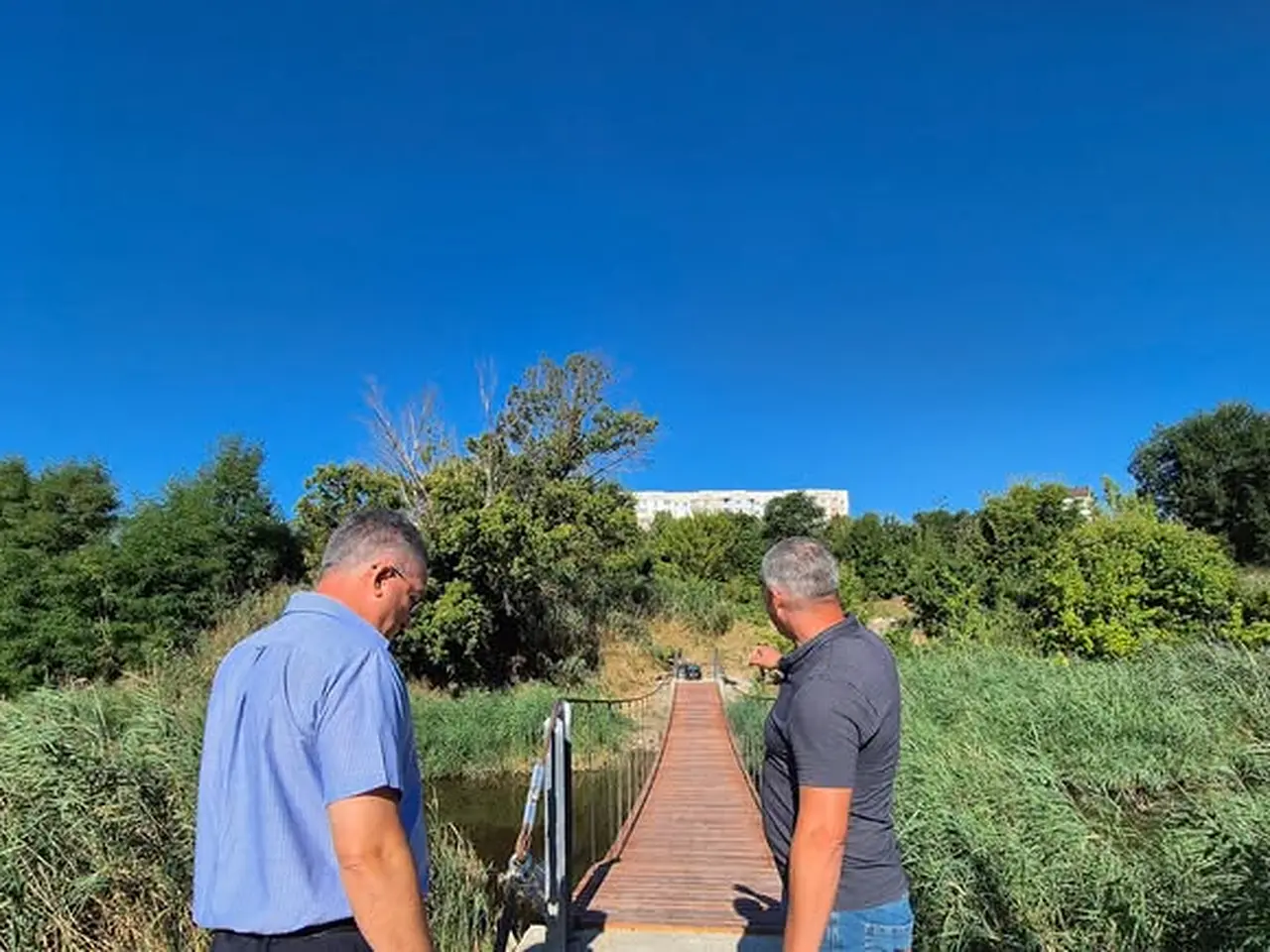
The leisure island on Lake Delia, in the municipality of Ungheni, is once again connected to the shore. Less than three months after the 22 May flood destroyed the footbridge to the island and damaged the access road, Ungheni Municipality announced on 13 August that a new suspension bridge has been built in its place, and that the road leading to it has been resurfaced. The work is “on the home stretch,” and the stated goal is for the area to be ready in September.
The site was inspected on 13 August by Mayor Vitalie Vrabie, who said he was pleased with what he saw and that, by September, the island “must look as it did before, and even better.” The announcement was accompanied by on-site photographs: the wooden bridge stretching across the water, the freshly paved access road, and the cable anchoring fittings.
What the water tore apart in May
The bridge rebuilt now is one of the marks left by one of the hardest days of spring. On 22 May, after torrential rains, Lake Delia overflowed, affecting farmland and households — an overflow captured at the time by the press’s drone footage as well. The same flood knocked out of use the leisure area the municipality was developing on the lakeshore: the island was left cut off by water, without its access footbridge, which is why the “Sânziene Unghenene” festival, held in 2025 on the island itself, was moved this year to the city centre.
The 22 May rains caused damage across the entire district, not only at Delia. The district commission for emergency situations assessed direct damage of nearly 40 million lei and asked the government for 65.5 million lei to rebuild the roads, culverts and dykes in the district’s villages. The bridge to Delia island, however, is a city project: it stands on a lake that has been under municipal management since 2024 and was rebuilt by the city’s own company, using its own resources — just as, after the same flood, that same company also repaired the access road to the beach on the Prut.
What was built
According to the Municipality, the new bridge is a cable-stayed suspension bridge with a deck of ash wood — a hard, dense wood, resistant to impact, suited to a surface that is walked on. The access road was likewise rebuilt: the silt left by the flood was excavated, a layer of stone was laid down and compacted, and then a five-centimetre layer of asphalt.
The work was carried out by “Servicii Comunale Ungheni”, the wholly municipally owned company that handles a large share of the city’s public works — from roads to preparing the seasonal beaches. This is the “in-house” model: the municipality carries out the work with its own company, without a separate works tender — a tender is used only to buy the materials, the stone, concrete or asphalt. The cost of rebuilding the bridge and the access road was not made public in the announcement, and, for now, no act recording the amount spent appears in the State Register of Local Acts — the same pattern as with other in-house works by the city’s company, where the sum per project usually remains unpublished.
Why a bridge that sways comes with a warning
The announcement ends with an unusual request for a construction notice: “We warn that the suspension bridge is not a swing. We respectfully ask you not to rock it,” followed by an appeal to parents not to leave their children unsupervised on the bridge.
The warning has a real physical basis. A cable-suspended pedestrian bridge is, by design, a light and flexible structure: it moves a little under the weight of those crossing it — that is not a flaw, but the way it works. The problem arises when the swaying is pushed deliberately, in rhythm. When a rhythmically repeating force — measured footsteps, or a group rocking the deck in unison — hits the structure’s natural frequency, the motion is amplified far beyond what it was designed for. This is the phenomenon of resonance, the same one in the old parable of soldiers breaking step on a bridge so as not to set it vibrating. A famous modern example is the Millennium Bridge in London, which swayed sideways so violently at its opening in 2000 that it was closed after two days and fitted with dozens of dampers — there, the culprit was an entire crowd, not a group of children, but the principle is the same: a flexible structure, forced rhythmically, sways more and more.
Hence the caution the Municipality asks for: deliberate rocking, especially by children left on their own, can lead to injuries and puts needless strain on the cables and anchorages. For anyone who uses it as intended — to cross to the island — the bridge is a passage, not a plaything.
One piece of the Delia development — and the state of the lake’s water
The island, with its gazebos and paths, is the “heart” of the leisure area the municipality is building around Lake Delia, a lake of nearly 100 hectares placed under the city’s management in 2024. The bridge rebuilt by “Servicii Comunale” is a project separate from the Lake Delia waterfront development — the promenade along the shore, whose first stage, worth about 5.8 million lei, is co-financed 39% by the city of Cluj-Napoca and carried out by a different company. These are different pieces of the same plan: to turn the Delia shore into a place where the people of Ungheni come to stroll, to the festival, to swim.
The bridge, then, is moving forward. In parallel, the quality of the lake’s water remains an open problem, documented by Triunghi.md: this year’s sample rated it class V — unfit for bathing, the third summer in a row, and in early August the lake saw a fish die-off. The bathing area has no sanitary permit and is not on the monitoring calendar, even though the municipal beach has been operating since 21 June. These are the two faces of the same lake: leisure infrastructure being rebuilt, and a sanitary status of the water that remains, for now, an open problem.
The data on the rebuilding of the bridge and the access road come from the official announcement of Ungheni Municipality of 13 August 2026, accompanied by on-site photographs. The overflow of Lake Delia on 22 May is confirmed by press reports from those days, while the relocation of the “Sânziene Unghenene” festival from the island and the lake’s sanitary status were documented earlier by Triunghi.md. The cost of the work and the technical specifications of the bridge were not made public at the time of publication. Quotations are translated from the original Romanian.