

A citizen of the Republic of Moldova was detained on Wednesday, 29 July, at the Sculeni Border Crossing Point, as he was entering Romania. According to the release of the Iași Territorial Inspectorate of the Border Police, at the border check it was established that the authorities in Finland had issued a European arrest warrant and an Interpol alert in his name, the man being investigated in a sexual-offence case. He was handed over to an operational team of the Iași County Police Inspectorate.
The accusations have not been tried. No court has ruled on his guilt. A European arrest warrant is not proof of guilt: it is an instrument of judicial cooperation through which one state asks another state to surrender a person so that they may be investigated or tried. The Romanian authorities have not made his identity public.
Beyond this case, the episode describes something that directly concerns Ungheni district: what happens, technically, at the booth through which Ungheni residents leave for the European Union.
A European warrant takes no account of nationality
The first idea to be corrected: the European arrest warrant does not concern only citizens of the European Union.
Framework Decision 2002/584/JHA, the act that created the instrument, defines it in article 1 as a judicial decision issued by a member state with a view to the arrest and surrender, by another member state, of a requested person — with no condition of nationality whatsoever. The same article provides that the member states execute any European arrest warrant. In the Romanian transposing law, Law 302/2004 on international judicial cooperation in criminal matters, the wording is identical: the surrender of “a person” is requested.
Nationality does matter, but the other way round from the common intuition: it does not exempt anyone from a warrant, but opens up additional protections. Romanian law provides, for instance, that the surrender of a Romanian citizen or of a person who has been legally resident in Romania for at least five years is subject to the condition that the person be brought back to the country to serve the sentence. A citizen of the Republic of Moldova who does not also hold Romanian citizenship and has not been legally resident in Romania for at least five years does not fall under these clauses.
The warrant and the Interpol alert are two different things
The release mentions two instruments, and the difference between them explains why they appear together.
The European arrest warrant is a judicial decision, binding on the member states of the European Union. The Interpol alert — whose best-known form is the red notice, although the release does not specify what type of alert is involved — is a request addressed to police forces worldwide to locate and provisionally arrest a person, pending extradition or surrender. It is based on a warrant or on a decision issued by the judicial authorities in the requesting country, and each state applies its own laws when deciding whether to make an arrest. The organisation also makes clear one thing that is often lost: people are not wanted “by Interpol”, but by a country or by an international tribunal.
The two therefore cover different areas. The warrant operates inside the Union; the Interpol alert reaches states outside it as well. A state looking for a person uses both precisely in order to cover both spaces.
What is checked at the booth in Sculeni
This is where the mechanism that made the detention of 29 July possible lies.
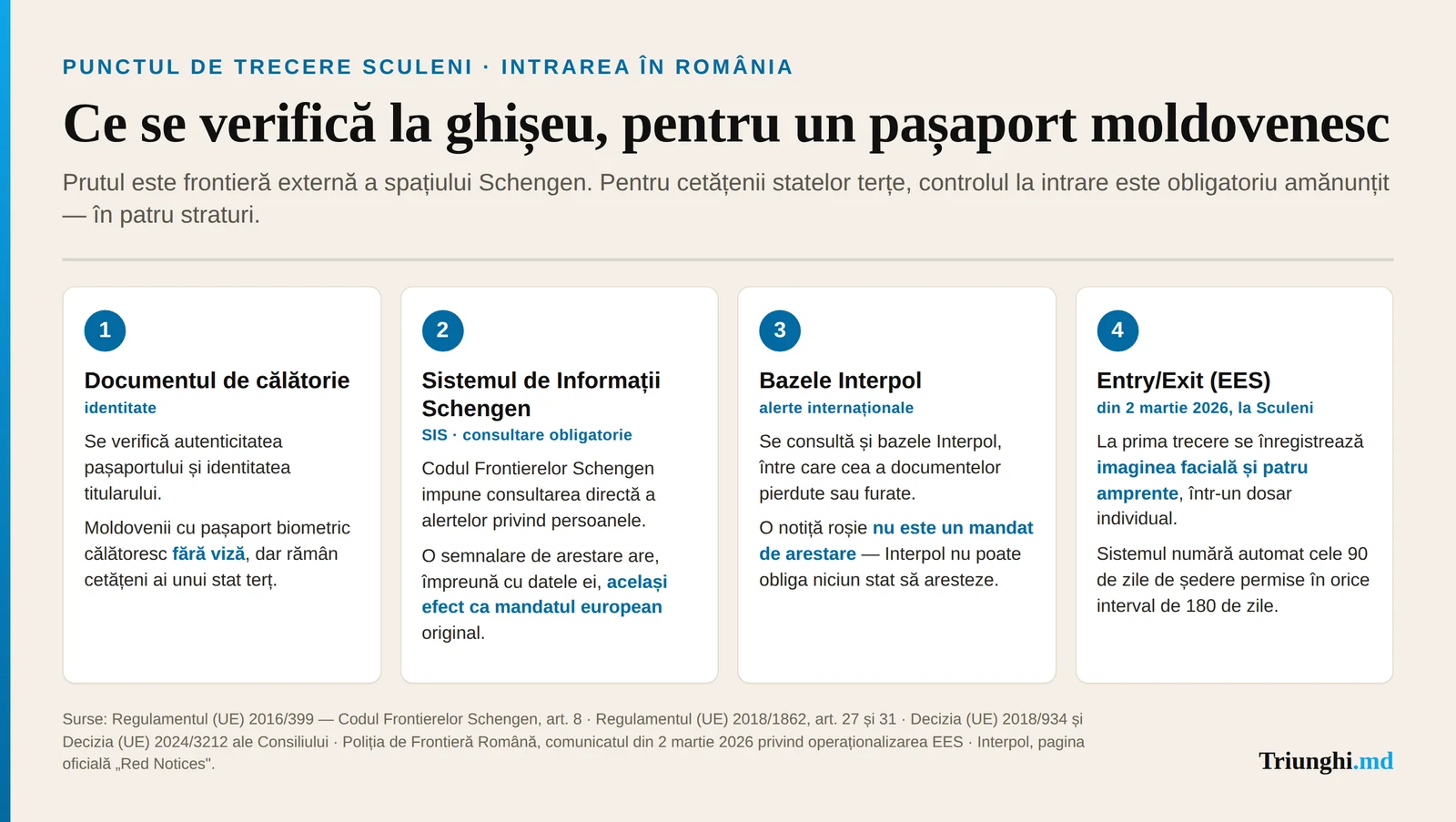
The border on the Prut is an external border of the Schengen area, and a Moldovan citizen is, in the terms of European legislation, a third-country national. The Schengen Borders Code — Regulation (EU) 2016/399 — requires for such travellers a “thorough check” on entry, which compulsorily includes the direct consultation of the data and the alerts on persons recorded in the Schengen Information System (SIS), without excluding the national databases and those of Interpol.
The detail that ties everything together: when a member state issues a European arrest warrant, it is obliged to enter into the SIS a copy of the original warrant. Regulation (EU) 2018/1862 provides, in article 31, that the alert in the system and the data accompanying it together constitute a European arrest warrant and have the same effect as one. In practice, the Finnish warrant did not have to be “sent” to Sculeni through some special channel: it was already in the system that the border police officer is obliged to query.
It is worth saying plainly, because it is often confused: this capability did not appear with accession to Schengen. Romania has applied the SIS provisions since 15 October 2010, and the initial restrictions concerned only the refusal-of-entry alerts, not those for the purpose of arrest; since 1 August 2018, through Council Decision (EU) 2018/934, the system applies without restrictions. What changed on 1 January 2025, through Decision (EU) 2024/3212, was something else: checks at the internal land borders between Romania, Bulgaria and the rest of the area were abolished, which shifted the weight of control onto the external borders — that is, including onto the bank of the Prut.
A European arrest warrant is, by construction, an instrument of the European Union. The Republic of Moldova is not a member state, so the first check that could act on the basis of this warrant was the one on entry into Romania.
The booth on the Moldovan bank has, in its turn, access to international databases. The Republic of Moldova has been a member of Interpol since 1994, and the national central bureau in Chișinău operates within the General Police Inspectorate; the organisation’s databases are queried at the crossing points themselves — the Border Police reported, for instance, the case of a car checked against the Interpol database at Leușeni and found to be wanted in Italy. The difference is one of legal regime, not of vigilance. For its own citizens leaving the country, Law no. 28/2024 on the state border provides as a rule a first-line check, centred on the document and on the “border alert” — a measure instituted on the basis of the acts issued by the empowered Moldovan bodies, such as the ordinances of the criminal investigation body or the acts of the courts. The European warrant, by contrast, travels through the Schengen Information System, to which only the authorities of the states in that area have access.
Why you stop twice
Anyone who passes through there asks the question: why the check is carried out separately, on each bank. The explanation again has to do with the status of the border. Being an external border of the European Union, the principle of “one single stop” cannot be applied — the two states carry out the checks separately, one after the other, a short distance apart.
The coordinated control regime, which merges the formalities, operates on the Moldovan-Romanian border at Leușeni–Albița, at Giurgiulești–Galați and at the Cantemir–Fălciu rail point, according to the Government of the Republic of Moldova. At Sculeni it did not apply, at the date of publication: the extension of the regime to this point was approved in October 2025, with Sculeni due to become the fourth.
Since March, the crossing through Sculeni is recorded biometrically
The second change concerns all the Ungheni residents who cross the bridge, not only cases of this kind.
On 2 March 2026, the Romanian Border Police announced the extension of the Entry/Exit (EES) system to the last crossing points, among them, on the Romanian-Moldovan border, Albița, Bumbăta, Galați, Iași (rail) and Sculeni. The process, begun gradually in October 2025, thus became complete at all of Romania’s external border points. The manual stamping of travel documents was abolished on 10 April 2026, when the system became operational across the whole of the European Union.
What this means concretely, at the booth:
- at the first crossing, the facial image and the fingerprints are collected, forming an individual profile;
- on subsequent journeys, the check is carried out on the basis of a single biometric element, which reduces waiting times;
- the system calculates by itself the duration of the legal stay — a maximum of 90 days in any 180-day period;
- the data are kept for 3 years, or 5 years if entry was refused or if the legal stay was exceeded;
- the person has the right of access to the data, and the right to have them rectified and erased;
- exempt from fingerprinting are children under 12 years of age, persons for whom the process is not possible and holders of a residence permit or of a long-stay visa issued by a member state.
The system applies to the citizens of states outside the European Union — a category that includes the citizens of the Republic of Moldova, including those who travel without a visa, on a biometric passport.
How often it happens
Six detections of persons flagged in the databases at Sculeni, in the first seven months of 2026, compared with three in the whole of 2025. At the level of the entire Iași Territorial Inspectorate of the Border Police, 37 cases in the first seven months of this year. The figures come from going through the releases published by the inspectorate between December 2024 and 30 July 2026.
In this year’s cases at Sculeni, the alerts had come from France (two), Germany, Hungary, Finland and Romania.
A note on method, without which the figures would be misleading: these are the reported cases, not the institution’s register. The releases do not cover every detection, so the figures show at least that many — not exactly that many.
The order of magnitude of the checks can be seen, however, in another figure, from the ITPF Iași assessment for 2025: 16,017 alerts of Schengen interest detected in a single year, of which 15,834 at the crossing points themselves. The alerts do not mean as many people wanted — the system also contains alerts on vehicles, documents or objects —, but they show how often the booth queries the European databases.
For context, how busy the gateway is: on a single documented day, 1 November 2024, 9,107 people passed through Sculeni in 24 hours — the third point in the country on that day, after Leușeni and Chișinău International Airport.
The surrender is decided in Iași, within time limits fixed by law
From the moment of the detention, the case leaves the hands of the border police and enters a judicial procedure with time limits fixed in law.
The detention itself is ordered by the prosecutor, through a reasoned ordinance and only after hearing the person in the presence of a defence lawyer, and it may not exceed 24 hours. The person has the right to a lawyer — chosen or appointed — to a free interpreter and to a translated copy of the warrant. The law also recognises a less well-known right: that of engaging a lawyer in the state that issued the warrant as well.
The authority that decides on the surrender is the court of appeal. For Sculeni — a locality in the commune of Victoria, Iași county — jurisdiction lies with the Iași Court of Appeal, which sits as a single-judge panel.
The court does not rule on guilt. The law limits its examination to the identity of the person and to the grounds for refusing surrender, expressly provided for. If the person consents to the surrender, the decision is taken within at most 10 days, and the consent is irrevocable. If they do not consent, the time limit is 60 days from the arrest, with a possible reasoned extension of a further 30, and the judgment may be challenged within 5 days before the higher court, which rules within at most three days. The actual surrender takes place within 10 days of the judgment becoming final, and exceeding the time limits leads to release.