

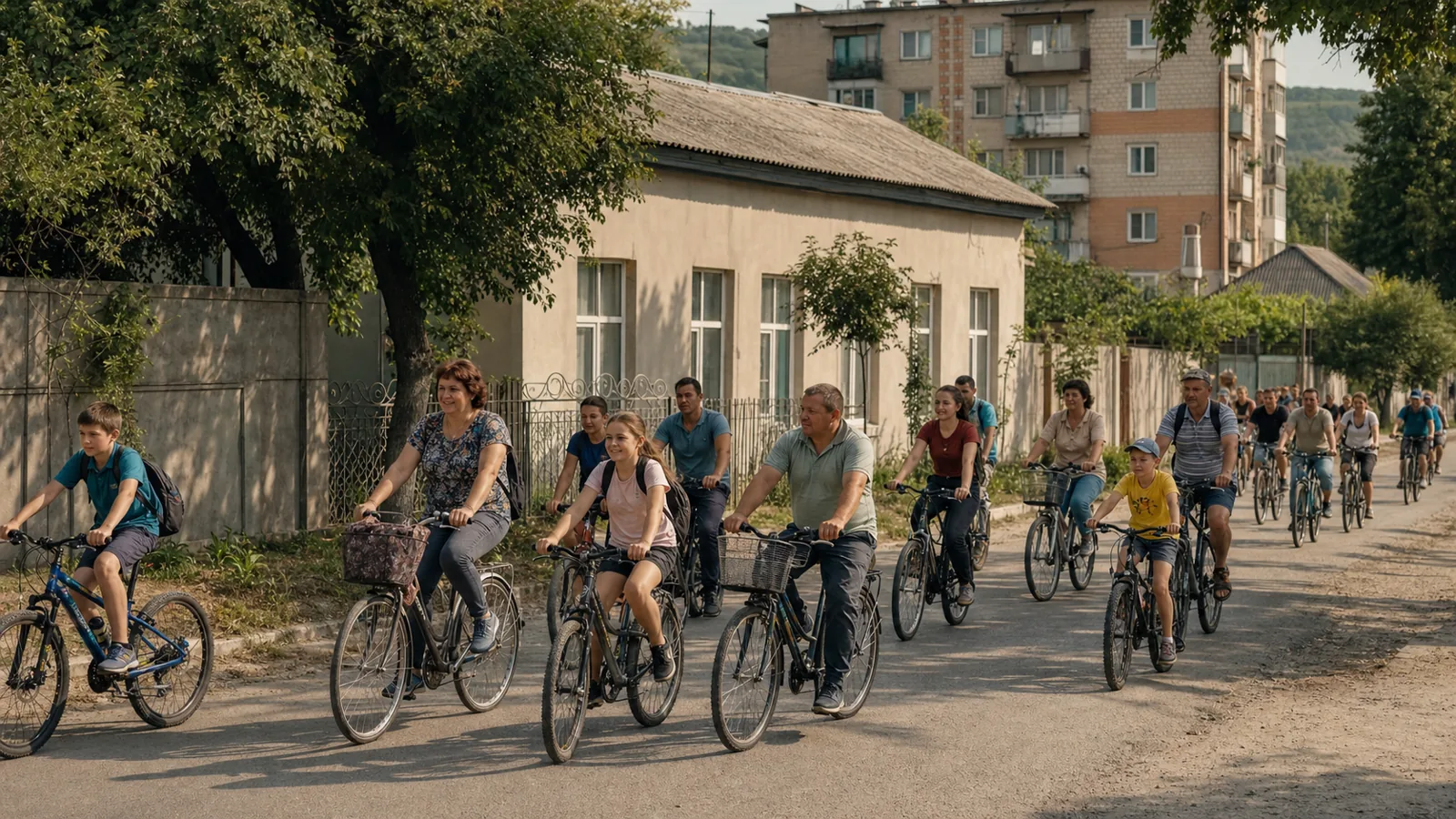
On Friday, 24 July 2026, from 16.00, the employees of Ungheni’s municipal enterprises are expected at the start of a new „VeloVineri” stage — the community bike ride the City Hall organises every Friday, setting off from the front of its headquarters. After the leisure ride of 26 June and the round of state institutions on 10 July, this time the companies the town owns are in the spotlight.
The City Hall said that, in the announcement of the 24 July edition, „this time, the municipal enterprises will be in the spotlight”.
Beyond Friday’s invitation lies a question few towns ask themselves so openly: can a municipality with ever more cars persuade its residents to swap, at least now and then, the steering wheel for the handlebars? „VeloVineri” is not an isolated ride, but the visible, street-level part of a European mobility strategy — and the municipal-enterprises edition is a good occasion to lay the figures on the table: both the ones that justify the effort and the ones that show how hard a town’s habits actually change.
Who the „municipal enterprises” are — and why it matters that they pedal
The municipal enterprises are the companies whose sole owner is the Ungheni Municipal Council: „Servicii Comunale Ungheni” (roads, sanitation, urban public transport — route 5, since February 2026 — and green spaces), „Apă-Canal Ungheni” (water and sewerage), „AVE Ungheni” (waste collection). They are the firms that keep the town running day to day — and which report, through their activity accounts, to the very council that owns them.
That they take to their bikes is not just a Friday photo. One of them, „Servicii Comunale”, is the enterprise that built the 770-metre pavement with a cycle lane on Ștefan cel Mare street — meaning the very company that lays the asphalt and marks out the lanes now goes to pedal on them. And the rotation the campaign follows — leisure, then the state institutions, now the municipal companies — has a logic: normalisation by example. Not by chance: the European analysis the project rests on lists, among the threats to cycling in Ungheni, „a strong preference for cars” and „the negative attitudes of other road users towards cyclists”. Bringing municipal officials and workers onto two wheels targets exactly this perception.
A town that is motorising, with narrow lanes
The reason Ungheni puts so much energy into the subject is captured in a single figure. As of 1 October 2023, the town had 311 cars for every 1,000 residents — about 40% more than the district average (222 per thousand) — and the municipality concentrated almost 43% of the district’s entire vehicle fleet. The trend is not local but national: according to National Bureau of Statistics data, the number of cars registered in the Republic of Moldova rose from nearly 270,000 in 2004 to over 894,000 at the end of 2025 — more than three times as many, of which a 45% increase in the last seven years alone.
As cars multiply, the infrastructure for cyclists stays thin. The territorial analysis carried out for the European project estimates the town’s lane network at about 15 kilometres, built in 2022–2023 along the Națională, Romană, Decebal, Ștefan cel Mare and Alexandru Boico arteries — but narrow, around 1.2 metres, and not separated from traffic. (A later project summary speaks of „20 kilometres”; the difference comes down to the town’s differing reports.) Through the Sustainable Urban Mobility Plan, Ungheni has set itself the goal that, by 2030, one in ten trips through the town be made by bike. It is an ambitious target: the surveys included in the same analysis show that, for now, the bicycle is a small slice — around 6% of respondents to a 2020 study said they use it daily — and the main brake, cited by 60% of those surveyed in 2018, is fear of drivers and unfriendly infrastructure.
What the data say about cycling
Beyond traffic, the subject touches health, the environment and the family budget — and here the figures are hard to ignore.
Health. The World Health Organization recommends adults between 150 and 300 minutes of moderate physical activity per week, and cycling contributes directly to this threshold. The stakes are high: the WHO estimates that 1.8 billion adults (31% of the world’s adult population) are insufficiently active, and insufficiently active people have a 20–30% higher risk of death. A landmark study published in BMJ in 2017, on about 263,000 Britons followed for roughly five years, associated cycle commuting with a 41% lower risk of premature death, 45% lower for cancer and 46% lower for cardiovascular disease, compared with commuting by car or public transport. It is an observational study — so we are talking about a strong association, not a guarantee — but the direction is clear.
Environment. Transport generates almost a third of the European Union’s greenhouse-gas emissions, and road transport alone — about 73% of transport emissions; it is, moreover, the only sector whose emissions have risen compared with 1990, according to the European Environment Agency. The emissions of walking and cycling are, by comparison, „near zero” — every kilometre pedalled instead of one driven is a kilometre without exhaust fumes. To which the town’s air adds: the same agency attributes over 238,000 premature deaths in the EU, in 2020, to exposure to fine particles.
Money. A Danish study that has become a classic, published in 2015, compared the real cost of a kilometre travelled by car and by bicycle in Copenhagen — factoring in the costs borne by society, not just the individual: about €0.50 for the car against €0.08 for the bicycle, roughly six times less. The absolute values belong to the Denmark of those years and do not transfer mechanically to Ungheni, but the principle is robust: the car leaves behind costs that everyone pays, while every kilometre pedalled brings a small net gain, through health.
It sparks the interest — but who builds the habit?
Here is the honest part of the story, which research tells without softening. A pleasant Friday ride, with a police escort, is useful — but it does not, on its own, move a town from four wheels onto two.
What works, a 2025 synthesis of 106 studies shows, is above all safe infrastructure: protected lanes and traffic calming have the strongest effect on cycling (the equivalent of about 28 extra minutes of pedalling per week), followed by programmes that work with people’s habits and by electric bicycles. A 2026 study of New York’s bike-sharing system was even blunter: the number of trips rose only where protected lanes were installed; lanes merely painted on the asphalt produced no measurable change. And the European cities that really did raise their cycling share — Paris, with over 60% in two years and a €250 million plan, Brussels, with +64% after introducing 30 km/h zones, Milan — did so through heavy investment in lanes plus discouraging the car, not through events.
That does not mean „VeloVineri” is pointless — quite the opposite. Studies on mass community events show that they do increase the number of bike outings, especially among beginners and first-time participants; and the visibility of institutions and companies on bikes erodes precisely that „negative attitude towards cyclists” that the town’s mobility document lists under risks. In other words, the event is a good entry point. Only that the gate opens onto a road that, in Ungheni, you still travel sharing a 1.2-metre lane with traffic — and from Monday to Thursday, when the Friday escort is gone, the fear that six in ten respondents spoke of is still there.
The infrastructure that will decide
The good news is that the lanes do not come from the „VeloVineri” budget, but from three investment flows already under way — and, in large part, carried out by the municipal enterprises themselves. On Ștefan cel Mare street the 770 metres of pavement with a lane are being laid, through „Servicii Comunale” and money from municipal bonds. In the French Park, currently a construction site, cycle and running lanes are planned, funded from national funds and a European cross-border project. And on the waterfront embankment on the bank of the Prut — 2.3 kilometres — a promenade with a cyclists’ lane will appear, from a European grant of over €920,000, together with the town of Dorohoi.
Over all this, the town’s Mobility Plan gathers a portfolio of 21 active-mobility projects, staggered up to 2030 — from optimising the lanes on Ștefan cel Mare (estimated at about €500,000) to a bike-sharing system (about €750,000) and a corridor on the bank of the Prut towards the French Park. Summed up, the figures in the plan exceed six million euros; they are, however, estimated budgets, which the document itself conditions on finding funding. The framework that ties everything together is CycleRight, an Interreg Europe project of over €2.1 million, coordinated from Hungary, in which Ungheni is a partner alongside towns from several European countries — and one of the first municipalities in Moldova with an approved mobility plan.
On Friday afternoon, the companies that dig the trenches, lay the asphalt and sweep Ungheni’s streets will pedal on a few of them. Whether the gesture stays a weekend photograph or becomes a day-to-day habit depends, the data show, less on the ride itself and more on the safe lanes those same enterprises are building now.
The details of the 24 July edition — the date, time, starting point and the theme of the municipal enterprises — come from the official announcement of Ungheni City Hall. The figures on motorisation, lane length, the mobility target, the surveys and the project portfolio come from the Territorial Analysis of Ungheni Municipality (2024), carried out within the CycleRight project (Interreg Europe); where the document has internal inconsistencies (for example, 311 versus 317 cars per thousand), we used the figure from the body of the analysis. The evolution of the national vehicle fleet is an own calculation on the National Bureau of Statistics series. The data on health, the environment and cost are attributed to their sources (WHO, the European Environment Agency, studies published in BMJ and Ecological Economics, a meta-analysis in Transport Reviews), and the conclusions about what changes mobility behaviour reflect the current state of research, with its limits.