
The Authority for Meteorology and Environmental Monitoring has issued a heatwave warning for 28 June – 1 July 2026, and the heat is building by the day. In Ungheni, in the centre of the country, the code rises from yellow to orange: on Tuesday and Wednesday, 30 June and 1 July, the highs reach +36…+38 °C, after +33…+35 °C over the weekend. In the south of Moldova a red code kicks in, with +39…+41 °C.
What it means for Ungheni
Specifically, for Ungheni district: a yellow code on Sunday and Monday, 28 and 29 June, with highs of +33…+35 °C, then an orange code on Tuesday and Wednesday, 30 June and 1 July, with +36…+38 °C. Throughout, the nights stay tropical — lows do not fall below +20 °C, which means the body gets no chance to cool down even at night.
The red code, with +39…+41 °C, covers the south of the country, not the centre. But the difference between orange and red is one of degrees, not of nature: heat is heat, and +38 °C in the shade strains the heart, the kidneys and the ability to concentrate just as seriously.
Where the heat comes from, and when it eases
The heatwave is driven by an anticyclone pushing masses of hot air over the region from Western Europe, where extreme temperatures have hit Spain, France, Belgium, Germany and the United Kingdom. According to the forecasts, only from 2 July should weather fronts bring the highs down towards 30–35 °C, with isolated showers. Until then, some of the hardest days of summer lie ahead.
Getting through the scorching days
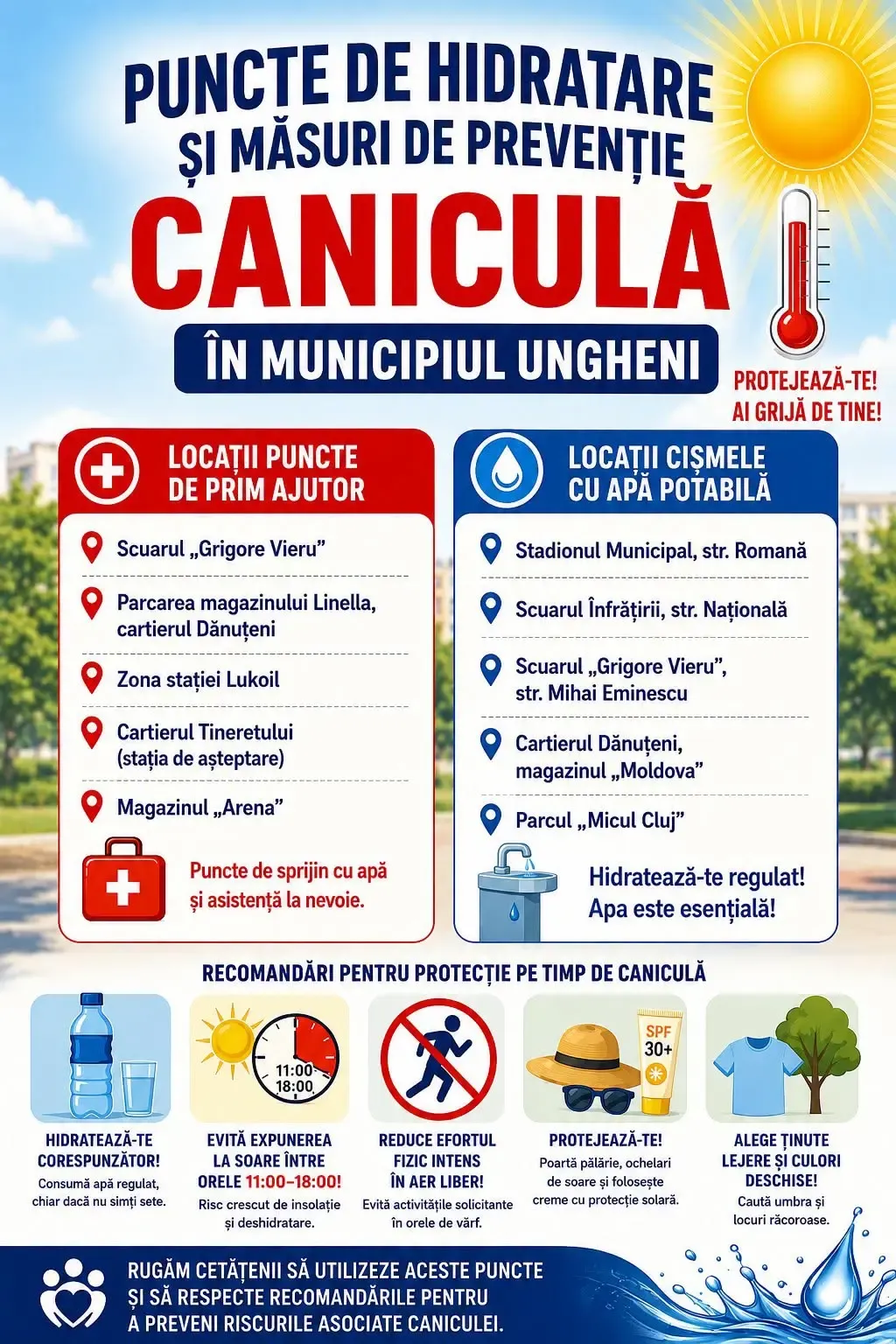
The authorities’ advice for hot days is the same every year, and that is exactly why it bears repeating: avoid sun exposure between 11.00 and 18.00; drink water often, even when you are not thirsty; cut back on outdoor physical effort; wear light-coloured, loose clothing. Pay extra attention to the most vulnerable — young children, the elderly and people with chronic illnesses, for whom extreme heat is not discomfort but a real health risk. At the first signs of sunstroke or heat exhaustion — dizziness, nausea, a racing pulse — move the person into the shade, into the cool, and call 112.
And the city shifts its work to dawn
The heat is changing institutions’ schedules too. Ungheni City Hall has announced that its Maintenance Sector starts work from Monday, 29 June, at 4 a.m. — precisely so that outdoor jobs, from cleaning to tending green spaces, are done in the cool, before the sun becomes dangerous for those working outside. The authority asks residents to bear with the noise of machinery in the early hours and repeats the same basic rules: avoid the sun in the middle of the day, stay hydrated, wear light, loose, pale clothing.
Ten water points across the city, open during the heatwave
Also on 29 June, the city hall announced the practical side, on the ground: for the duration of the heatwave the municipality runs five first-aid points — support points with water and assistance if needed — and five drinking-water fountains, where anyone can rehydrate for free.
The first-aid points are at Grigore Vieru square, the car park of the Linella store in the Dănuțeni district, the Lukoil station area, the Tineretului district (waiting stop) and the Arena store. The drinking-water fountains are at the Municipal Stadium, on Romană street; at Înfrățirii square, on Națională street; at Grigore Vieru square, on Mihai Eminescu street; in the Dănuțeni district, near the Moldova store; and in Micul Cluj park.
On 30 June, the City Hall confirmed that these support and first-aid points keep operating, with teams from the Ungheni Emergency Situations Directorate present at the point in the “Grigore Vieru” square, on Vasile Alecsandri Street, where they give first aid to those in need.
Where to cool off safely
In heat like this, the temptation is the water. But here the other warning of the summer comes in: across the whole municipality of Ungheni there are only two developed, lifeguard-supervised swimming spots — the beach on the Prut River and the one on Lake Delia. Any other water in the district — ponds, pools, undeveloped stretches of the Prut — is at your own risk.
This is not a bureaucratic detail. Since the start of 2026, 18 people have drowned in Moldova, two of them children, almost all at unsupervised spots. And the basic rules do not change with the temperature: do not plunge suddenly into the water after sitting in the sun, to avoid thermal shock; do not drink alcohol before swimming; and never leave children alone by the water for a moment.
For the people of Ungheni, the message of these days is twofold: heat of up to +38 °C, with nights that no longer cool, and a single safe route to the water — the two lifeguard-staffed beaches.
The heat codes, the maximum temperatures, the regional breakdown and the warning period come from the Authority for Meteorology and Environmental Monitoring (the former State Hydrometeorological Service). The heat-safety recommendations and the drowning figures belong to the General Inspectorate for Emergency Situations. The number of lifeguard-staffed beaches in Ungheni comes from the mayor’s order on the opening of the 2026 summer season. The list of first-aid points and drinking-water fountains comes from the Ungheni City Hall notice of 29 June 2026.