

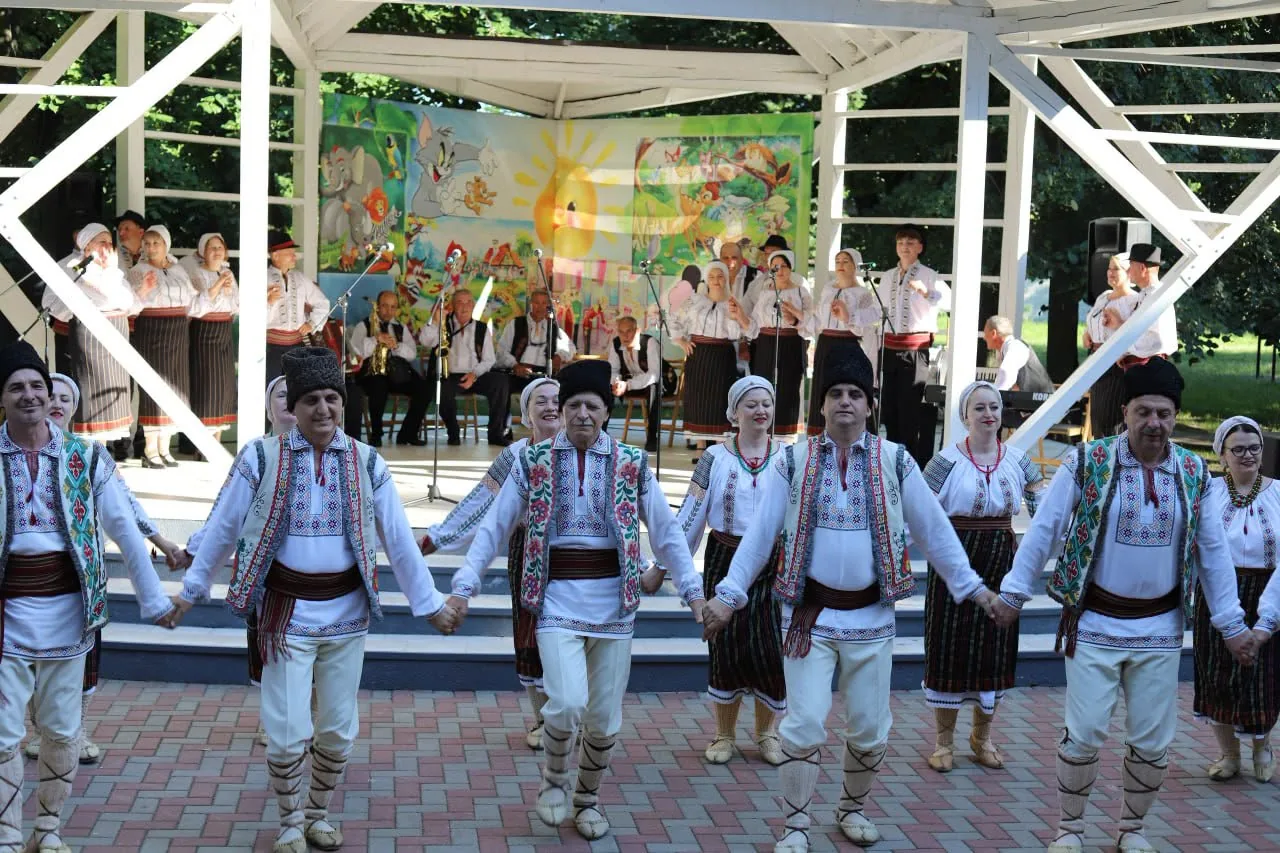
On Sunday evening, the stage in Micul Cluj Park in Ungheni did not stand empty. Under the “Cultural Summer in the Park” project, three ensembles spun the hora and held the audience in place at the folk show “Hai la Joc și voie bună”: the “Hora de la Prut” folk-dance ensemble and the group of fiddlers of the town’s House of Culture, together with the “Datina” folk ensemble from the village of Zagarancea. An ordinary Sunday became, for a few hours, a celebration of folklore — with costumes, song and a park full of people of all ages.
Beyond the evening itself, the show says something about how Ungheni lives its summer: culture steps out of the hall and into the open air, onto a stage with a story of its own.
Why “Micul Cluj”
The town’s Central Park — the largest green area of the municipality, around 12 hectares — has since 2020 borne the name Micul Cluj Park, chosen in gratitude to the twin city of Cluj-Napoca. The link is not only symbolic: the cooperation agreement between the two cities was signed in November 2016, and 2026 marks ten years since Ungheni and Cluj began working together on matters ranging from administration to culture. With Cluj’s help, the summer stage, the alleys and other facilities in the park were rehabilitated — the very spaces where the shows are now held.
So it happens that the stage on which people danced on Sunday is, in good part, the fruit of this friendship between cities.
Who took the stage
“Hora de la Prut” and the group of fiddlers are the flagship groups of the House of Culture, an institution led by director Silvia Zagoreanu, which since this month also has a new artistic director, Edgar Bunea. “Datina”, the evening’s guest, comes from Zagarancea, a village just a few kilometres from town, with a repertoire of traditional songs gathered over years. Three groups, two ways of life — one urban, one rural — brought together on the same stage.
Free access, in the open air, a stone’s throw from home: for many people in Ungheni, that is what “Cultural Summer in the Park” means.
The summer has only just begun
Sunday’s show is not an end but a link in a chain. This year, as the House of Culture building is due to enter an EU-supported renovation, the stage in the park takes on even greater weight as the town’s cultural space — in effect, the great summer hall is moving outdoors.
The next big moment is already set: the “Sânziene Unghenene” festival, its seventh edition, scheduled for 5 July in the town centre. Until then — and afterwards — the park is likely to remain the place where song and dance are heard most often. The full summer programme is kept by the organizers, on the House of Culture’s pages; anyone who does not want to miss the next folk evening would do well to follow them.
The list of ensembles, the date and the “Cultural Summer in the Park” banner come from the official communication of the Ungheni House of Culture. The history of Micul Cluj Park and of the twinning with Cluj-Napoca comes from the website of the Ungheni City Hall and from the twin-city page of Cluj-Napoca City Hall. The information about the renovation of the House of Culture building comes from a Moldpres report. The detailed programme of the 2026 edition was not published on accessible sources at the time of writing.