

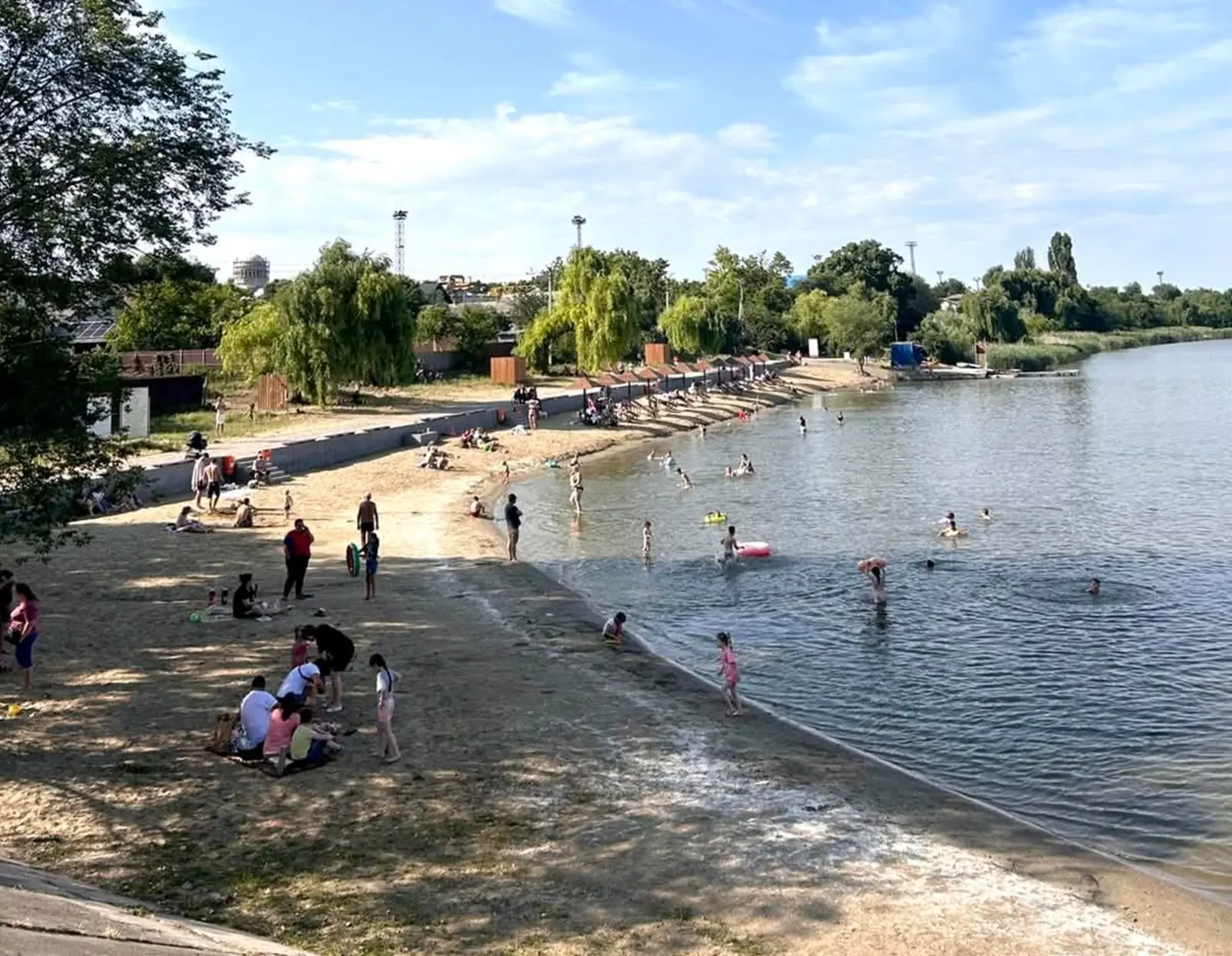
After the fish die-off in Lake Delia in early August, Ungheni City Hall requested that a water sample be taken for laboratory analysis. The result was released by the Ungheni Public Health Centre on August 11, through two official responses to the newsroom’s requests, and it is unequivocal:
The analysis of water samples from Lake Delia shows a quality unfit for bathing. In chemical terms, the water falls into class V (the lowest quality class). In microbiological terms, the water falls into quality class II. Ungheni Public Health Centre, no. 06-3/524 of August 11, 2026
The sample was taken on August 5, at the City Hall’s request. On the shore of the same lake, the municipal beach has been open since June 21, with lifeguards, and has not been closed by any act.
What “class V” means
Bathing water quality is measured on five classes, set by the standard in force (Government Decision no. 890/2013): class I is the best, class V — the lowest. Water in class V does not meet the requirements for bathing. At Lake Delia, the August 5 sample falls into class V by chemical parameters and into class II by microbiological ones — the Public Health Centre’s overall verdict being, verbatim, “unfit for bathing.”
This is not an isolated result. At the newsroom’s request, the same institution reported the results from the past three years, and all of them show the same problem:
2026: in chemical terms, the water falls into class V (the lowest quality class); in microbiological terms, the water falls into quality class II. 2025: the sample taken was placed in quality class V by physico-chemical parameters (the lowest category provided by Gov. Decision no. 890/2013), while by microbiological parameters the water was placed in class II (good). 2024: of the 4 samples collected, all 4 were placed in class V by microbiological parameters, and 3 of the 4 samples were placed in class V by physico-chemical parameters as well. Ungheni Public Health Centre, no. 06-3/525 of August 11, 2026
In other words, Lake Delia’s water fell into the lowest quality class in 2024, in 2025 and in 2026 — three consecutive summers in which it failed to meet the requirements for bathing.
A beach without authorization and without monitoring
Beyond the result of a single sample, two things concern the status of the place. First: the recreation zone on Lake Delia “does not hold a Sanitary Authorization to operate,” the Public Health Centre writes. The Recreation Zones Regulation, approved by Government Decision no. 737/2002 and in force, requires a bathing zone to hold such an authorization and the water to be sampled periodically during the season.
Second: Lake Delia is not on the bathing water monitoring calendar for 2026. Of Ungheni’s two municipal beaches, only the one on the Prut river is included in the programme approved by National Agency for Public Health Order no. 102 of May 8, 2026. For Lake Delia, a sample is taken only if someone requests it — as was the case now, after the fish die-off.
The institution also states that it informed the local public administration about what must be done in such areas:
The Ungheni Public Health Centre informed the Local Public Administration (LPA), which has the duty to take the appropriate measures — including restricting access to bathing and posting warnings on site — for the leisure areas under its jurisdiction. Ungheni Public Health Centre, no. 06-3/525 of August 11, 2026
The notification, the Centre states, bears the number 06-6/675 and dates from October 31, 2025 — before this season.
Where you can swim
The useful news for bathing is on the town’s other shore. All samples taken since May 2026 from the recreation zone on the bank of the Prut river — the only one in the municipality included in the monitoring calendar — fell into quality class II (good), according to the Public Health Centre. Consequently, this summer the Prut beach is the municipal zone with water that is verified and compliant for bathing; Lake Delia is not.
What the City Hall says
Ungheni City Hall has managed the lake since 2024 and owns the beach. The newsroom requested its position as early as August 7 — on what grounds the beach stays open without a sanitary authorization and whether it intends to suspend bathing or post warnings — and followed up with questions after the August 5 result: what measures the City Hall took after the sample that confirmed the water was unfit, and whether it acted on the Public Health Centre’s notification of October 2025. By the time of publication, the City Hall had not responded. We will reflect its position as soon as we receive it.
The cause of the fish die-off also remains open, which falls within the competence of the Environmental Protection Inspectorate; the newsroom’s request on this subject has a legal deadline of August 25.